Master
Chamfer and corner-radius points for programming
Chamfers and corner radii are on almost every turned part. The maths is simple, but the lathe's diameter programming catches people out. Here are the points for the common cases.
45° chamfer on a lathe
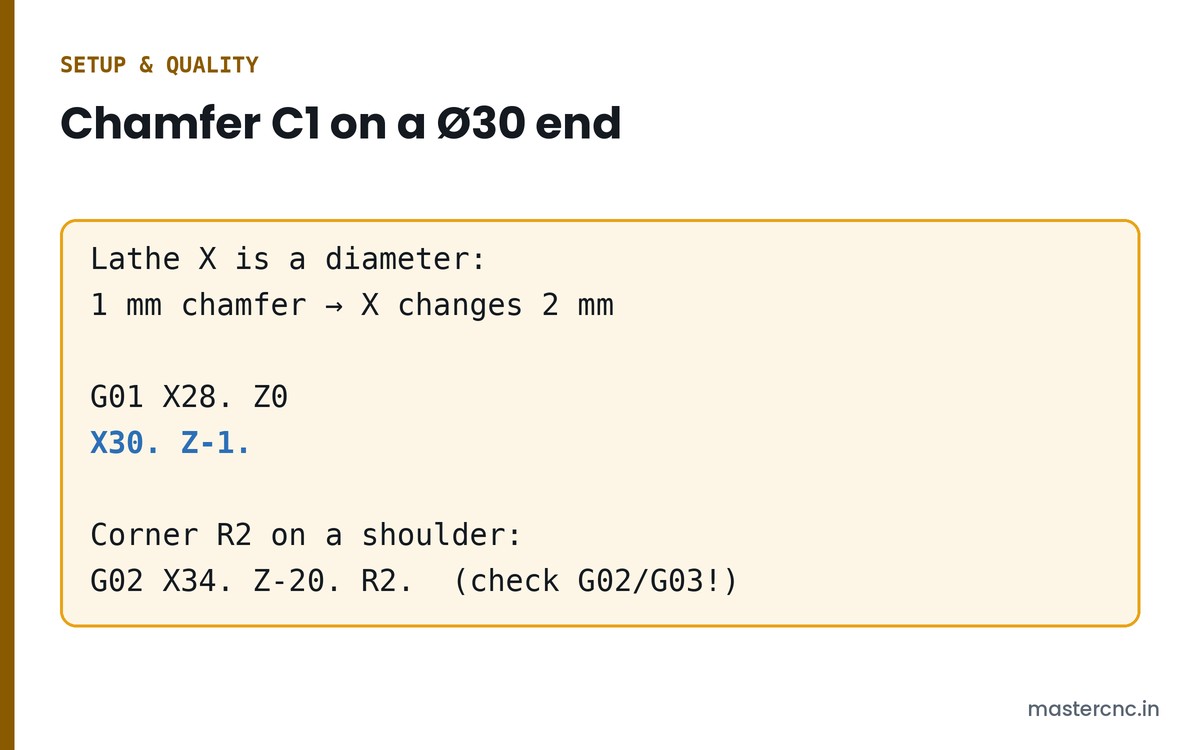
A chamfer C1 (1 × 45°) on the end of a Ø30 diameter. The chamfer is 1 mm along Z and 1 mm on the radius, so 2 mm on the diameter.
G00 X26. Z2.
G01 X28. Z0 F0.15  (start of chamfer)
X30. Z-1.  (end of chamfer)
Z-20.
30° chamfer
A chamfer 2 mm long in Z at 30° to the axis: the radial depth is 2 × tan 30° = 1.155, so X changes by 2.309.
On a Ø30 end the chamfer starts at X = 30 − 2.309 = 27.691:
G01 X27.691 Z0
X30. Z-2.
If the drawing gives the chamfer as 30° to the face instead of the axis, swap tan for cot (the radial depth becomes 2 ÷ tan 30° = 3.464). Always check which side the angle is measured from.
Corner radius on a shoulder
An R2 radius where a Ø30 diameter meets a face at Z-20, the face going out to Ø40:
G01 X30. Z-18.  (radius starts 2 mm before the face)
G02 X34. Z-20. R2.  (radius ends 2 mm up the face: Ø30 + 4)
G01 X40.
Whether it is G02 or G03 depends on the turret position and the direction (see G02 or G03). Check it in the simulator.
Fanuc chamfer and corner shortcuts
Many Fanuc lathes accept a C or R word on a G01 block between two square moves (direct drawing or chamfering function, sometimes an option):
G01 Z-20. R2.  (corner R2 at the end of this move)
X40. C1.  (chamfer C1 at the end of this move)
Check that your control has the function and which letter it uses; ,C and ,R with a comma on some controls.
On a mill
The same geometry, but X and Y are real distances, not diameters. Chamfer mills and corner-rounding mills do the job in one pass along the edge, with the right Z depth for the chamfer size.
Nose radius
Chamfers and radii are where nose radius compensation matters most: without it, a C1 chamfer comes out short. See nose radius compensation.
Trigonometry for these points is covered step by step in trigonometry for CNC programmers.
Calculators, process sheet to program, simulation, codes and lessons. Free to start, no sign-in, on phone and laptop.
Open the app