 Master
CNC programming, in plain words
Cycles explained with real examples, code differences between controls, and guides to the Master CNC app.
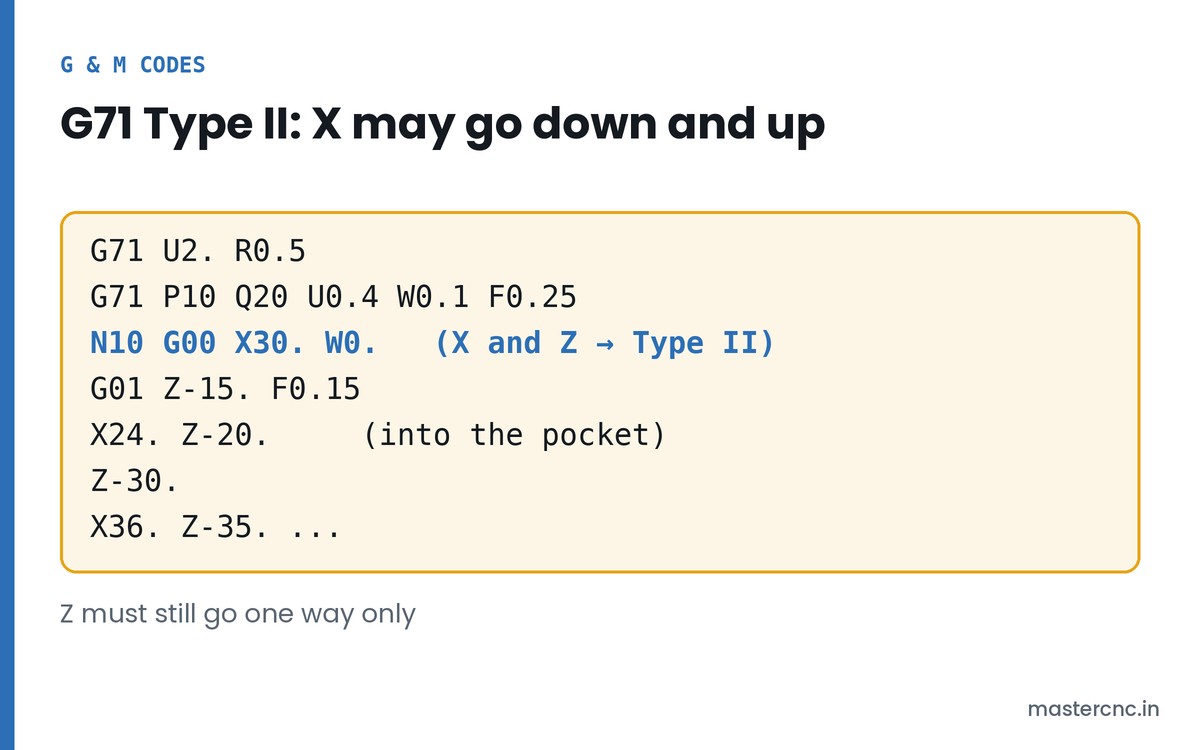
Fanuc G71 Type II: roughing profiles with pockets
How Fanuc G71 Type II roughs turned profiles that go down and up again in X (undercuts and pockets), how the first block tells the control it is Type II, and the tool you need.
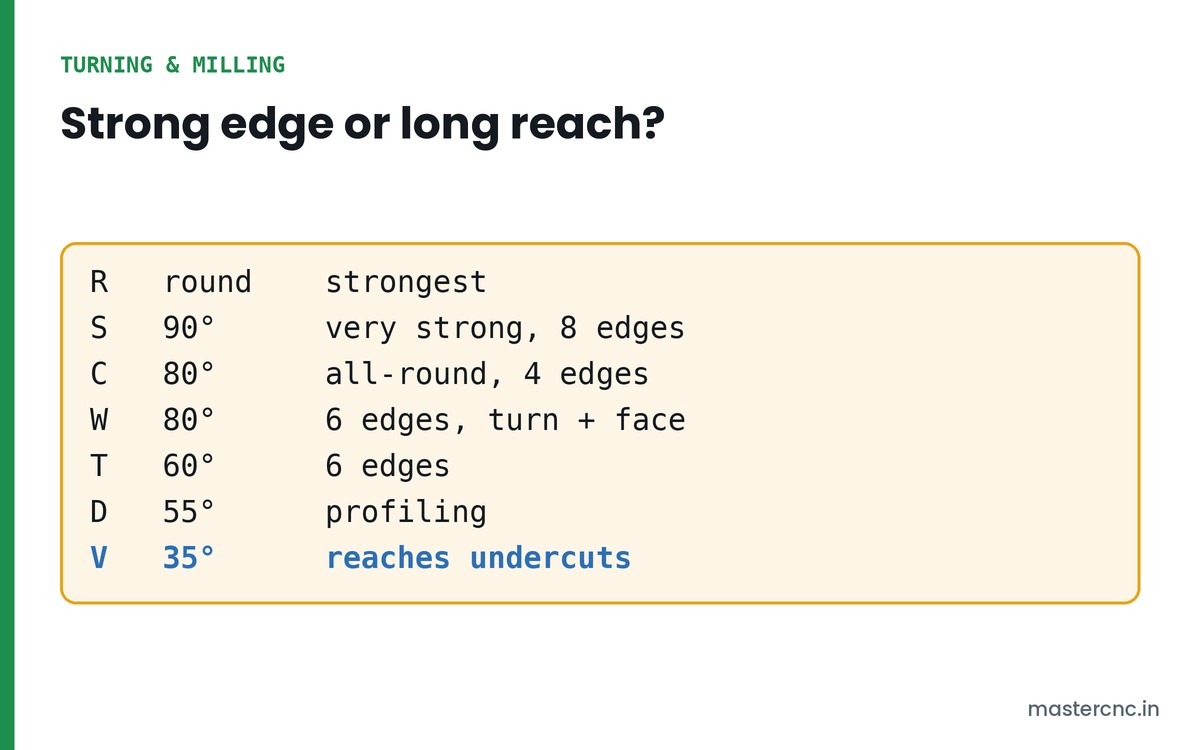
Insert shapes: C, D, V, W, T, S, R compared
How the shape of a turning insert affects strength, number of edges and the profiles it can reach, with a comparison of C, D, V, W, T, S and R inserts and when to choose each.
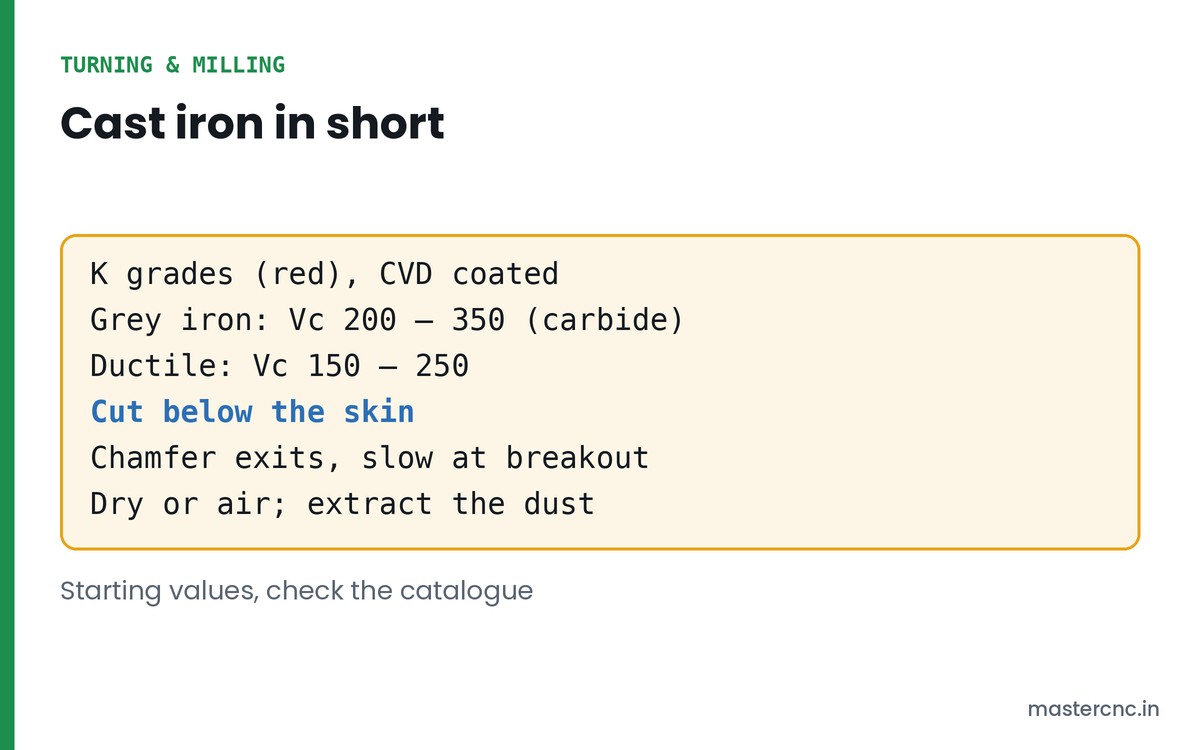
Machining cast iron
How to machine grey and ductile cast iron on CNC machines: insert grades, cutting speeds, dry or wet cutting, dealing with the casting skin, edge breakout at exits, and dust.
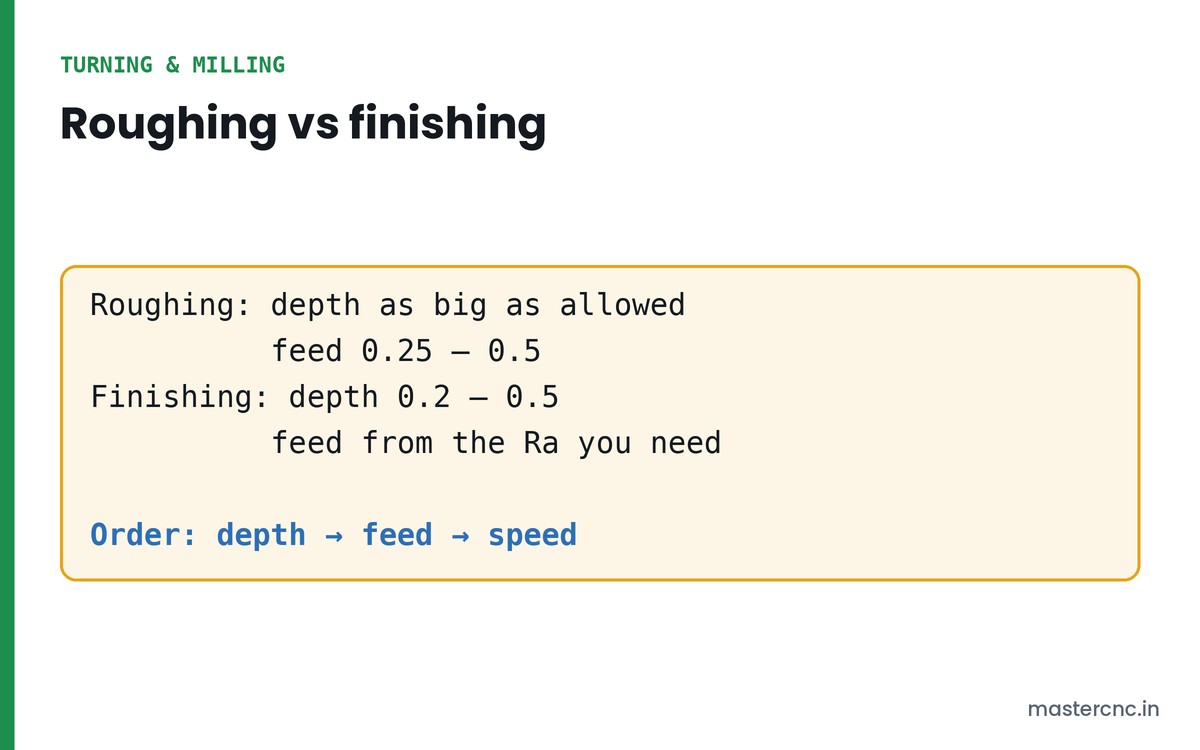
Depth of cut and feed: roughing vs finishing
How to choose depth of cut and feed for roughing and finishing passes on a lathe: big depth first, then feed, then speed, the finishing allowance to leave, and why a finishing cut must not be too light.
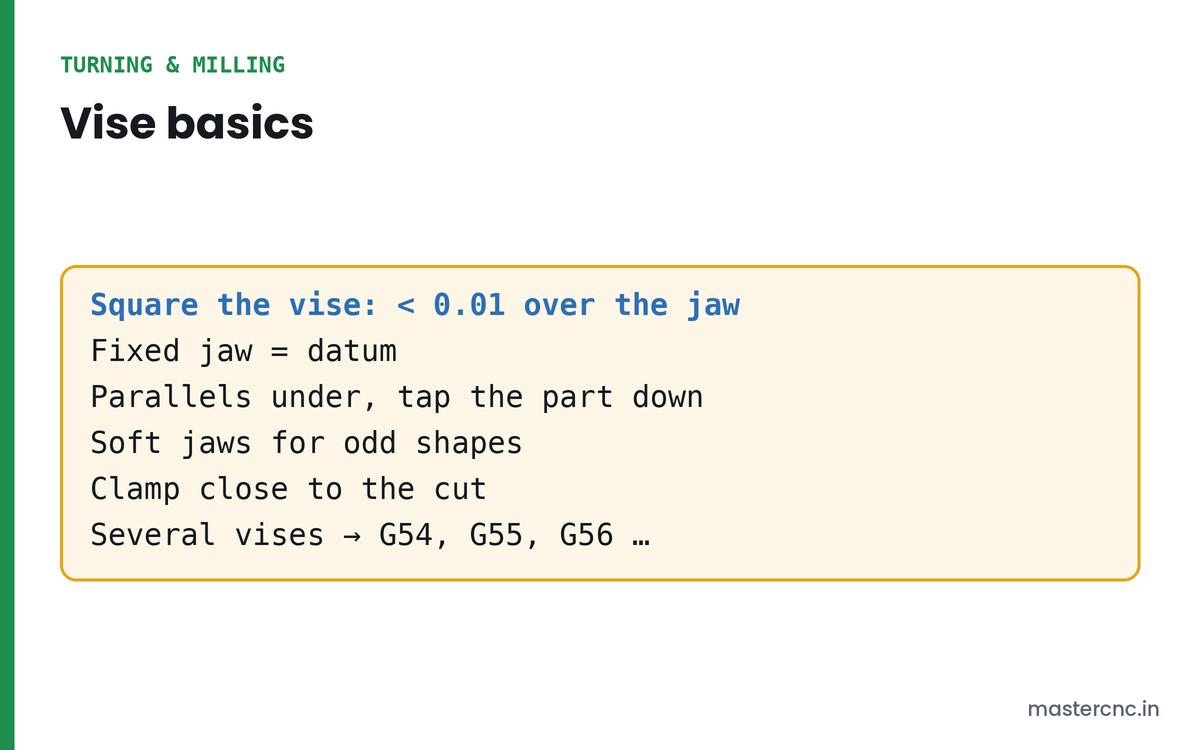
VMC vises and fixtures basics
How to hold parts on a vertical machining centre: setting a vise square, hard and soft jaws, parallels, tapping parts down, fixture plates, zero-point systems and running several parts with G54 to G57.
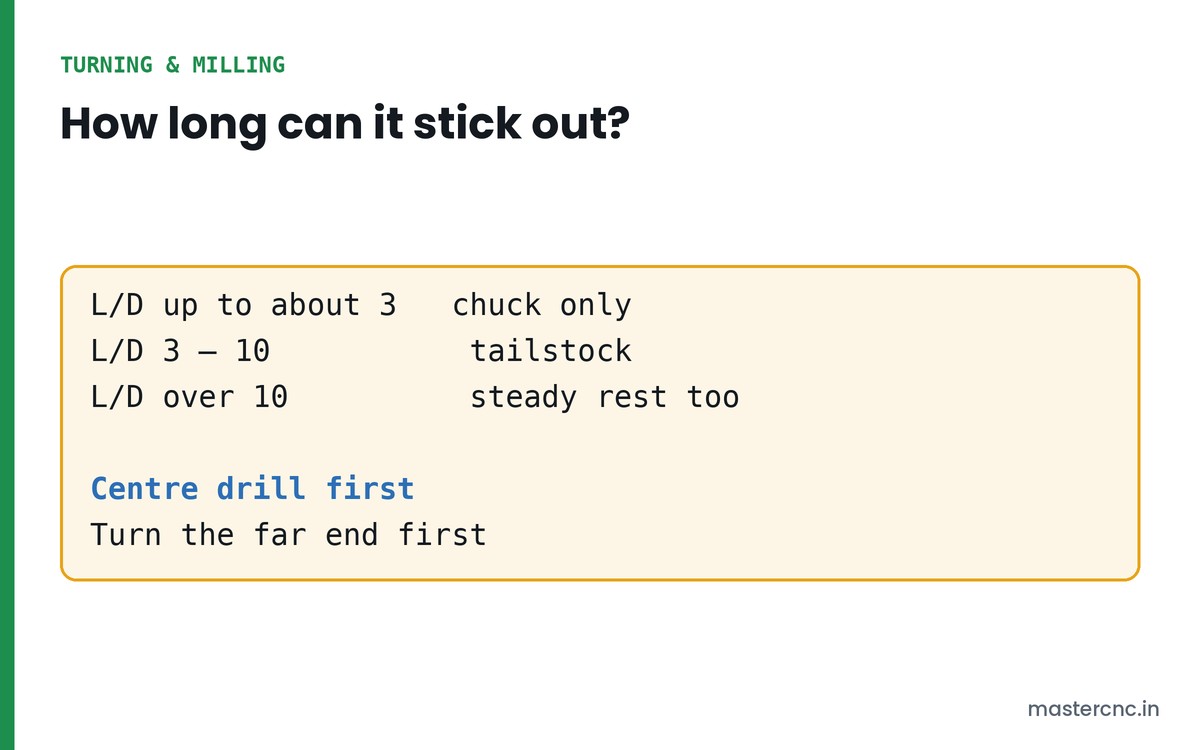
Long parts: tailstock and steady rest
When a long turned part needs the tailstock or a steady rest, the length-to-diameter rules, centre drilling, tailstock force, where to put a steady rest, and the order of cuts for slender shafts.
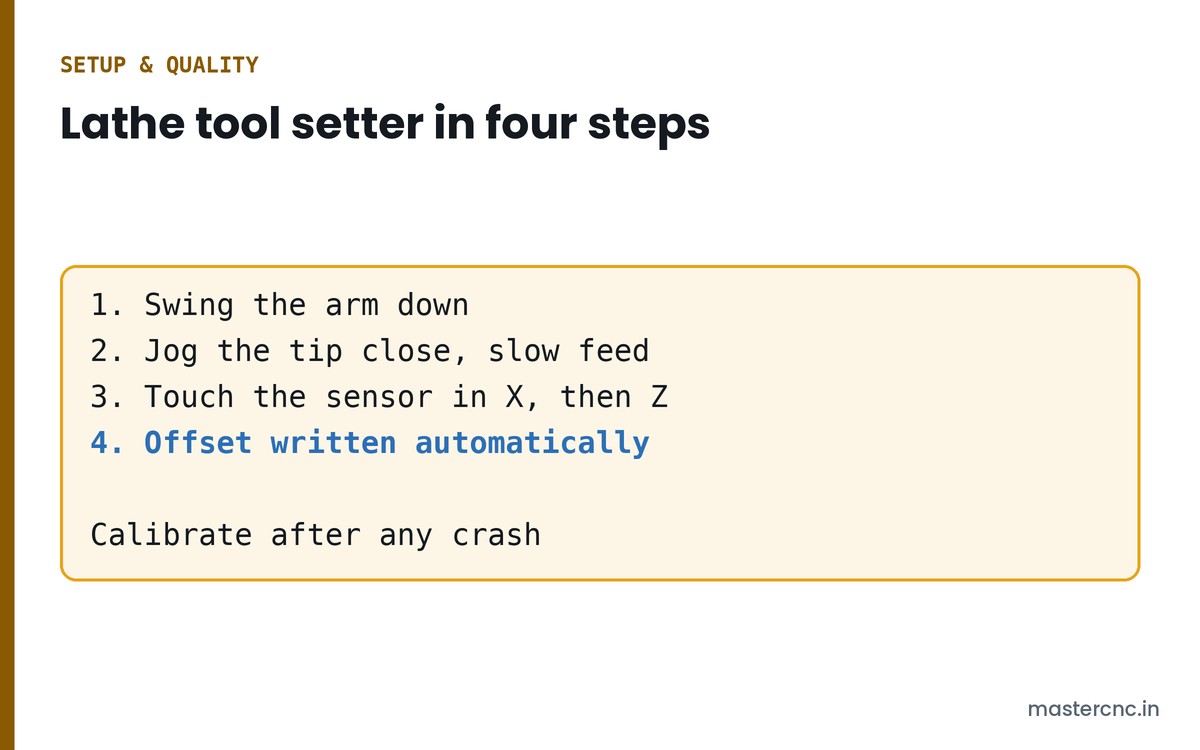
Tool setter (Q-setter) on a lathe
How a lathe tool setter arm measures tool offsets automatically, the steps to use it for X and Z, how it relates to the work shift, and how to keep it accurate.
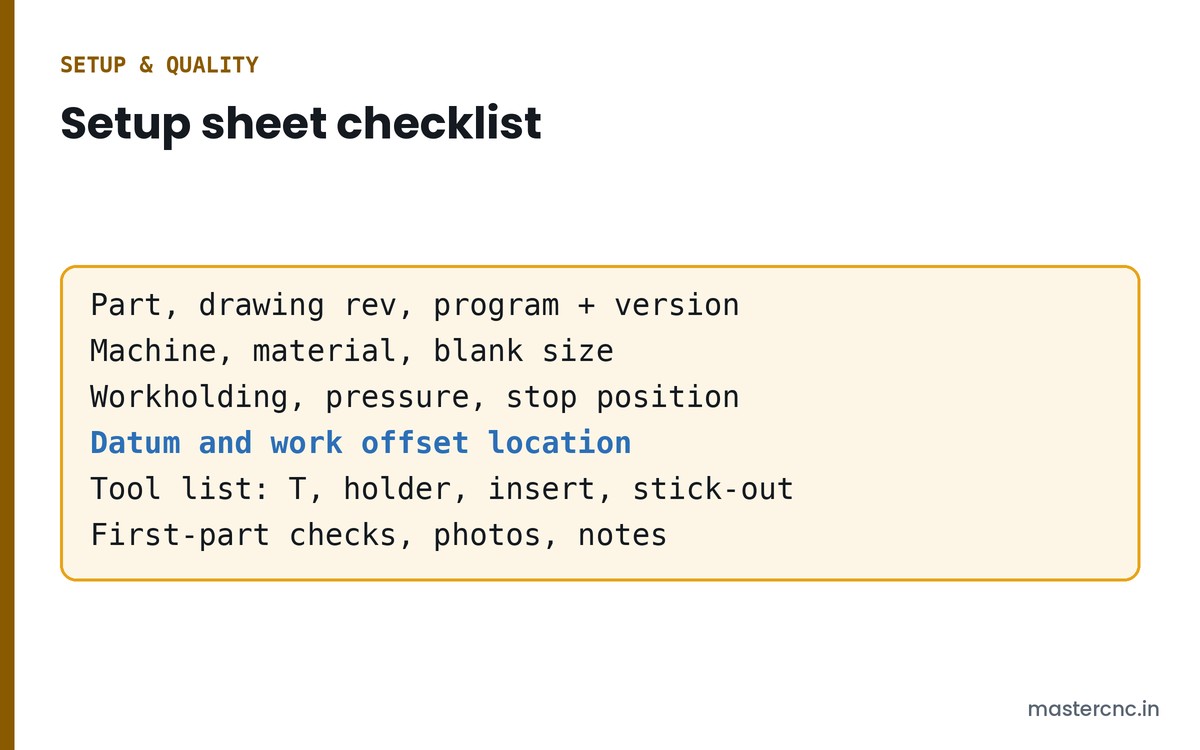
What a good setup sheet includes
What to put on a CNC setup sheet so any setter can repeat a job: part and program revision, material and blank, workholding, datums and offsets, tool list, first-part checks, photos and notes.
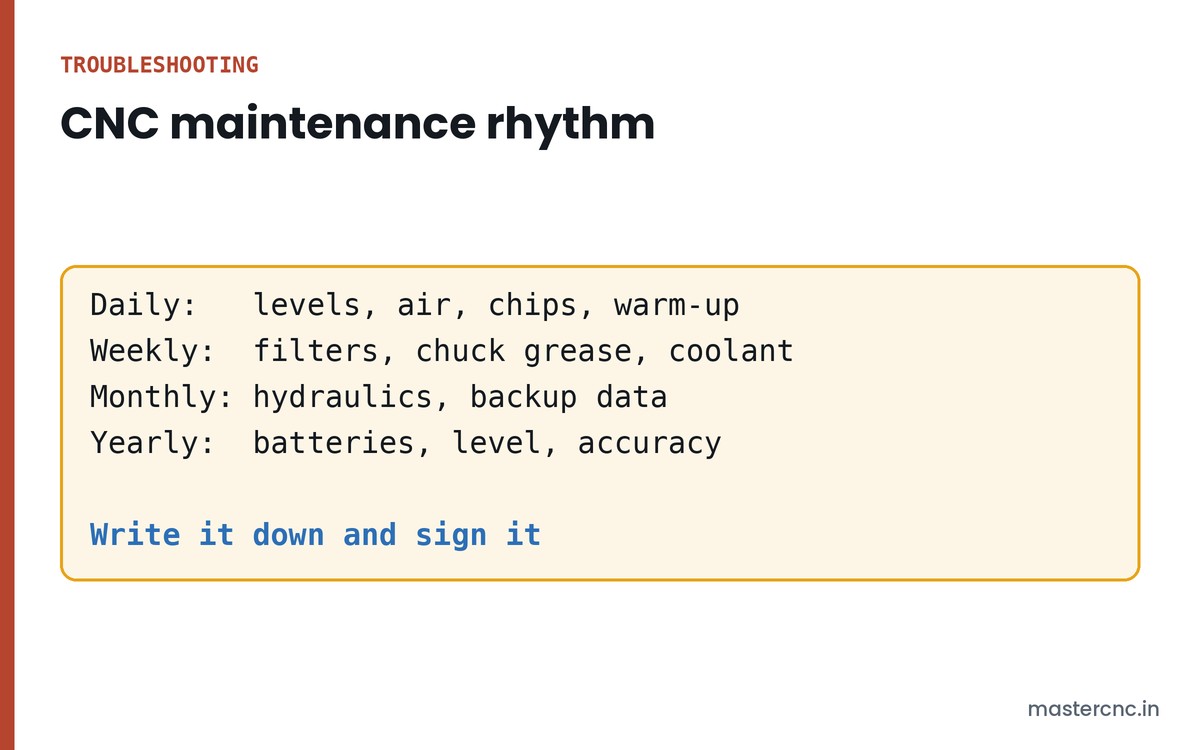
Daily and weekly CNC maintenance checklist
A practical CNC machine maintenance checklist for daily, weekly, monthly and yearly tasks: levels, cleaning, chuck greasing, filters, backups, batteries and accuracy checks.
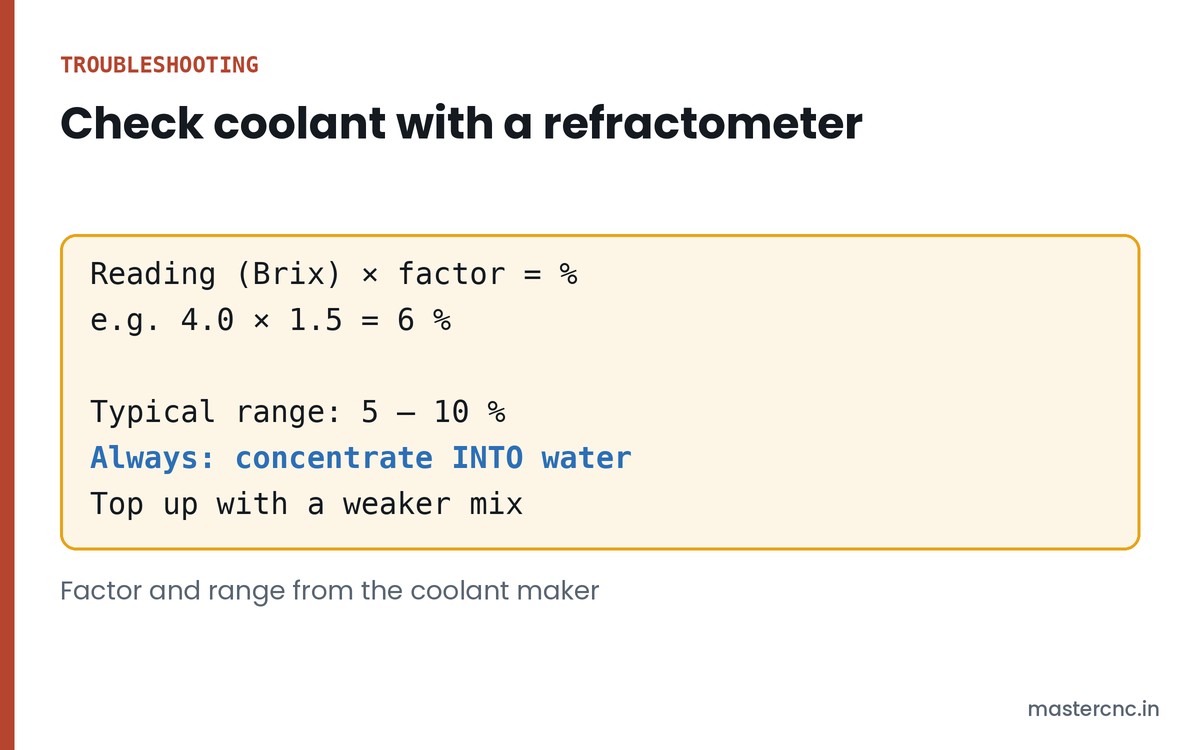
Coolant concentration: why it matters
Why water-soluble coolant concentration matters for tool life, rust and health, how to measure it with a refractometer, typical ranges, how to mix and top up, and how to keep the tank healthy.
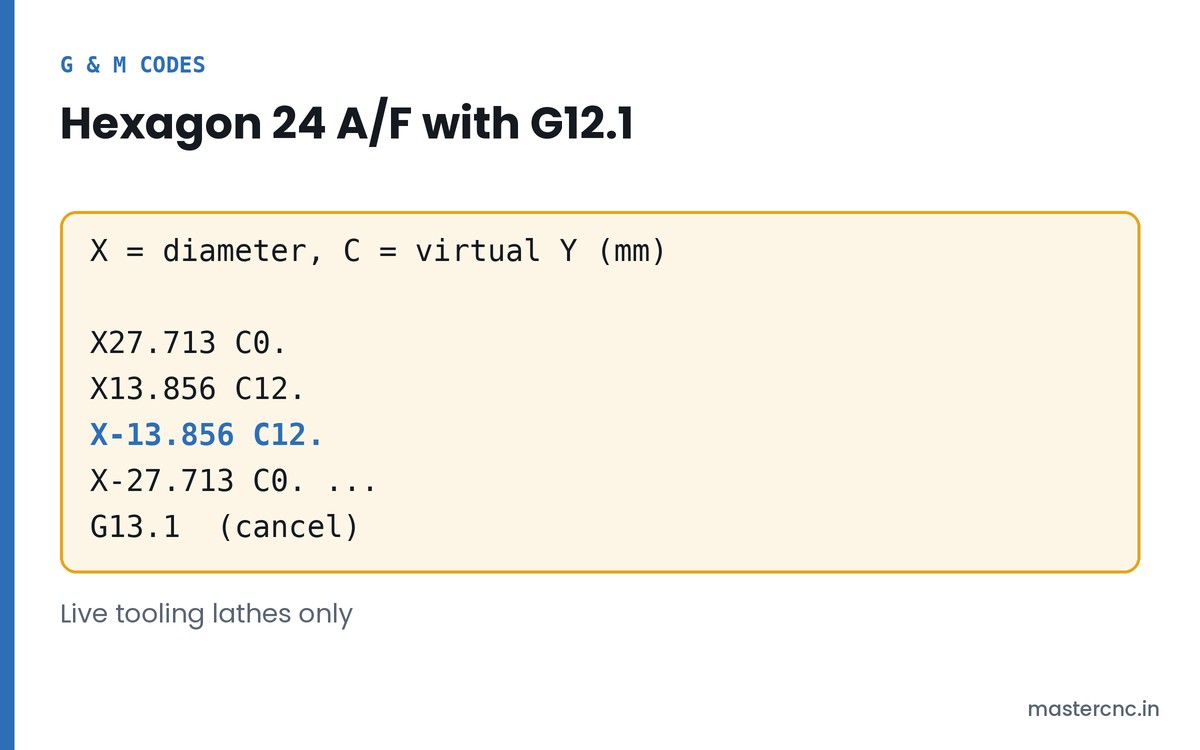
Polar coordinate interpolation G12.1 / G112
How polar coordinate interpolation lets a lathe with live tooling and a C axis mill flats and hexagons on the face as if it had a Y axis, with the X and C rules and a hexagon example.
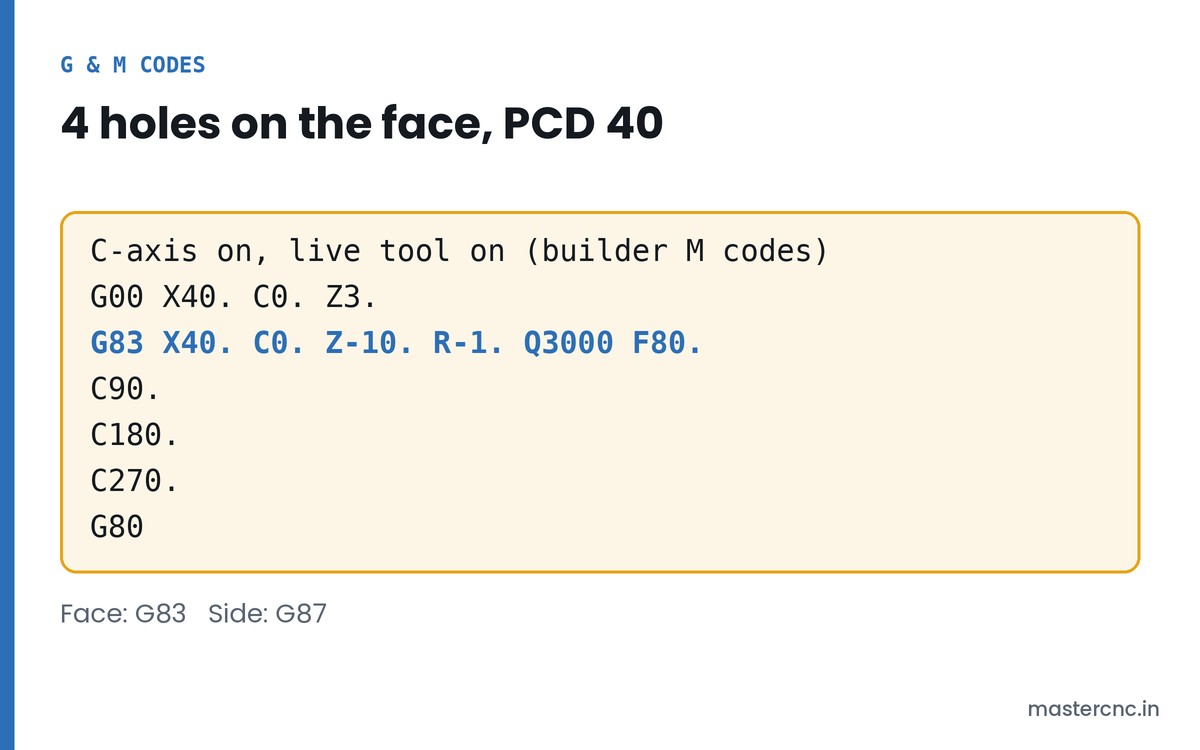
Live tooling: C-axis face and side drilling
How a lathe with live tools drills holes on the face and the side using the C axis: face drilling cycles (G83), side drilling (G87), C positions for a bolt circle, and the M codes to check.
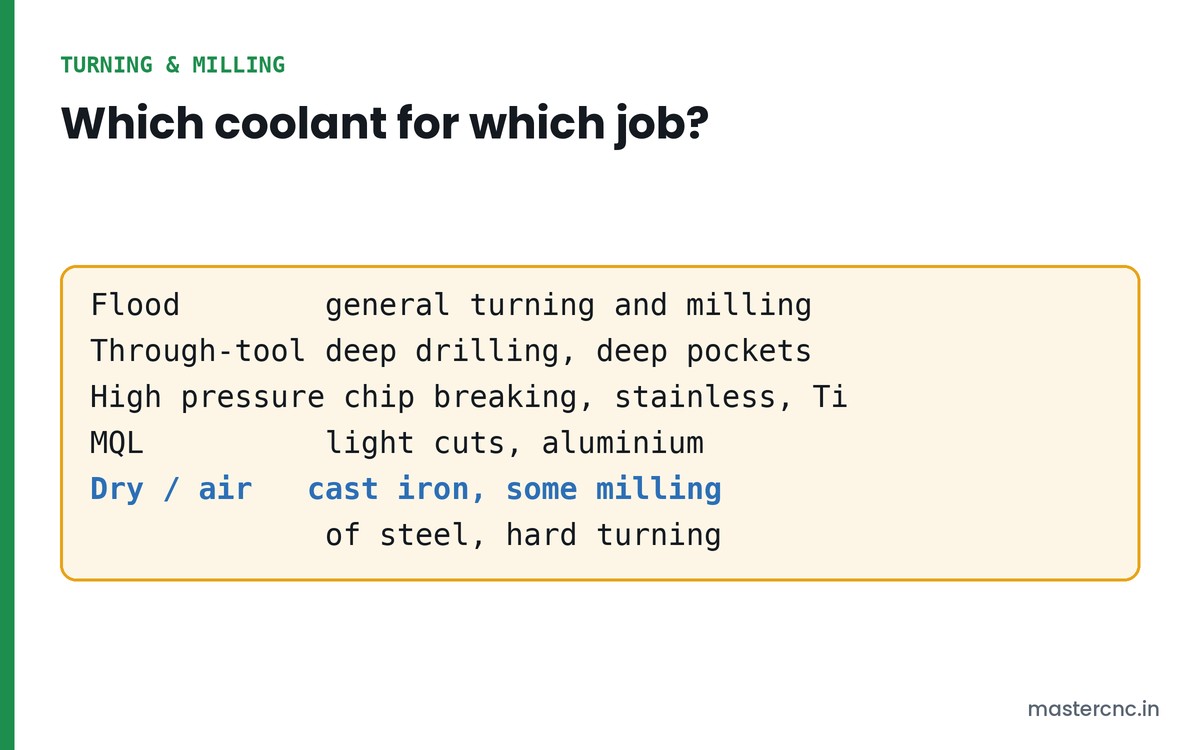
Coolant: flood, through-spindle or MQL
The coolant options on CNC machines, flood, high-pressure through-spindle, minimum quantity lubrication, air blast and dry cutting, and which to use for drilling, turning and milling different materials.
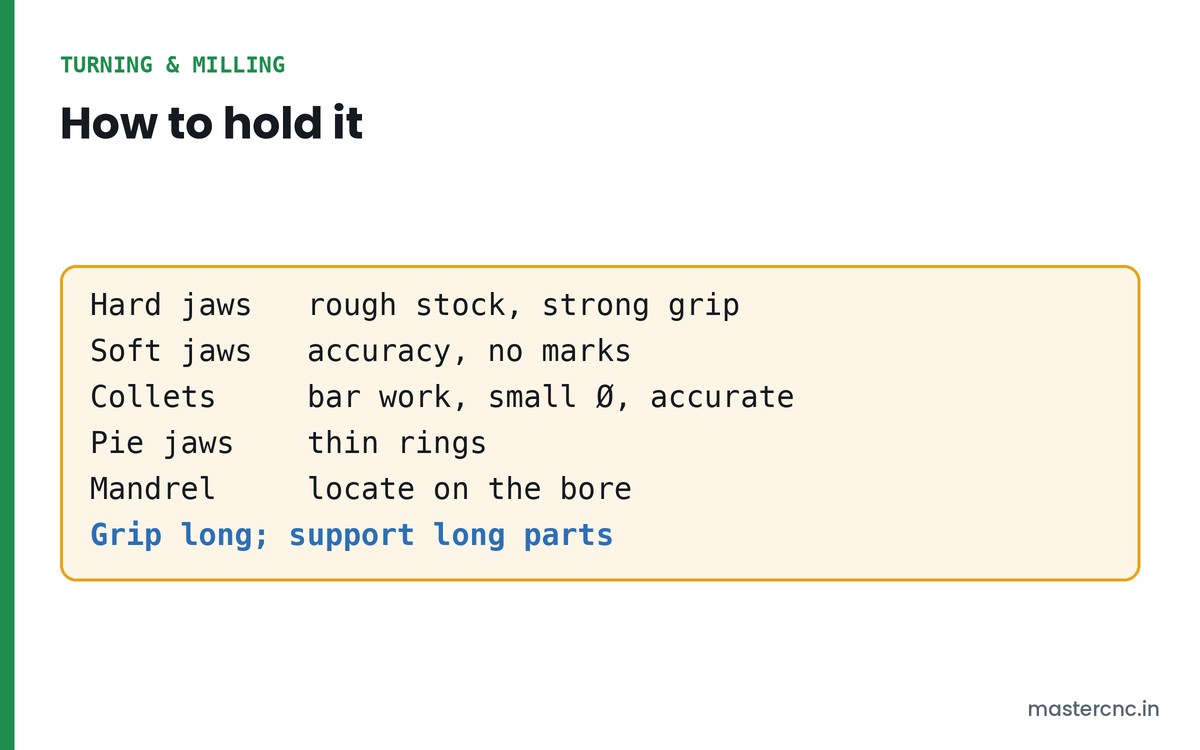
Lathe workholding: hard jaws, soft jaws, collets
The main ways to hold a part on a CNC lathe, hard jaws, soft jaws, collets, pie jaws, mandrels and centres, with when to use each, how much to grip, and the speed limits to watch.
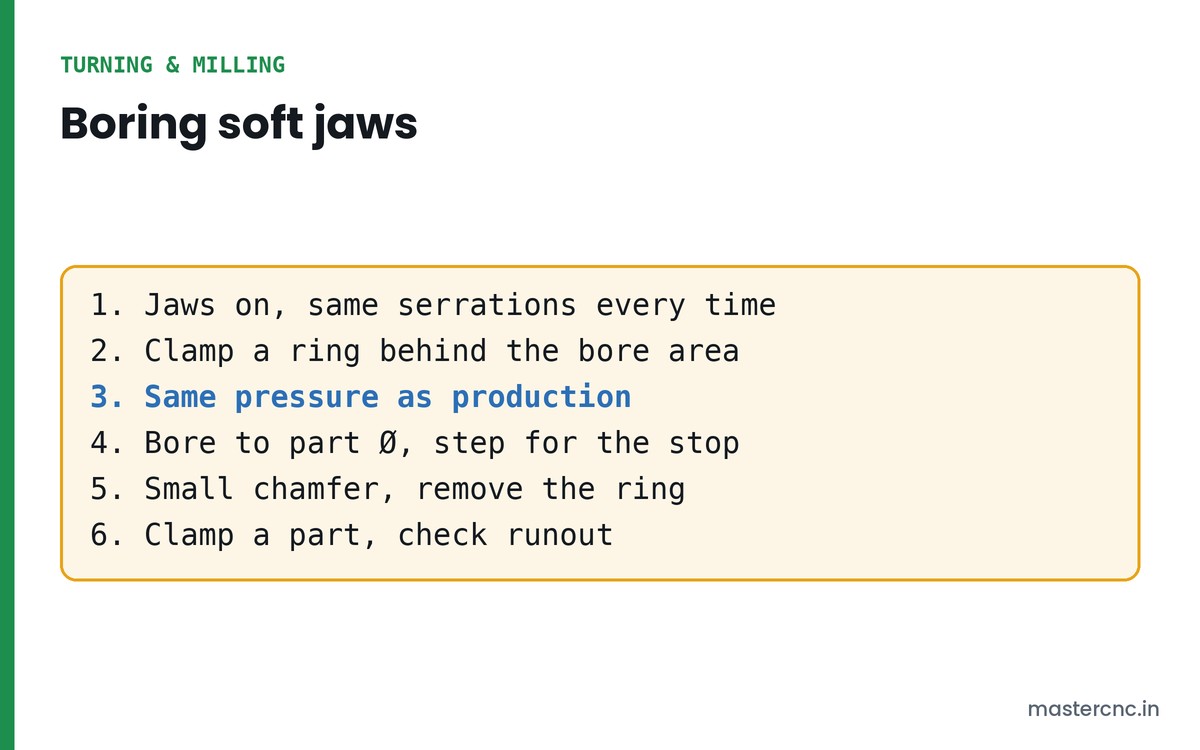
Boring soft jaws step by step
How to bore soft jaws on a CNC lathe so a part runs true: clamping a boring ring, using production pressure, boring diameter and depth, and checking the result.
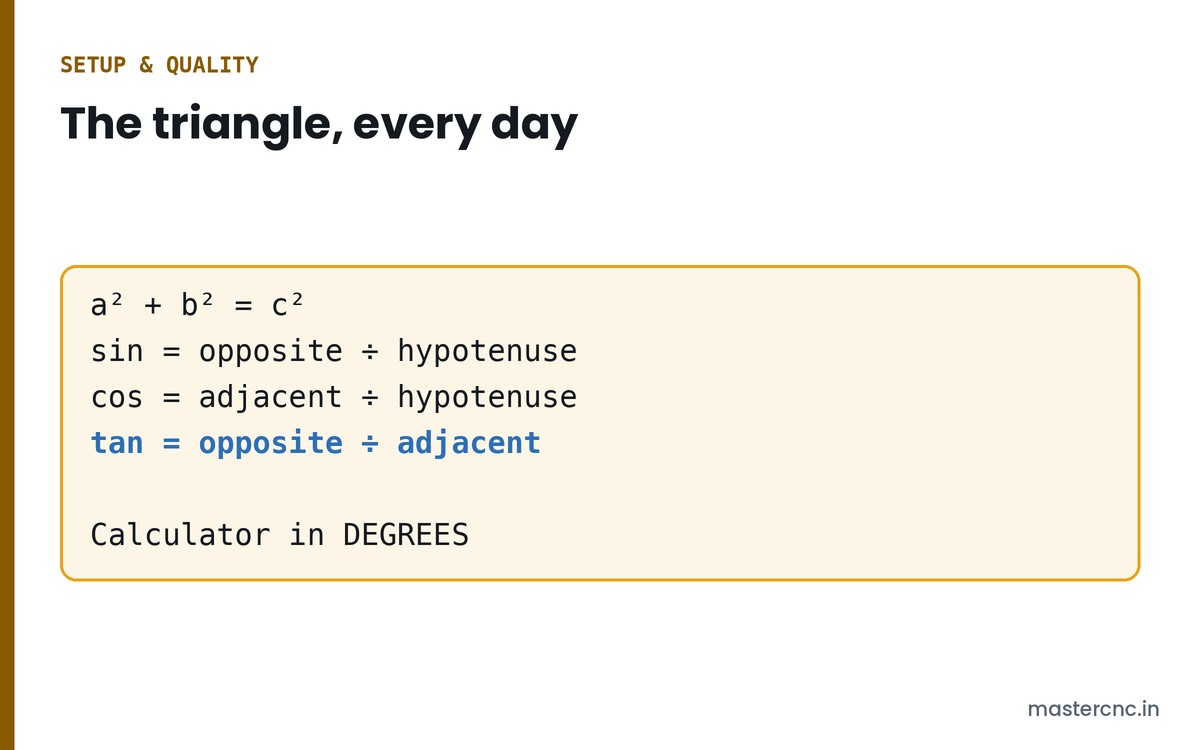
Trigonometry for CNC programmers
The right-angle triangle maths CNC programmers use every day: Pythagoras, sine, cosine and tangent, finding angles with inverse functions, with shop examples for chamfers, tapers, holes and distances.
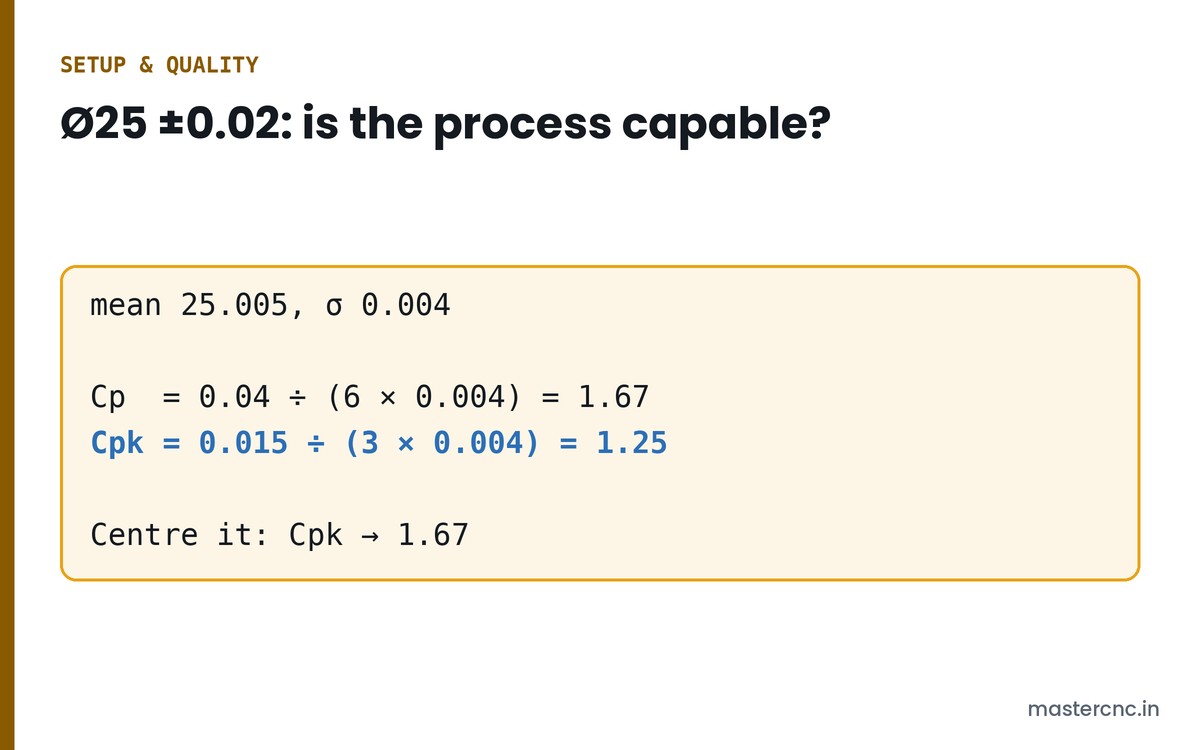
Cp and Cpk for CNC parts
What Cp and Cpk mean for a machined dimension, how to calculate them from measured parts, a worked example on a Ø25 ±0.02 diameter, and the targets customers usually ask for.
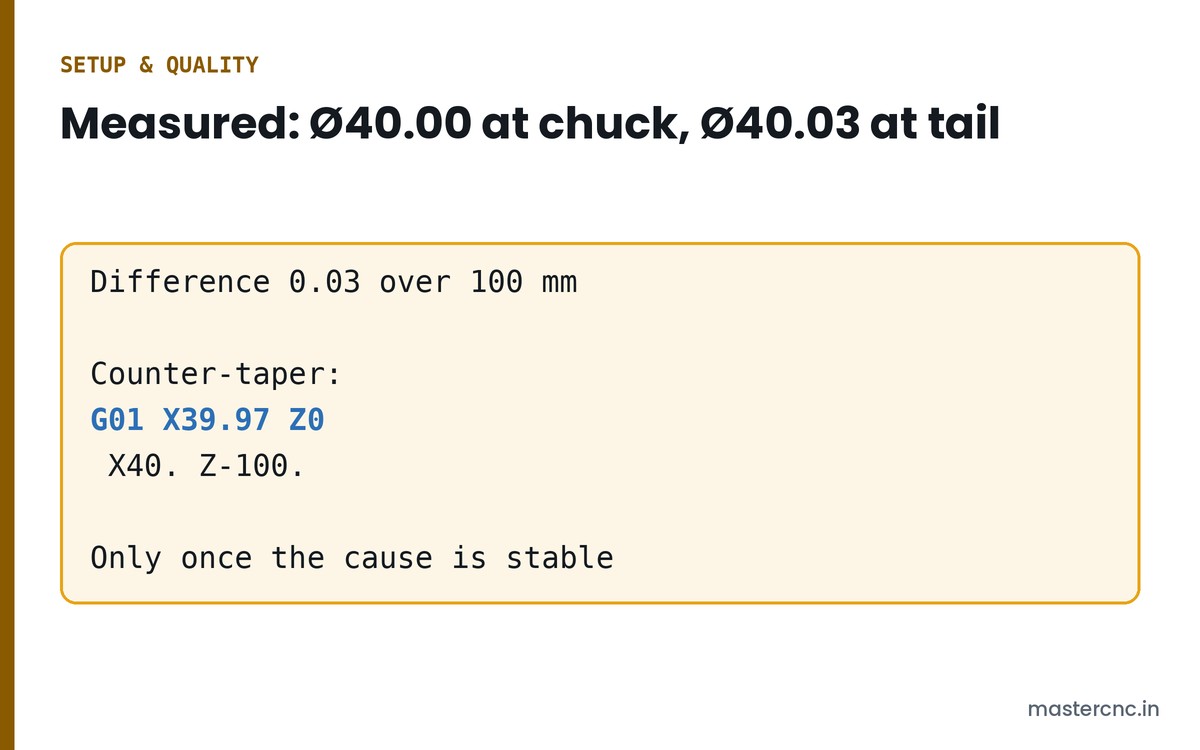
Correcting taper on a lathe
How to correct an unwanted taper on a CNC lathe: find the cause first, then fix it with tailstock adjustment, support, a spring pass or a small programmed counter-taper, with a worked example.
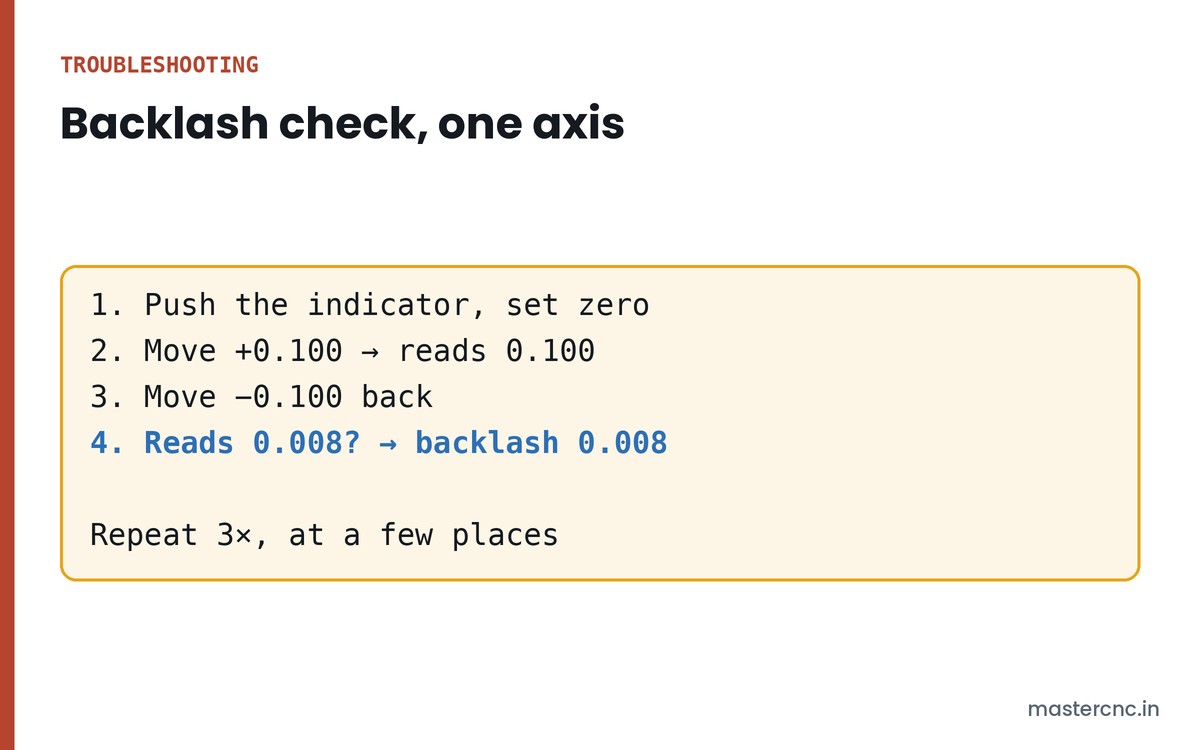
Checking backlash with a dial gauge
How to measure axis backlash on a CNC machine with a dial indicator and the handwheel, what values are normal, what backlash does to parts, and when to call maintenance.
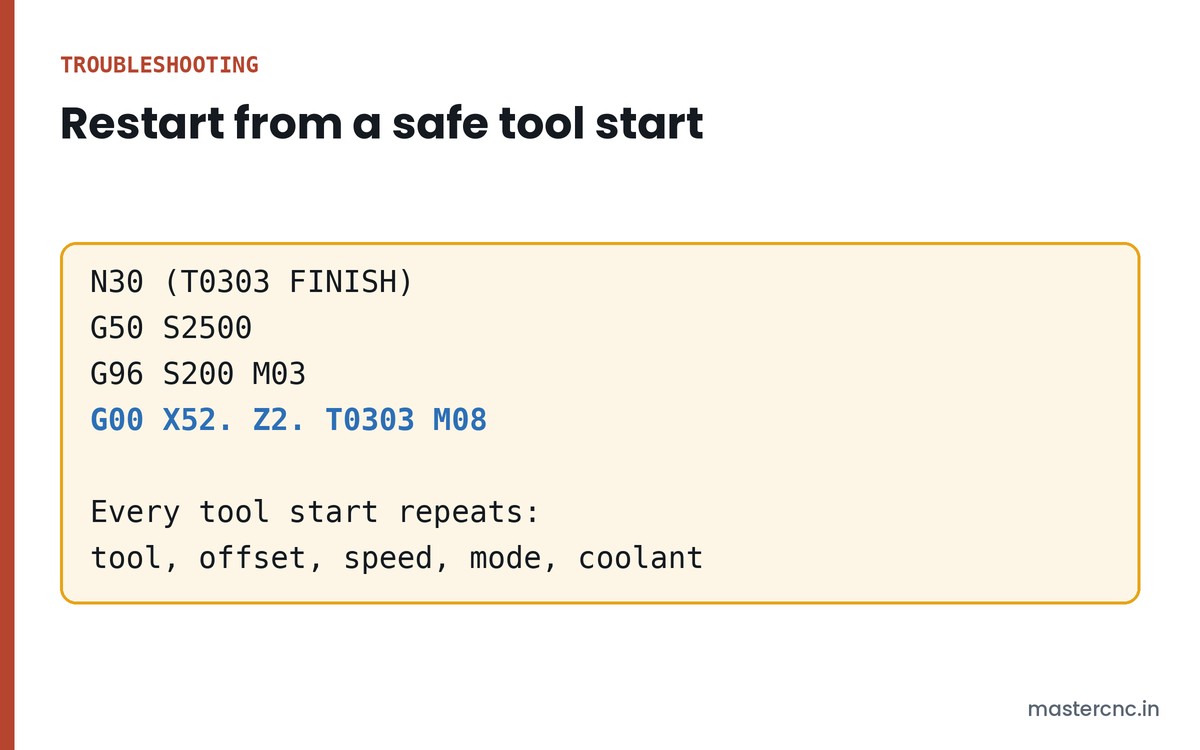
Restarting a program safely after a stop
How to restart a CNC program after a broken tool, an alarm or a power cut without crashing: retract first, restart from a safe tool start, why every tool start must repeat the modal codes, and the restart functions.
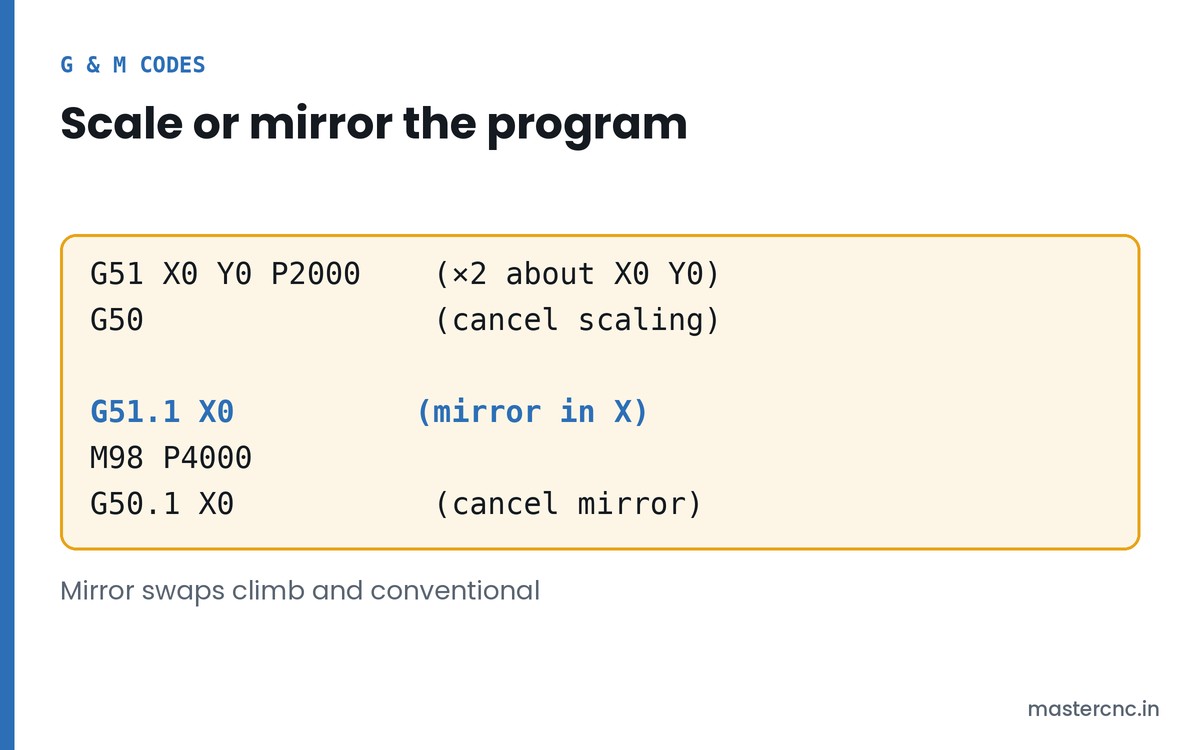
G51 scaling and G51.1 mirror image
How G51 scales a programmed shape up or down and G51.1 mirrors it on a Fanuc machining centre, with examples for a mirrored left and right part, and the rules that keep it safe.
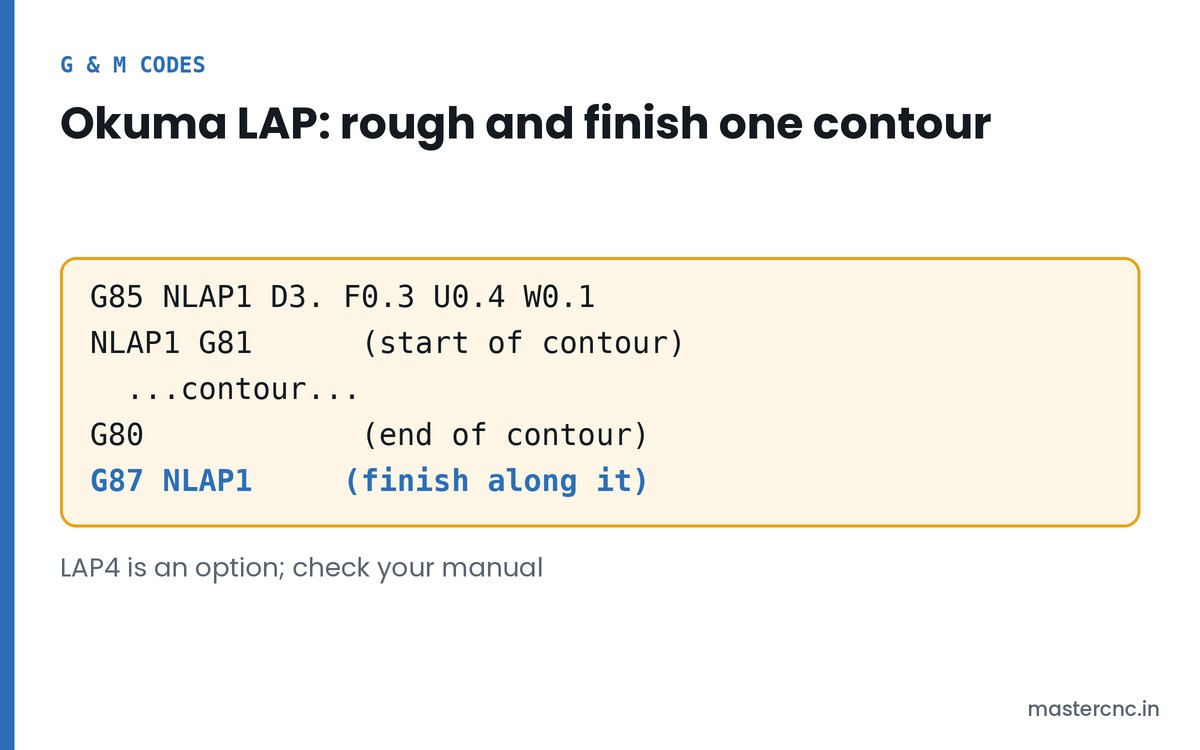
Okuma OSP LAP4 roughing cycles explained
An introduction to Okuma OSP Lathe Auto-Programming (LAP4): the contour definition between G81 and G80, the G85 roughing cycle, G87 finishing, and how it compares with Fanuc G71 and G70.
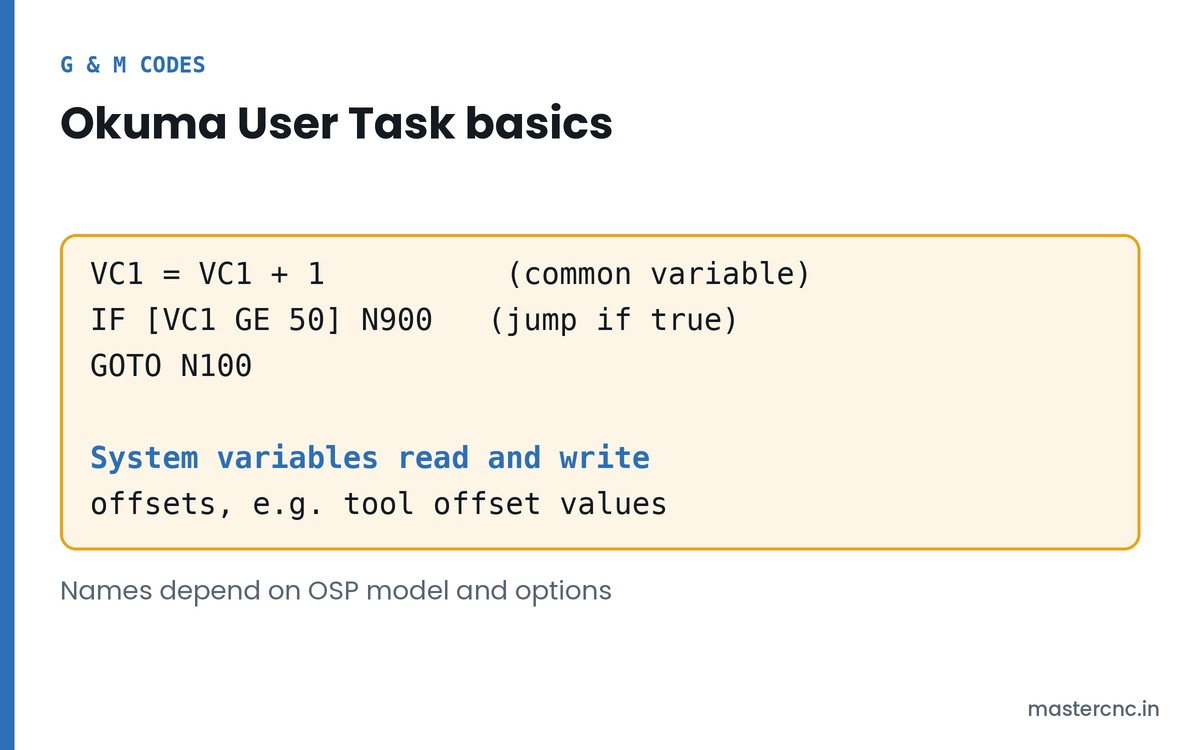
Okuma OSP User Task 2: variables and IF
An introduction to Okuma OSP User Task programming: common and local variables, arithmetic, IF and GOTO jumps, system variables for offsets, and a simple part counter, compared with Fanuc Macro B.
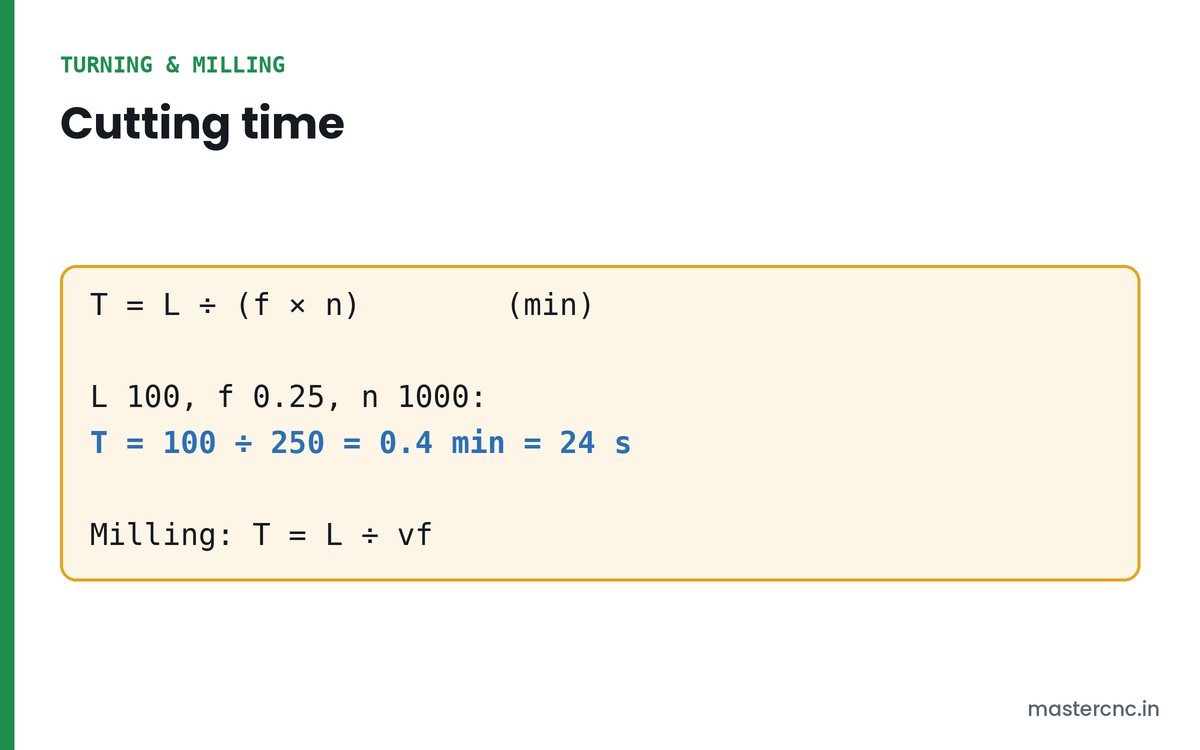
Cutting time for turning and drilling
How to calculate cutting time for turning, facing, drilling and milling from length, feed and speed, with worked examples, so you can quote jobs and compare methods.
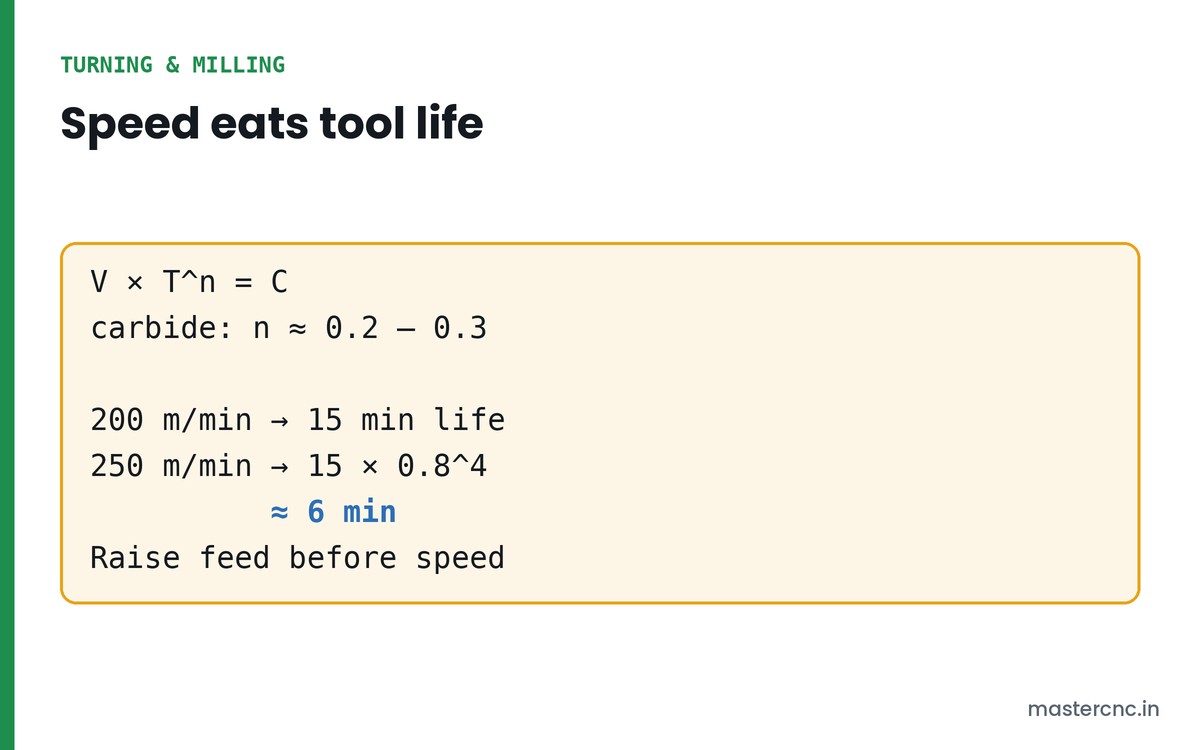
Tool life and Taylor's equation
How cutting speed affects tool life, Taylor's tool life equation with typical exponents, a worked example of what a 25 % speed increase does, and why raising feed is usually the better way to go faster.
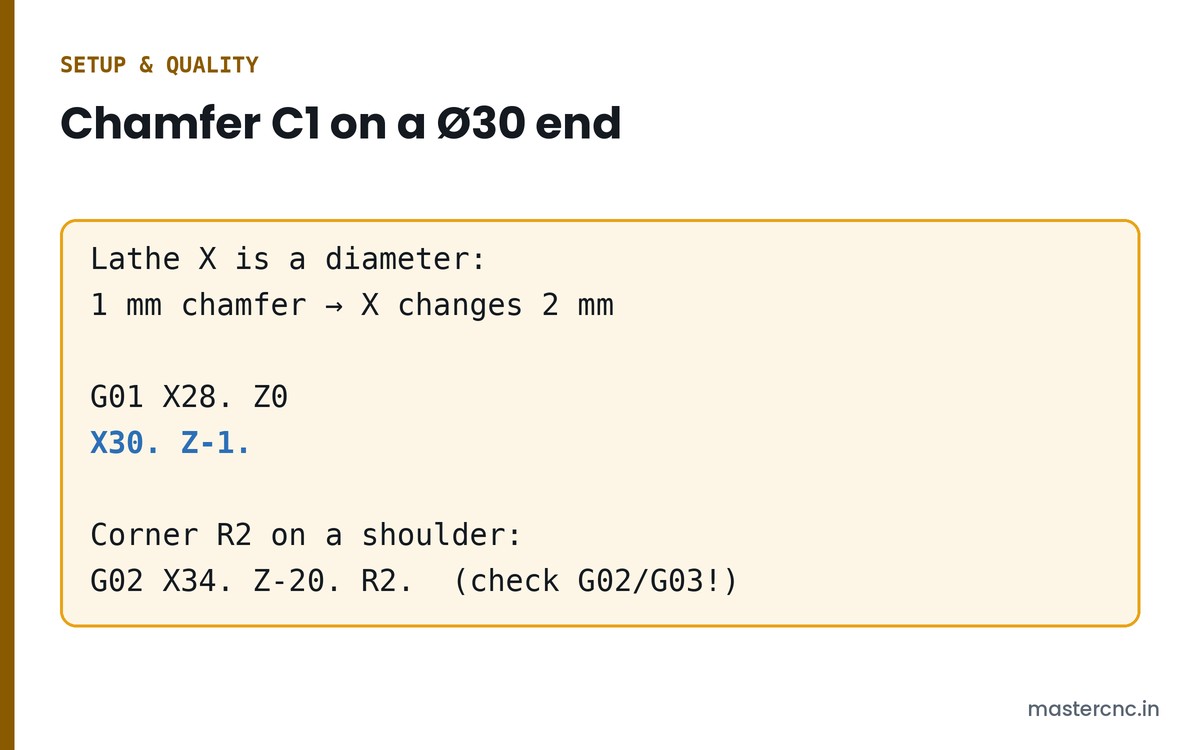
Chamfer and corner-radius points for programming
How to calculate program points for 45° and 30° chamfers and corner radii on a CNC lathe (diameter values) and mill, with worked examples and the Fanuc C and R shortcuts.
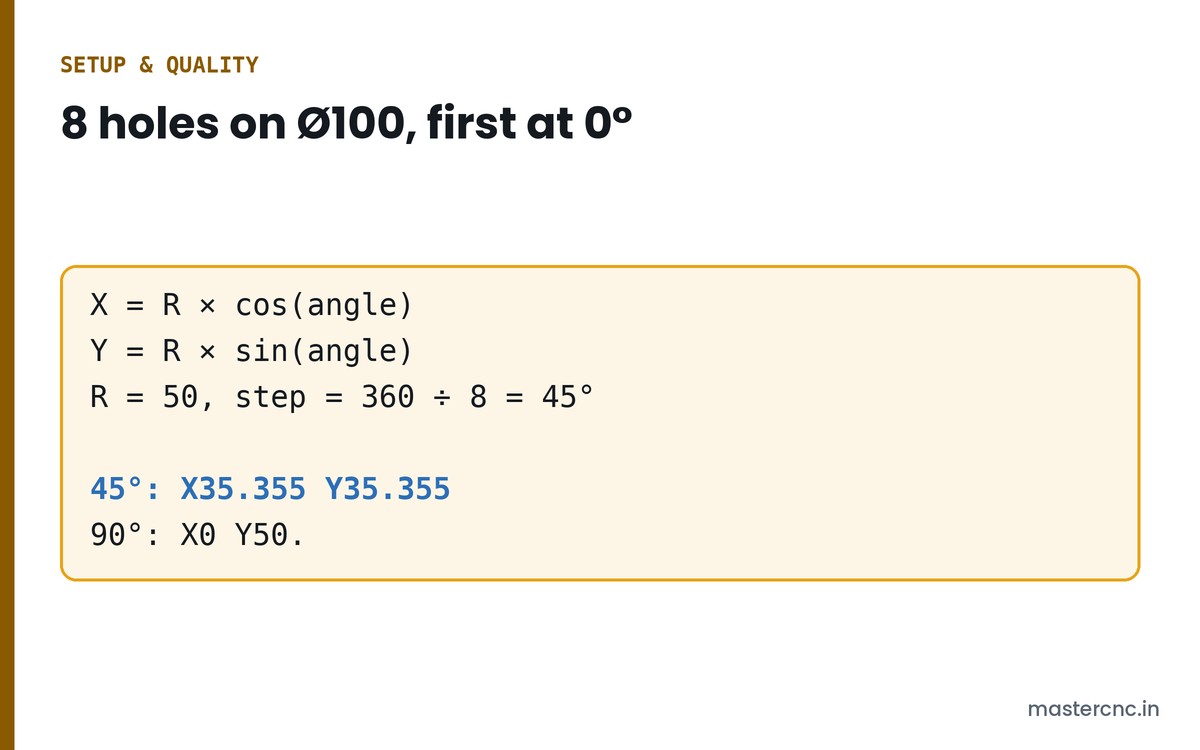
Bolt hole circle coordinates by hand
How to calculate X and Y for holes on a pitch circle with sine and cosine, with a full table for 8 holes on a Ø100 PCD, the half-angle start, and how to check your numbers.
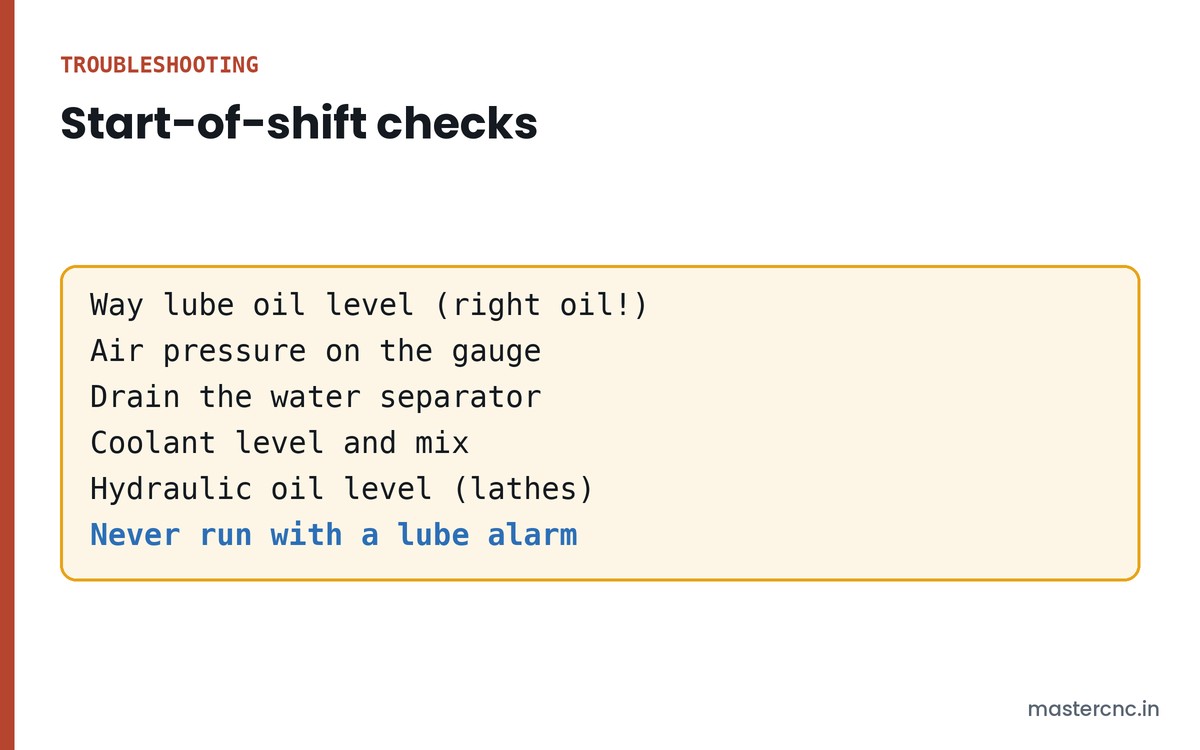
Lube and air pressure alarms: daily checks
Why CNC machines stop with low lubrication or low air pressure alarms, the daily checks that prevent them: way lube oil, air supply and water separator, coolant and hydraulic levels.
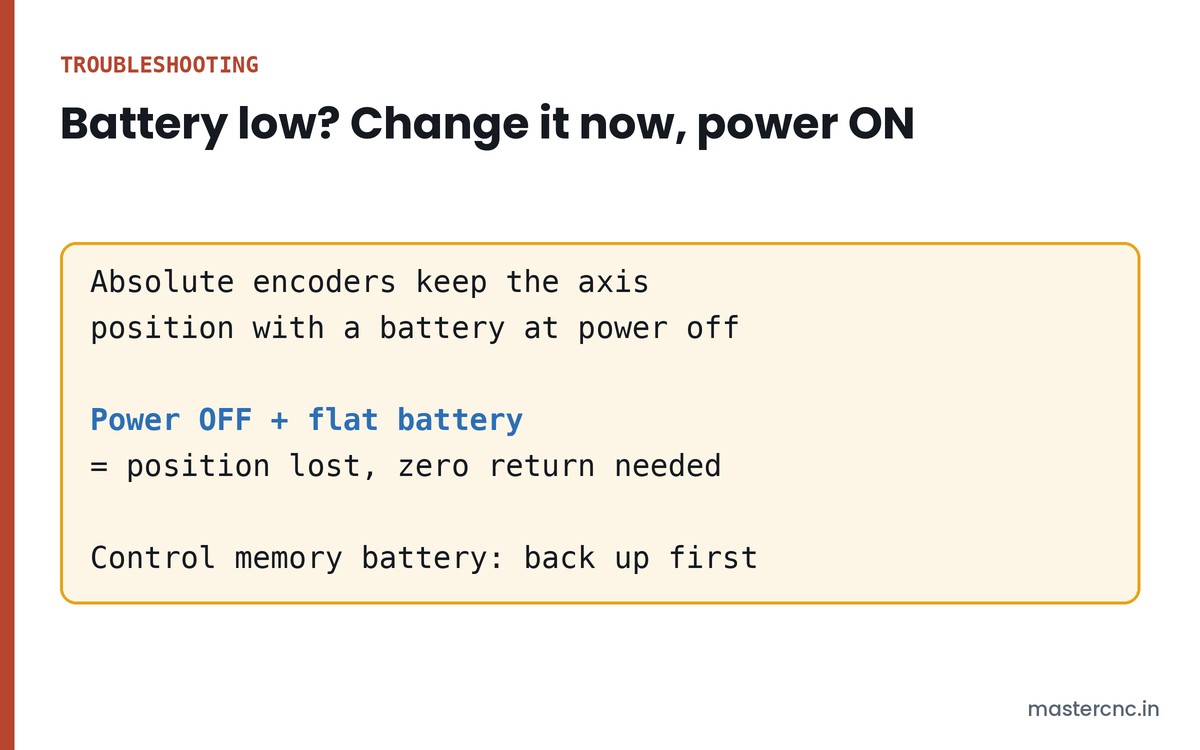
Encoder battery alarm: change it with power ON
Why CNC machines with absolute encoders have batteries, what the low battery alarm means, why the batteries must be changed with the power on, and what happens if they run flat.
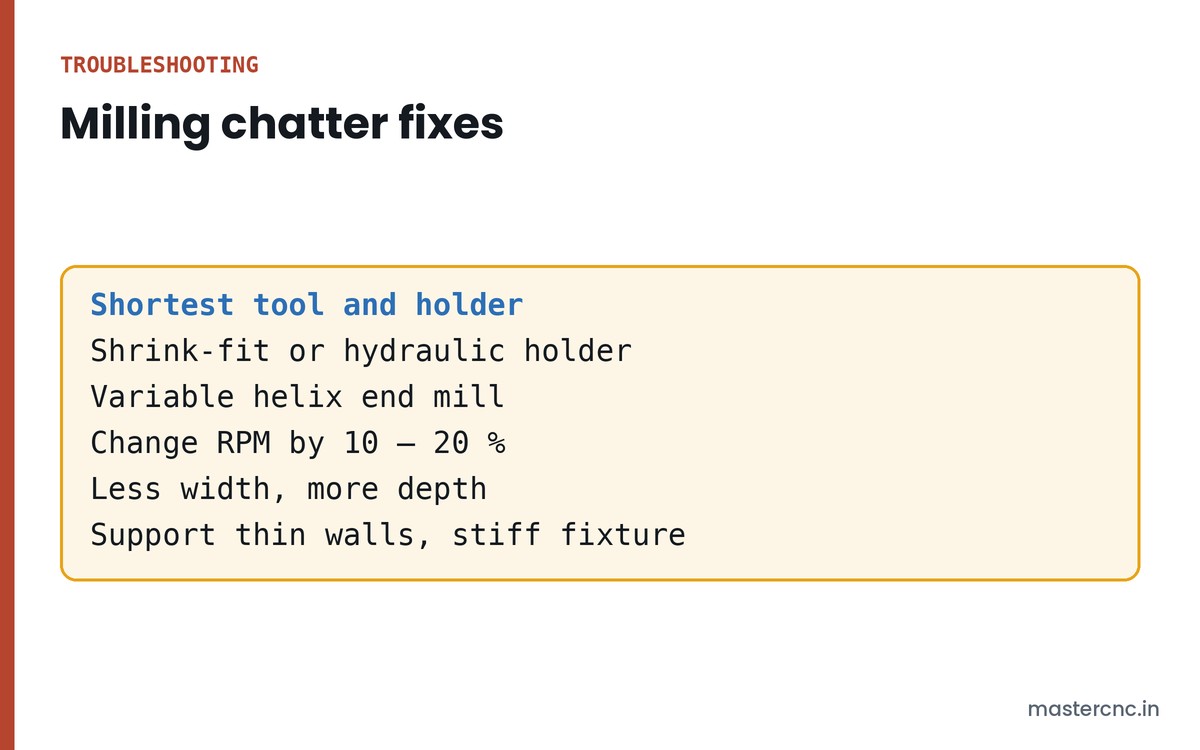
Chatter in milling: causes and fixes
Why end mills and face mills chatter: tool stick-out, holders, thin walls, weak fixtures, radial engagement and spindle speed, and the fixes that make milling quiet and accurate.
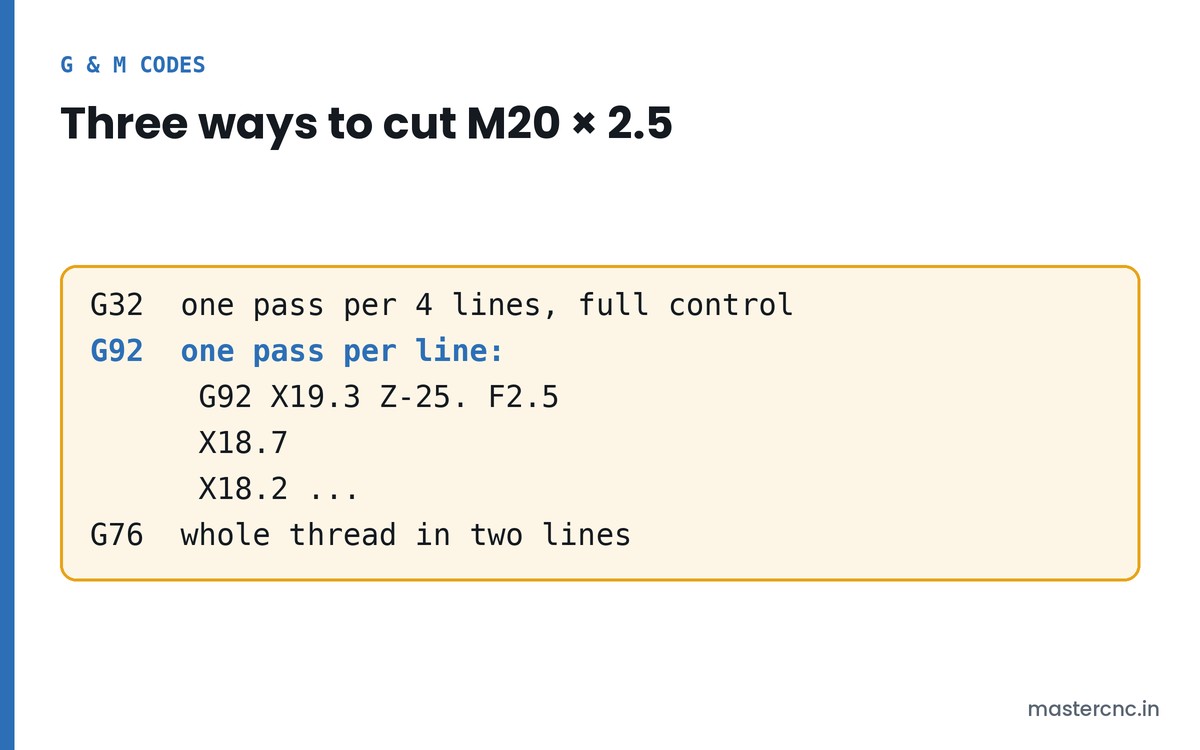
G32, G92 or G76: three ways to cut a thread
The three threading methods on a Fanuc lathe compared: G32 single moves, the G92 threading box cycle and the G76 multi-pass cycle, with an M20 × 2.5 example and when to use each.
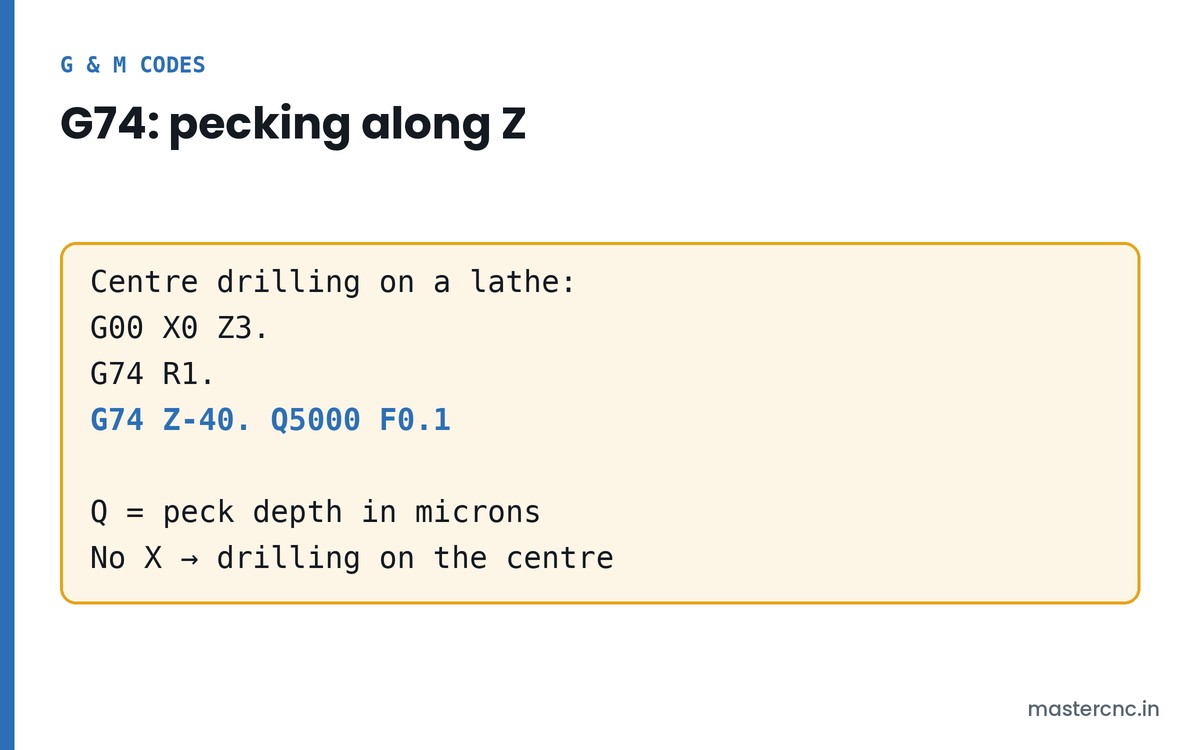
Fanuc G74 face peck drilling and face grooving
How the Fanuc lathe G74 cycle drills deep centre holes with pecking and cuts face grooves wider than the tool, with R, X, Z, P, Q explained and two example programs.
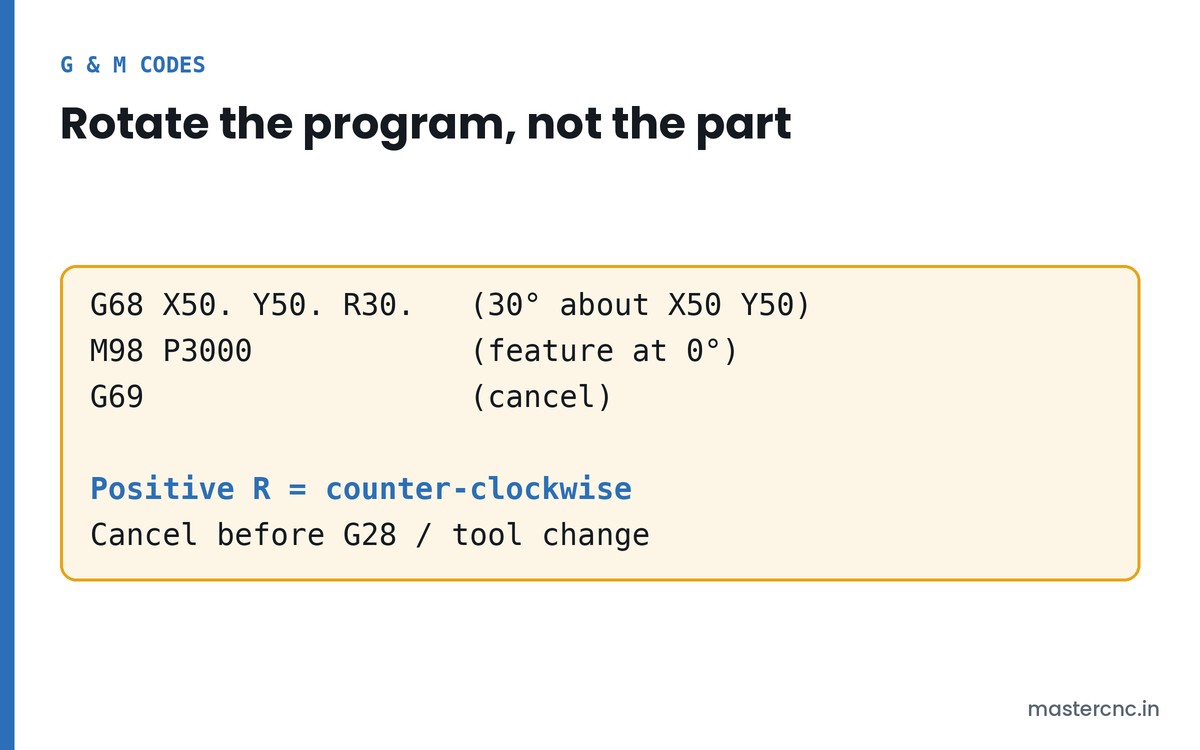
G68 coordinate rotation
How G68 rotates the programmed coordinates on a machining centre, with the centre and angle, how to repeat a feature around a circle with G68 and a subprogram, and how to cancel with G69.
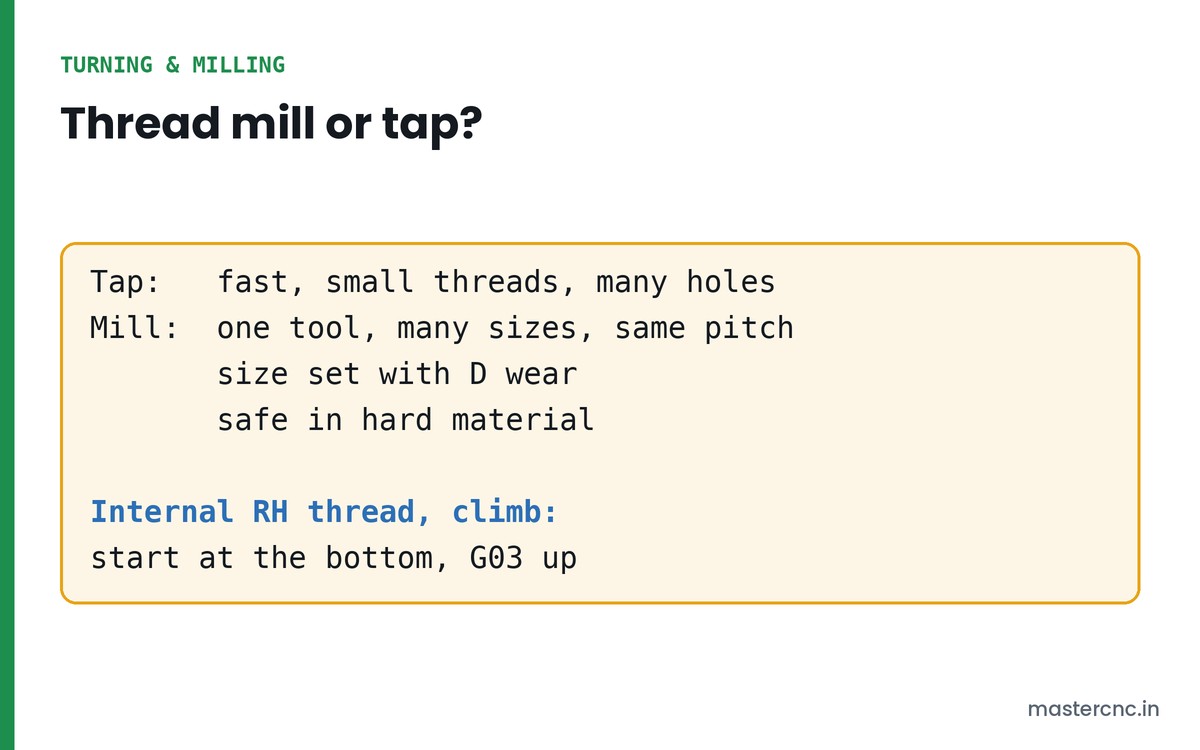
Thread milling vs tapping
When to thread mill instead of tap on a machining centre: the advantages and limits of each, how a thread milling helix works, and a simple internal M10 thread milling program.
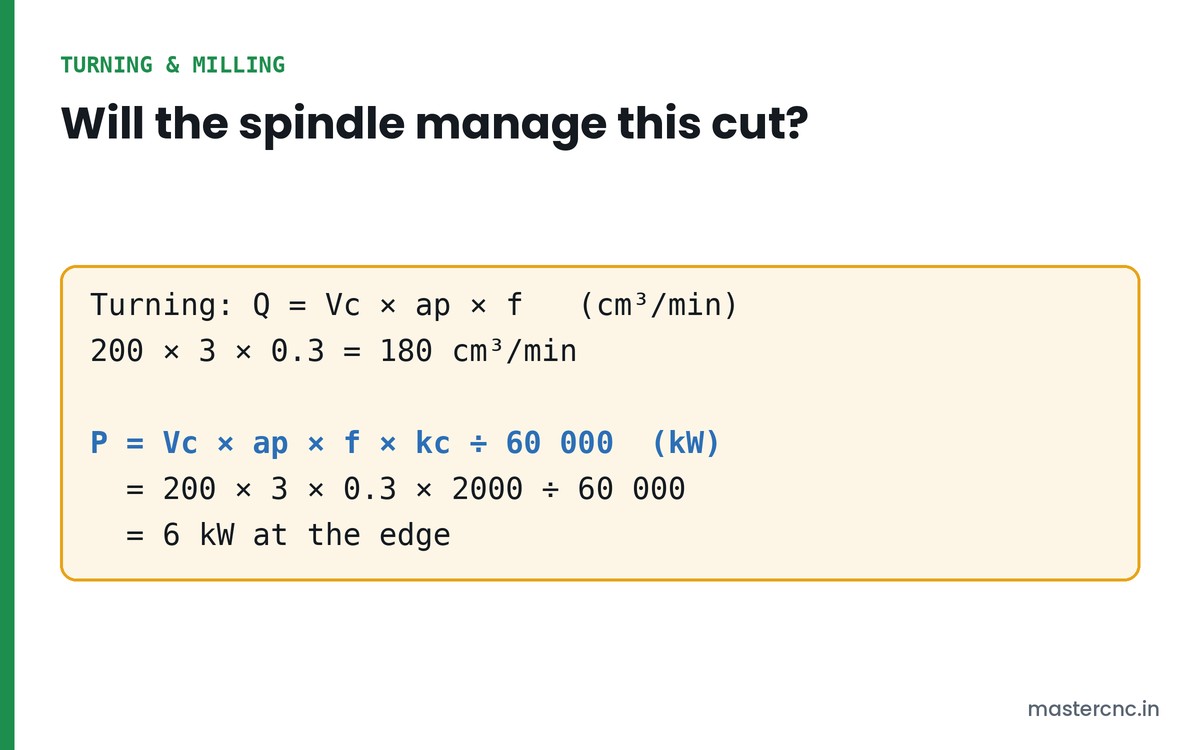
Material removal rate and spindle power
How to calculate material removal rate and cutting power for turning and milling, typical specific cutting force values, and how to check a roughing cut against your machine's spindle power.
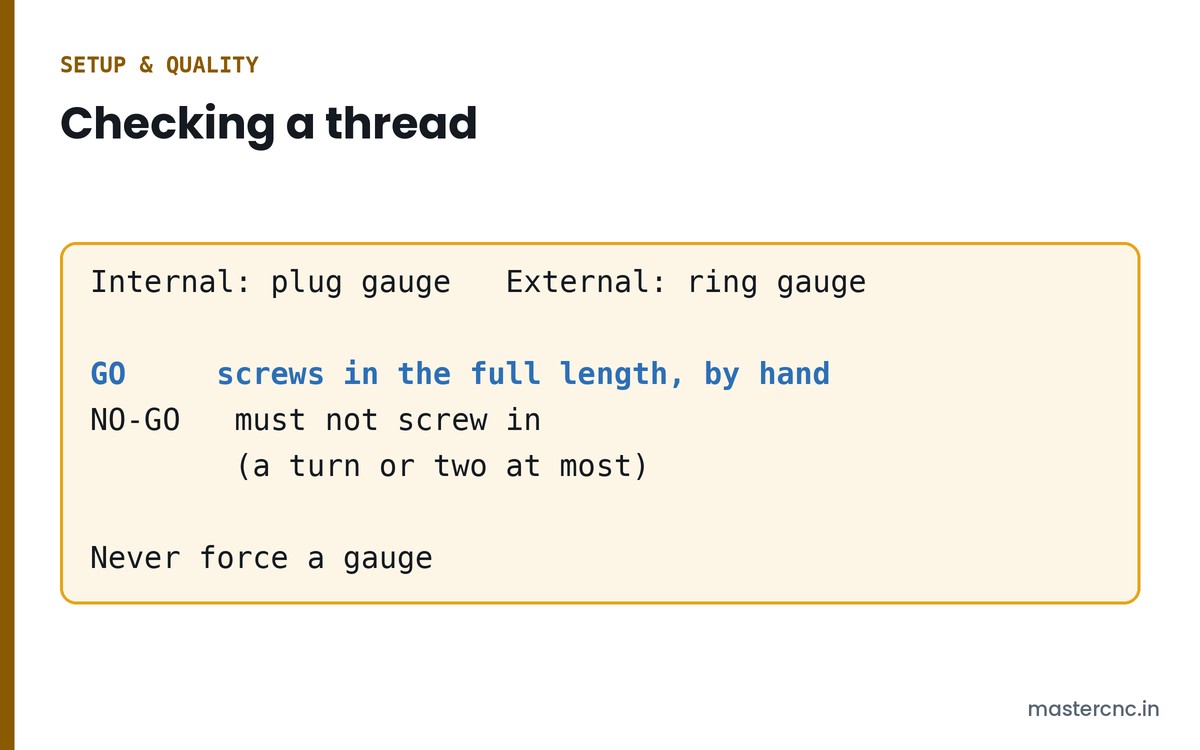
Thread gauges: GO / NO-GO rings and plugs
How to check internal and external threads with GO and NO-GO plug and ring gauges, what counts as a pass, how far NO-GO may enter, and how to care for thread gauges.
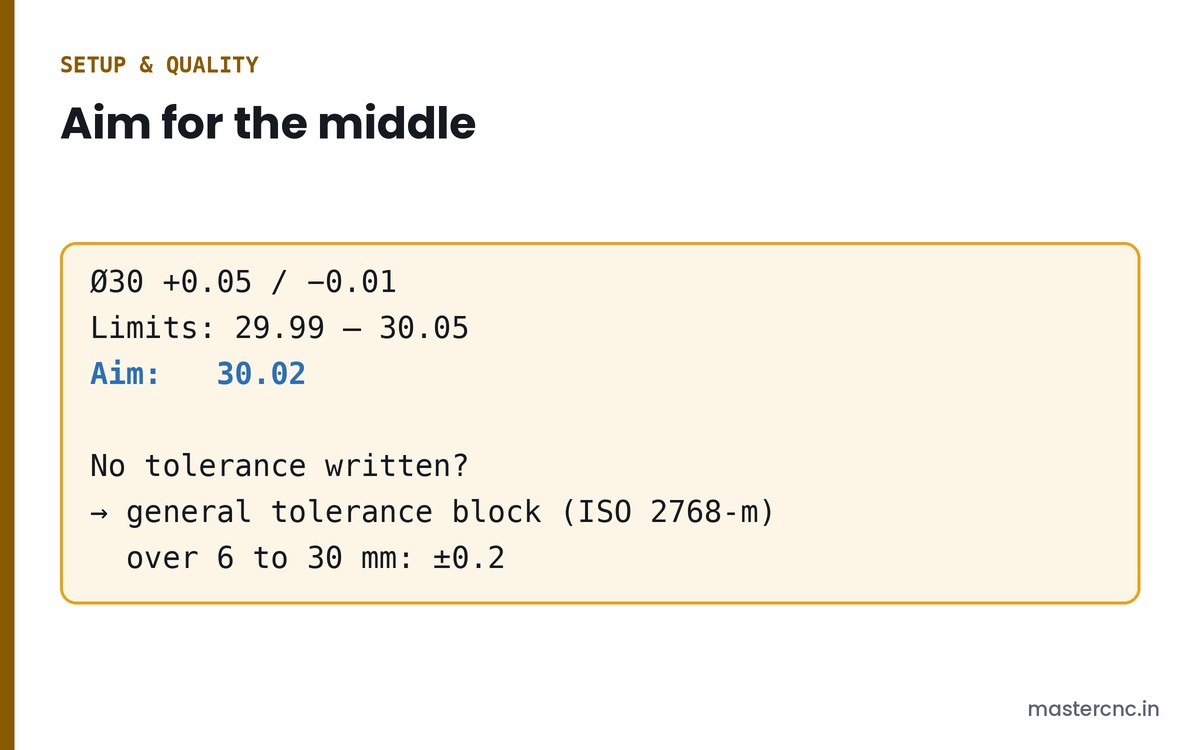
Reading a tolerance: limits and IT grades
How to read plus/minus, unilateral and limit tolerances, what the general tolerance block (ISO 2768) means, IT grade widths, and how to turn a tolerance into the size you aim for.
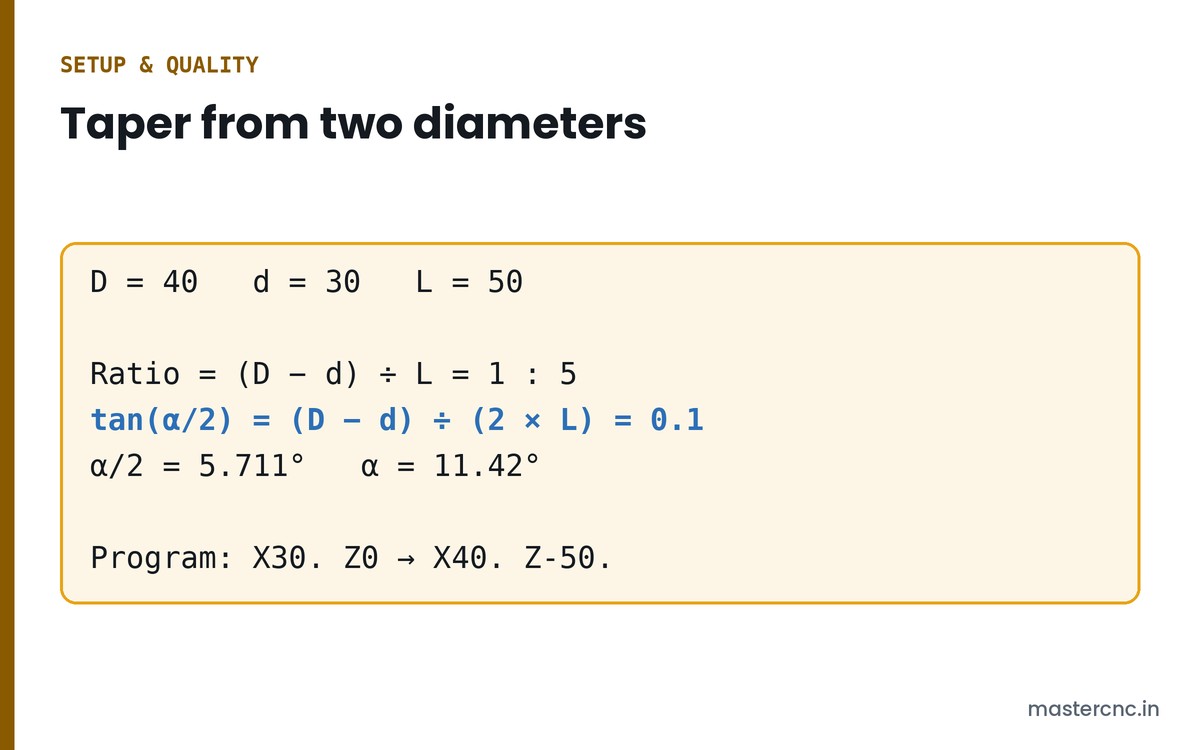
Taper calculation: angle, ratio and program points
How to calculate a taper's angle, ratio and diameters for a CNC lathe program: from two diameters and a length, from an angle, and why nose radius compensation matters on tapers.
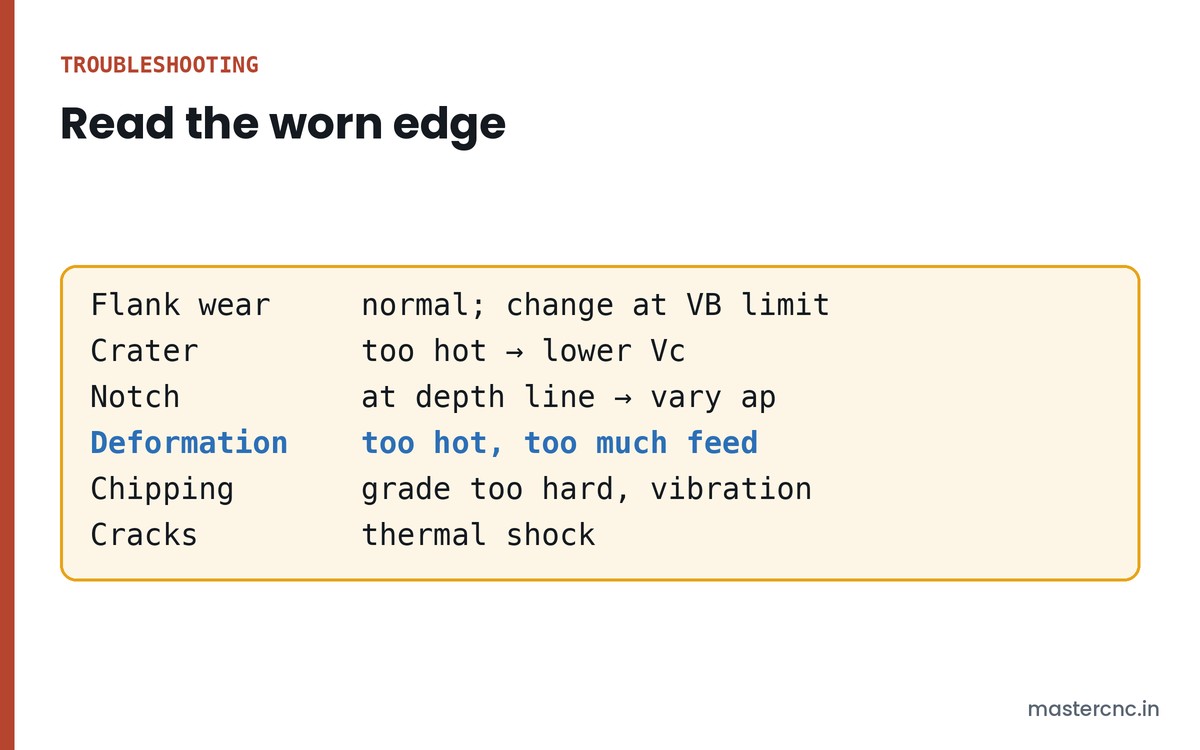
Tool wear types: flank, crater and notch
How to read a worn insert: flank wear, crater wear, notch wear, plastic deformation, chipping and thermal cracks, what each one means and what to change.
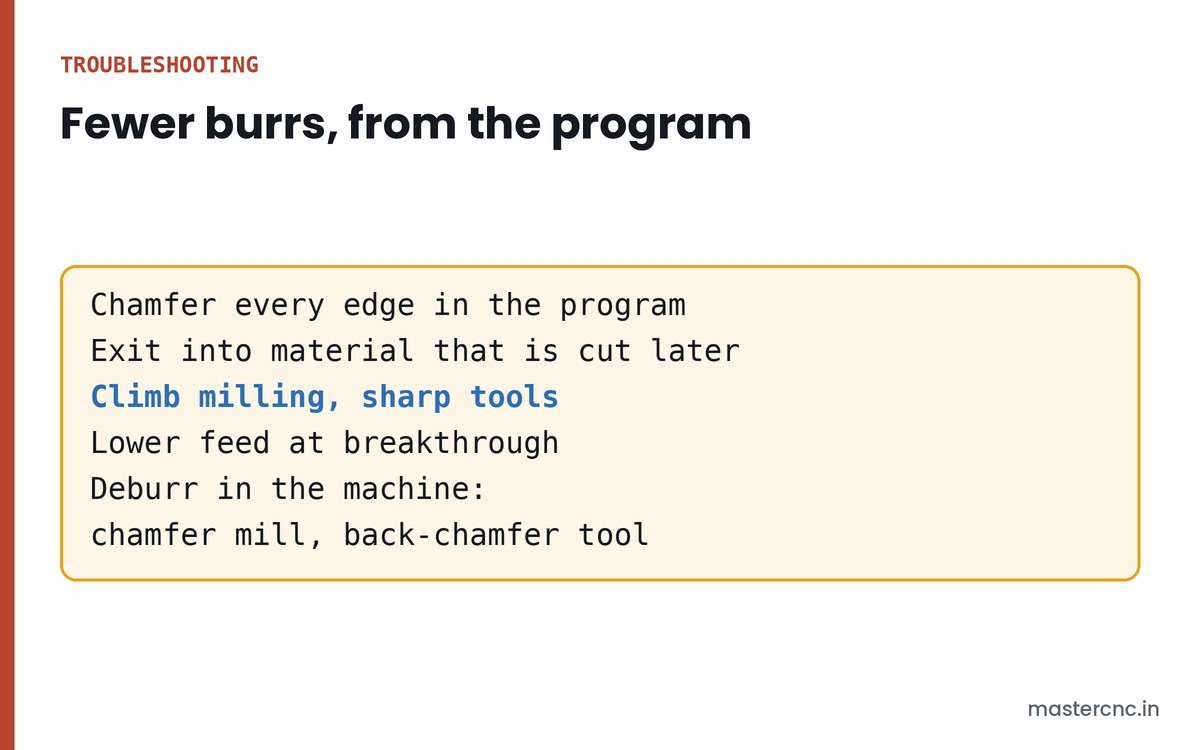
Reducing burrs with better programming
Ways to make fewer and smaller burrs on CNC parts through the program: chamfer passes, cutting direction, exit paths, operation order, sharp tools and deburring tools in the machine.
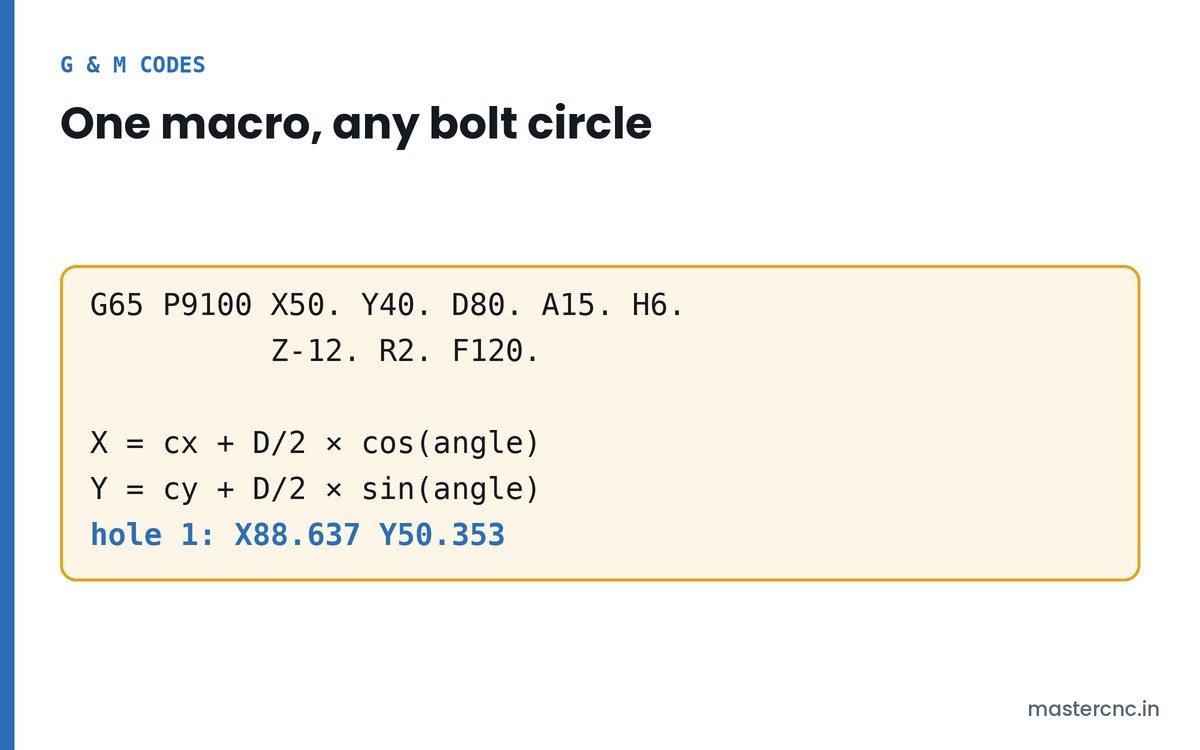
Macro B example: bolt hole circle
A complete Fanuc Macro B program that drills any bolt hole circle from a few arguments, with the maths explained, a hand-check of the first hole positions and how to call it with G65.
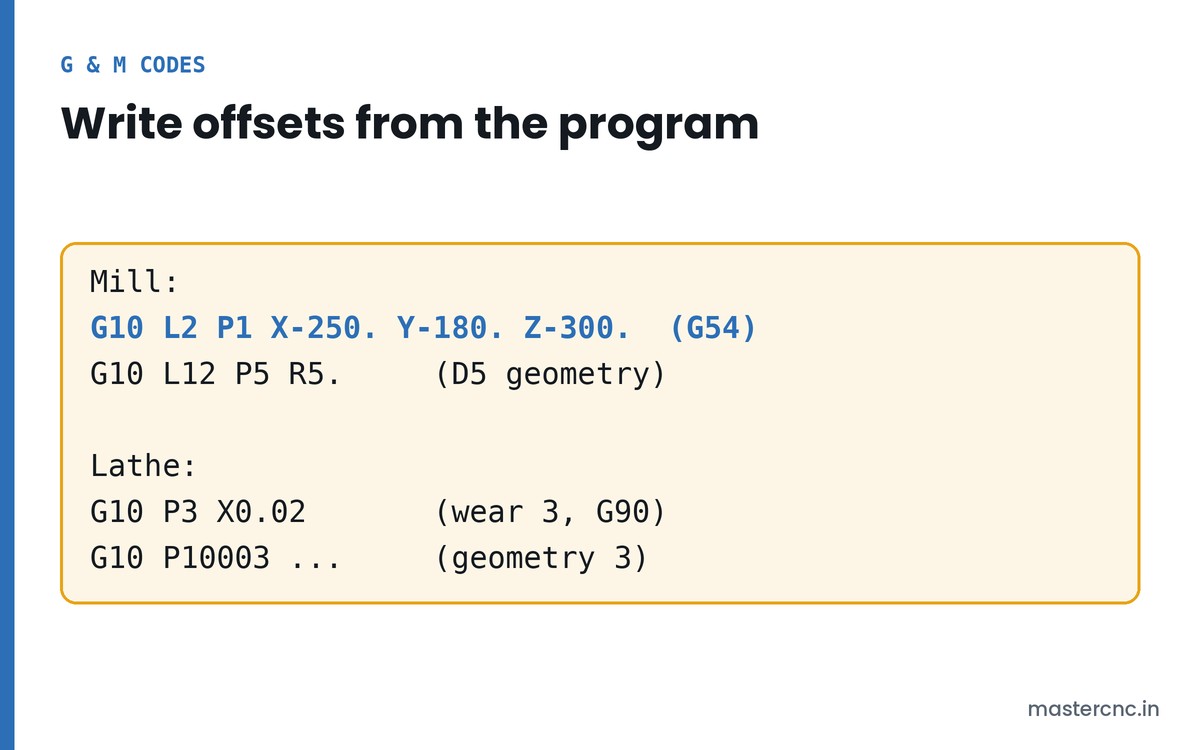
G10: setting offsets from the program
How G10 writes work offsets and tool offsets from inside a CNC program on Fanuc mills and lathes, the L and P words, absolute vs incremental, and when it is useful or risky.
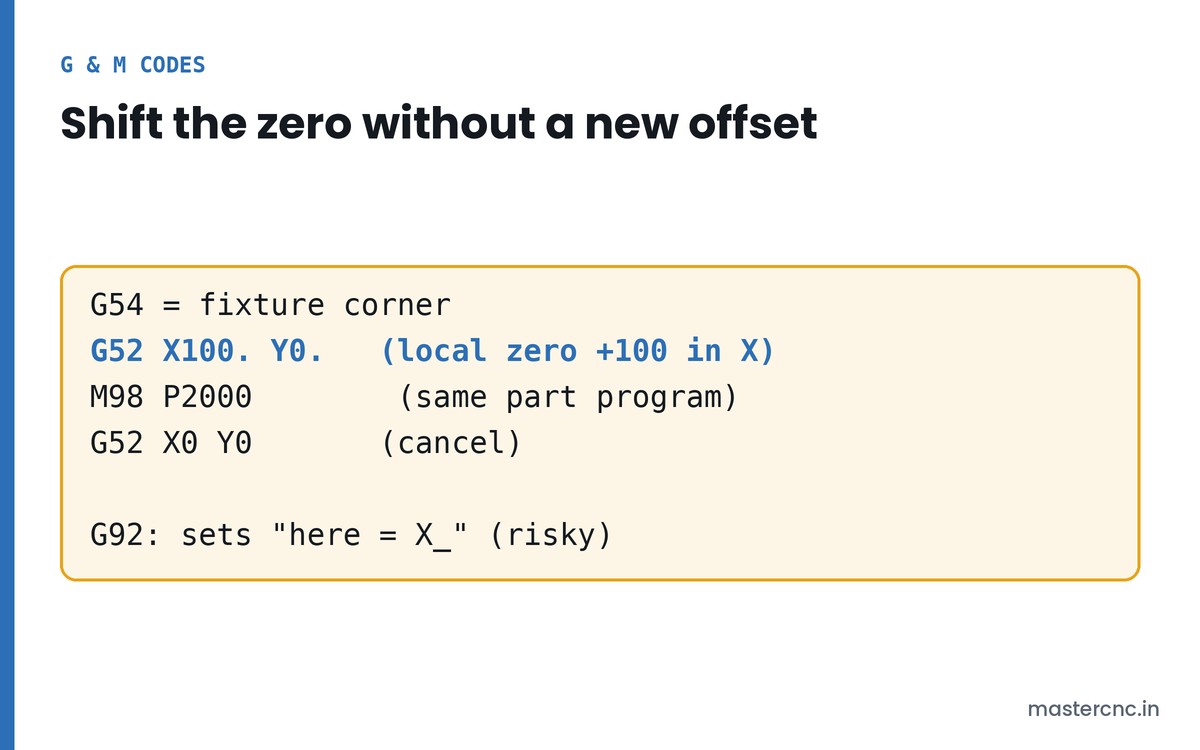
G52 and G92: local and temporary coordinates
How G52 shifts a local coordinate system on top of G54, how it helps with multiple parts or features, why G92 is risky on a mill, and how to cancel both safely.
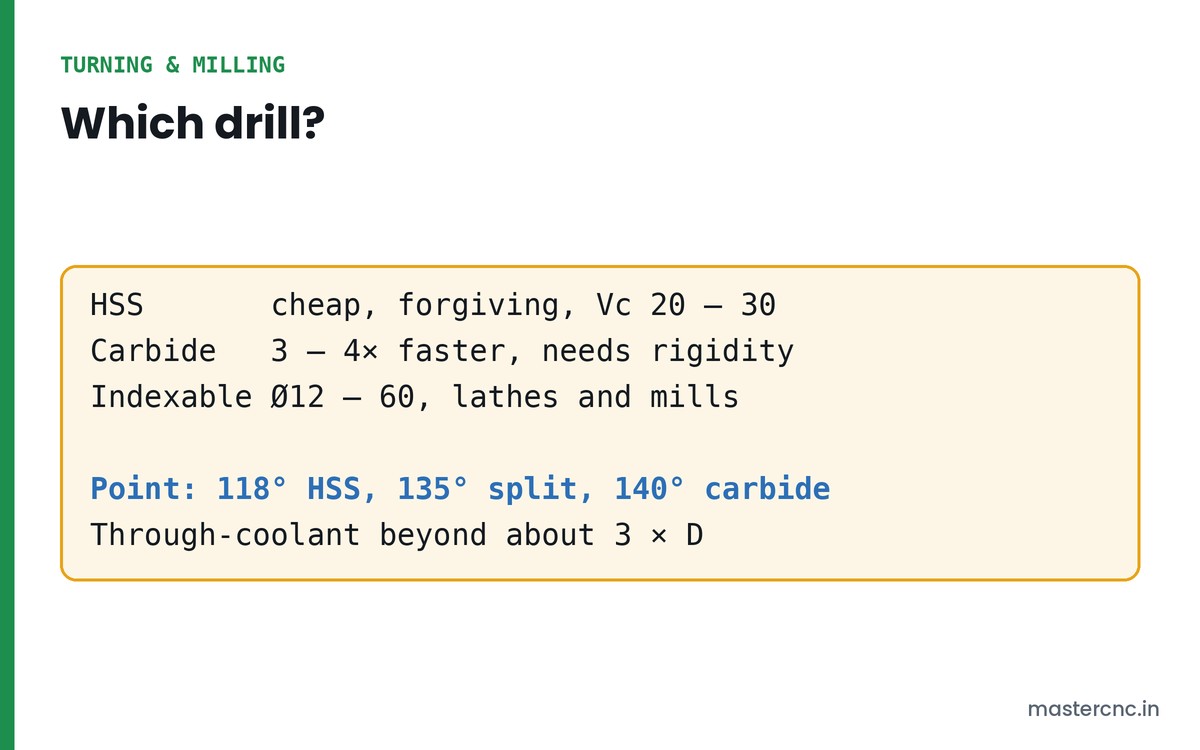
Drilling: carbide vs HSS, point angle and coolant
How to choose between HSS, solid carbide and indexable drills, what 118°, 135° and 140° point angles are for, when you need through-coolant, and what hole quality to expect.
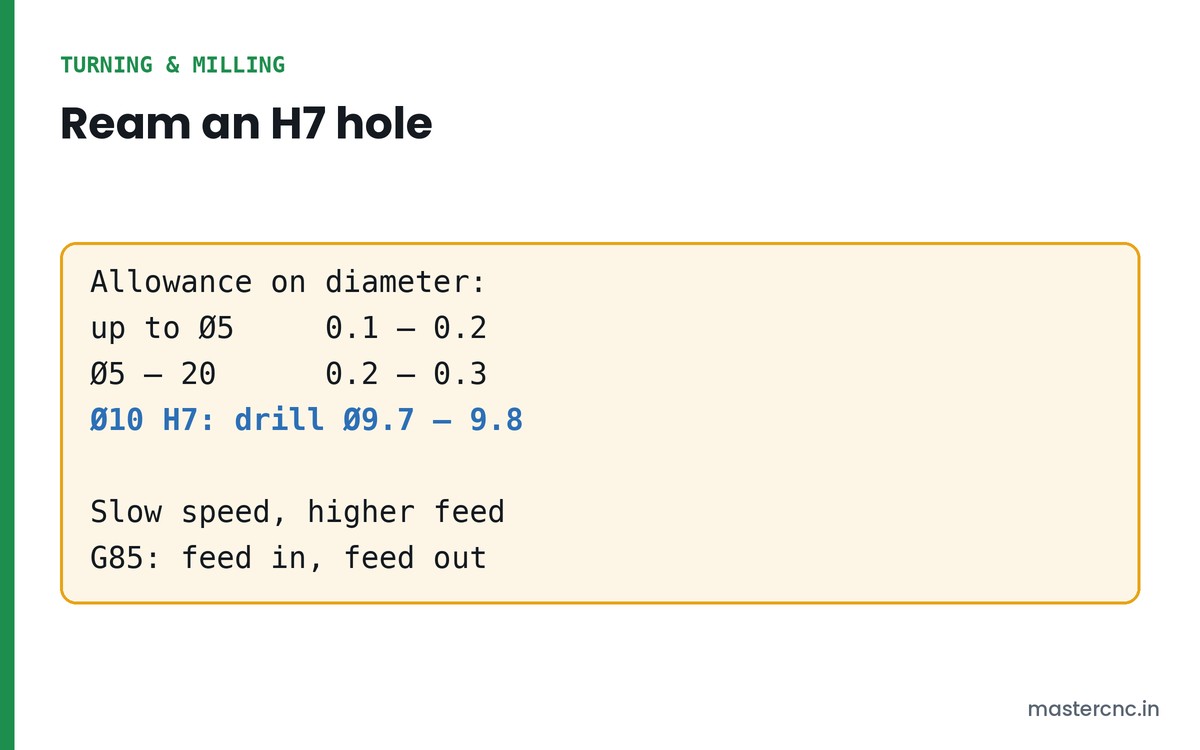
Reaming: allowance, speed and feed
How much stock to leave for a reamer, starting speeds and feeds, straight vs spiral flutes for through and blind holes, holders and the G85 cycle, for accurate H7 holes.
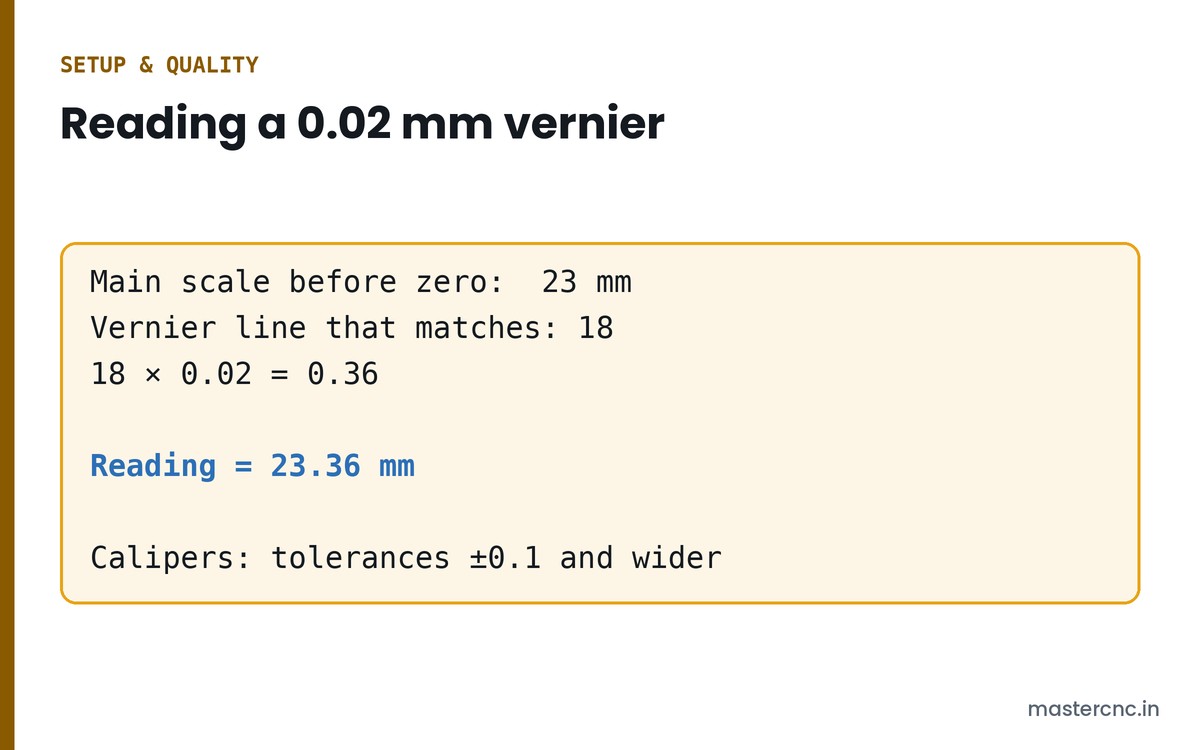
Vernier and dial caliper: common reading mistakes
How to read a vernier caliper, what accuracy to expect from vernier, dial and digital calipers, and the measuring mistakes that cost 0.05 mm or more.
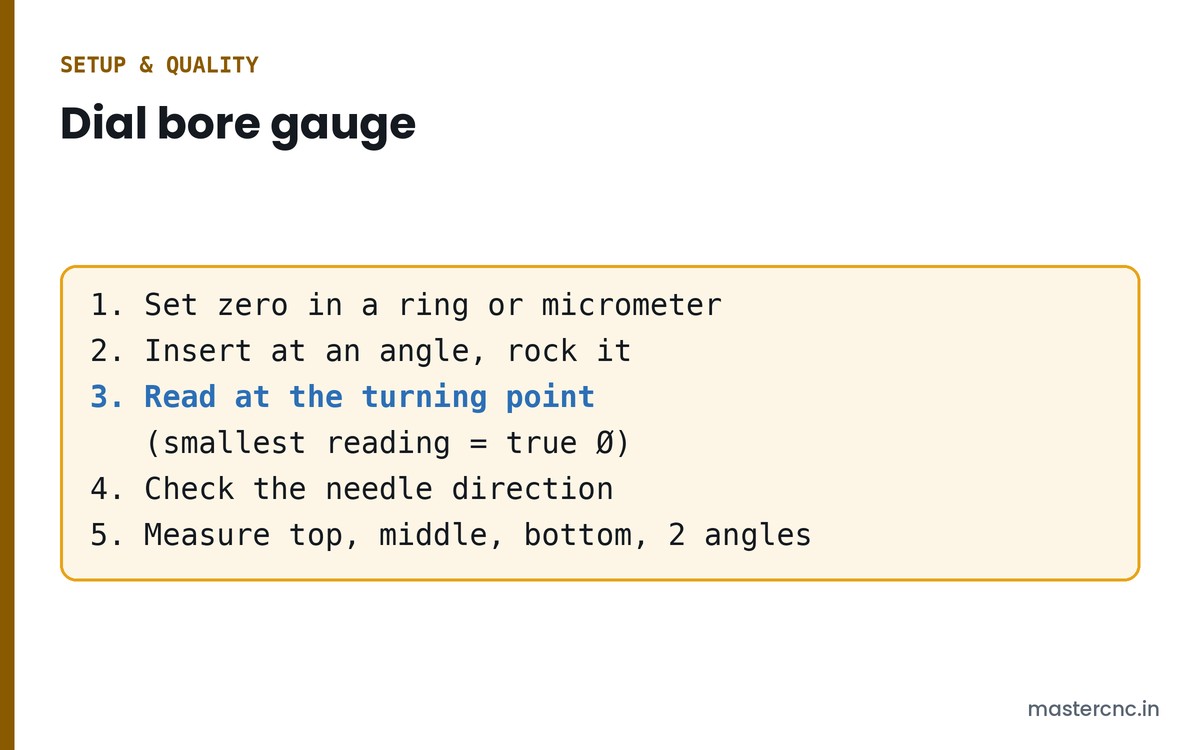
Setting and reading a bore gauge
How to set a dial bore gauge to zero with a setting ring or micrometer, how to rock it to find the true diameter, which way the needle moves, and how to check a bore for taper and ovality.
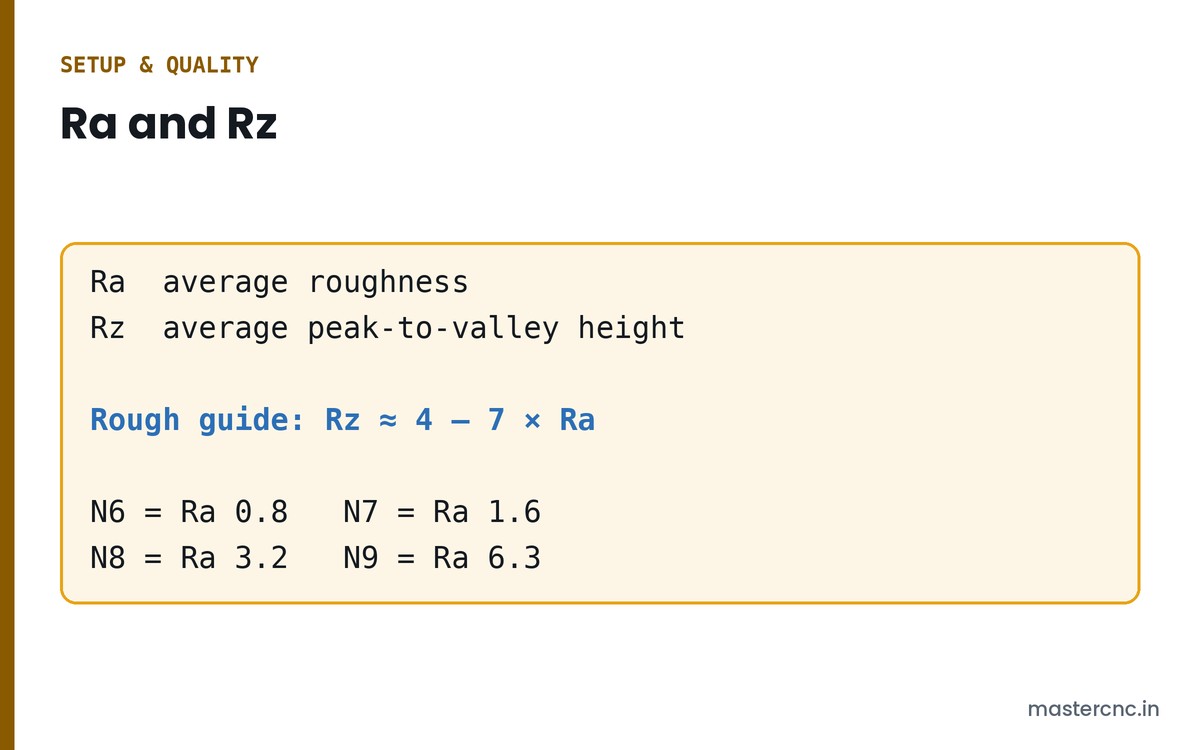
Ra and Rz: surface roughness and how to measure it
What Ra and Rz mean on a drawing, how they relate to each other and to old N grades, how a surface roughness tester measures, and how feed and nose radius set the theoretical value.
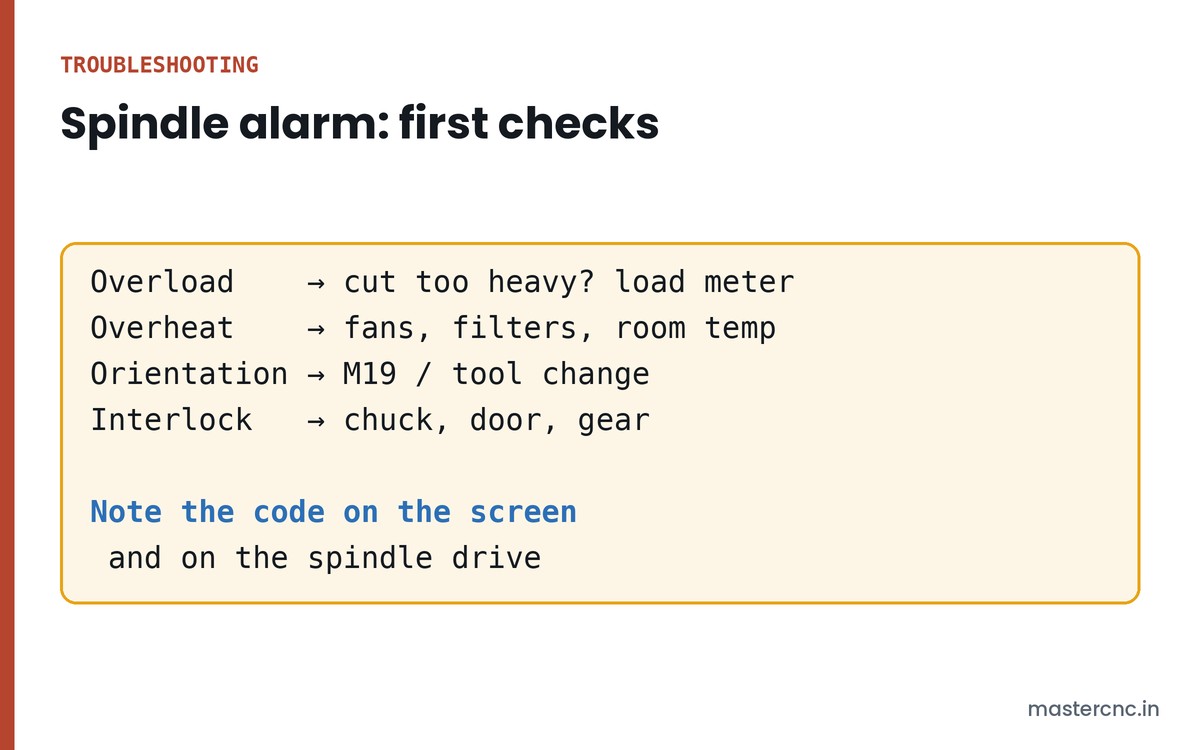
Spindle alarms: first checks
What to do when a CNC spindle alarm stops the machine: the common causes from overload and overheating to orientation and interlocks, what an operator can check, and what to tell maintenance.
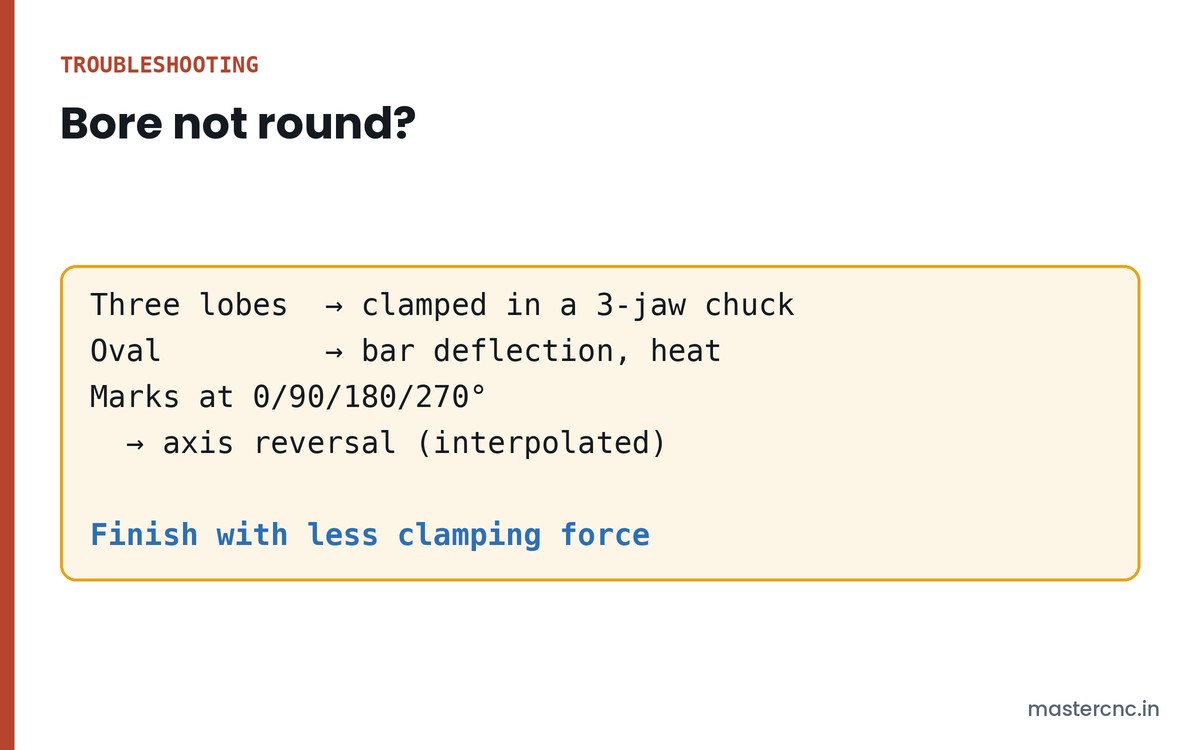
Out-of-round bores: causes
Why a bored or interpolated hole comes out oval or three-lobed: clamping distortion of thin parts, boring bar deflection, heat, machine axis errors in circular interpolation, and the fixes.
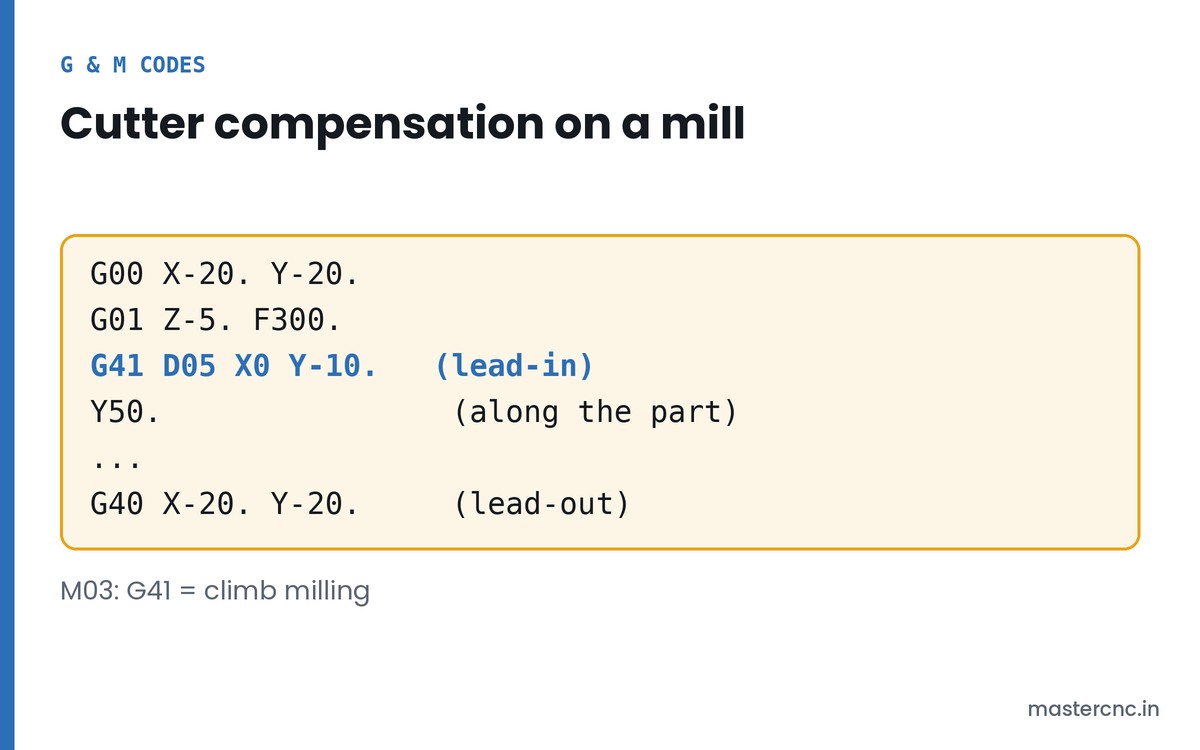
G41 and G42 cutter compensation on a mill
How cutter radius compensation works on a machining centre: G41, G42 and G40, the D offset, lead-in and lead-out moves, wear values for size correction, and the alarms it causes.
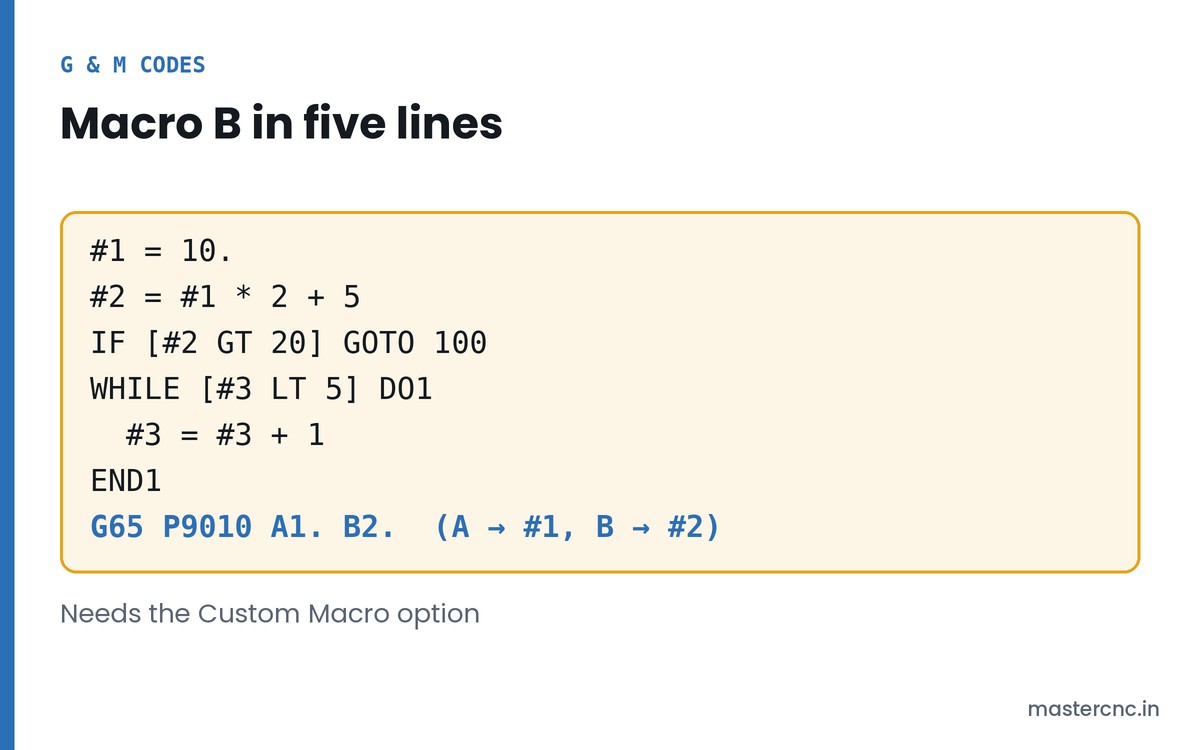
Fanuc Macro B basics: variables, IF and WHILE
An introduction to Fanuc Custom Macro B: local, common and permanent variables, maths, IF and GOTO, WHILE loops, G65 arguments and a part counter example.
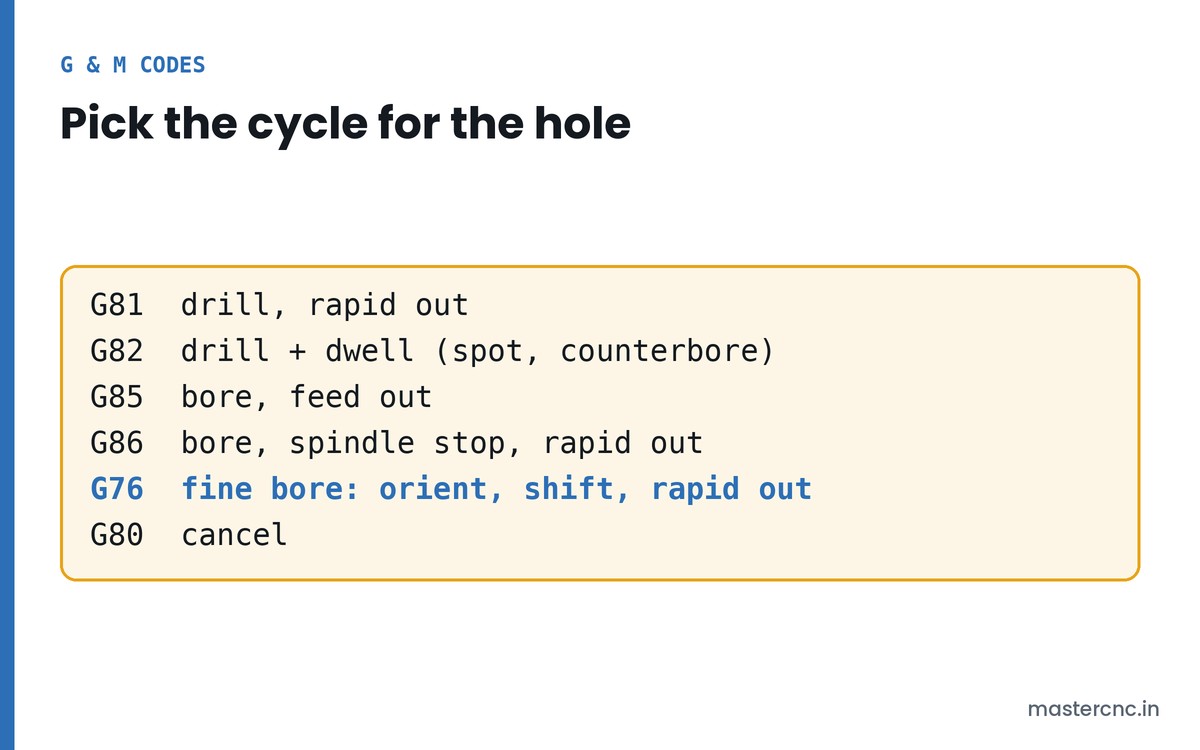
Mill drilling and boring cycles: G81, G82, G85, G86, G76
The canned cycles on a Fanuc machining centre for drilling, spot facing and boring: what G81, G82, G85, G86 and G76 do, how they retract, and which to use for each hole.
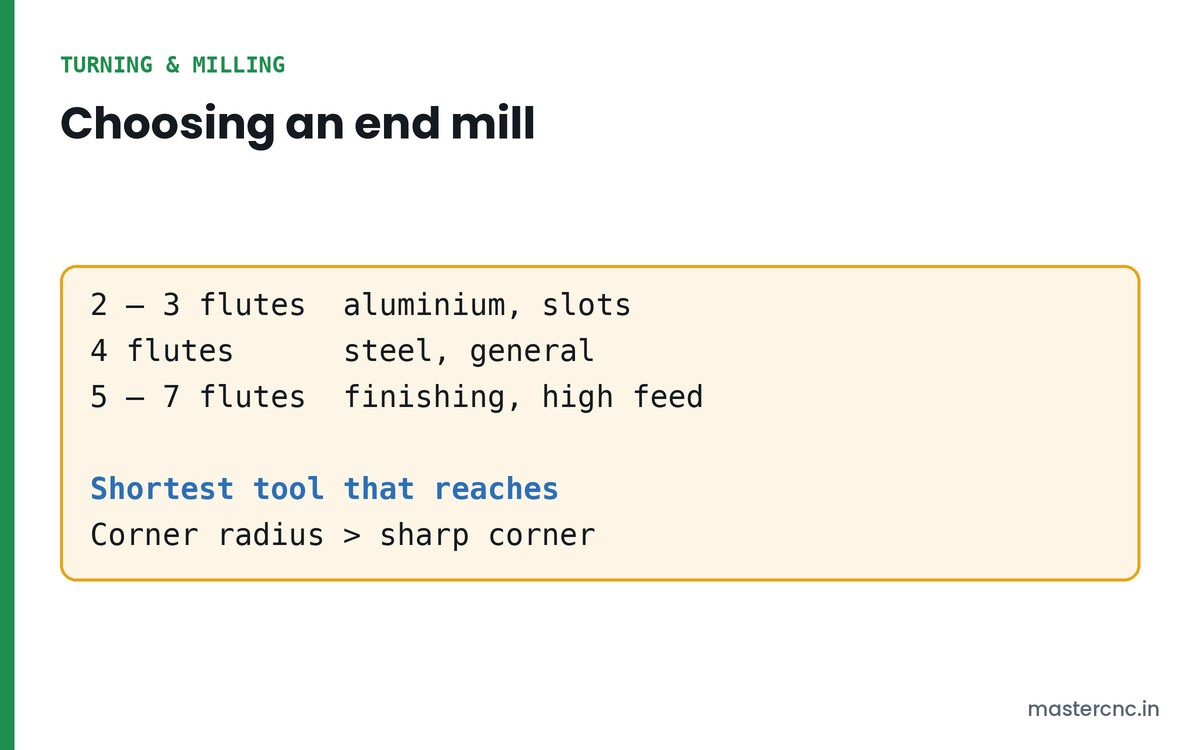
End mill basics: flutes, helix, coating, corner radius
How to choose a solid carbide end mill: number of flutes, helix angle, coating for steel or aluminium, corner radius, length and the shortest-tool rule.
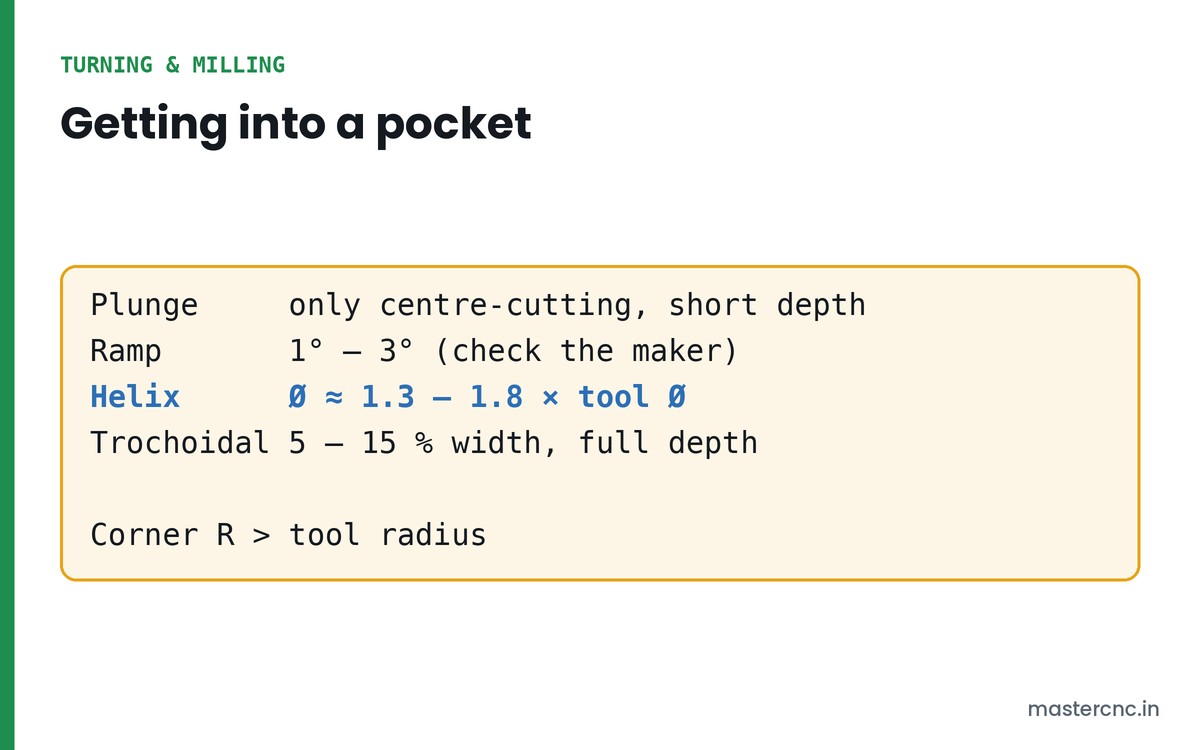
Pocket milling: ramping, helical entry and trochoidal
How to get an end mill into a closed pocket and clear it safely: plunging, ramping angles, helical entry, trochoidal and adaptive milling, and how to handle corners.
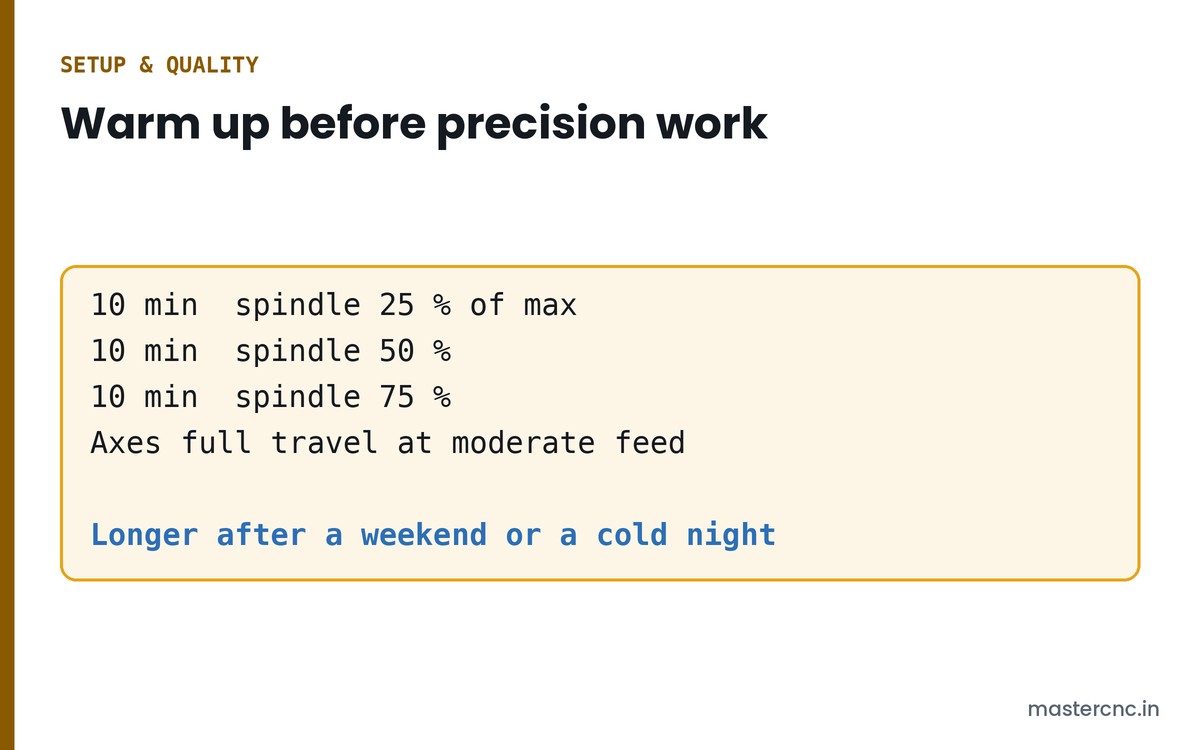
Warm-up programs: why the spindle needs them
Why CNC machines need a warm-up before precision work, what thermal growth does to sizes, and a simple warm-up program that steps up spindle speed and moves every axis.
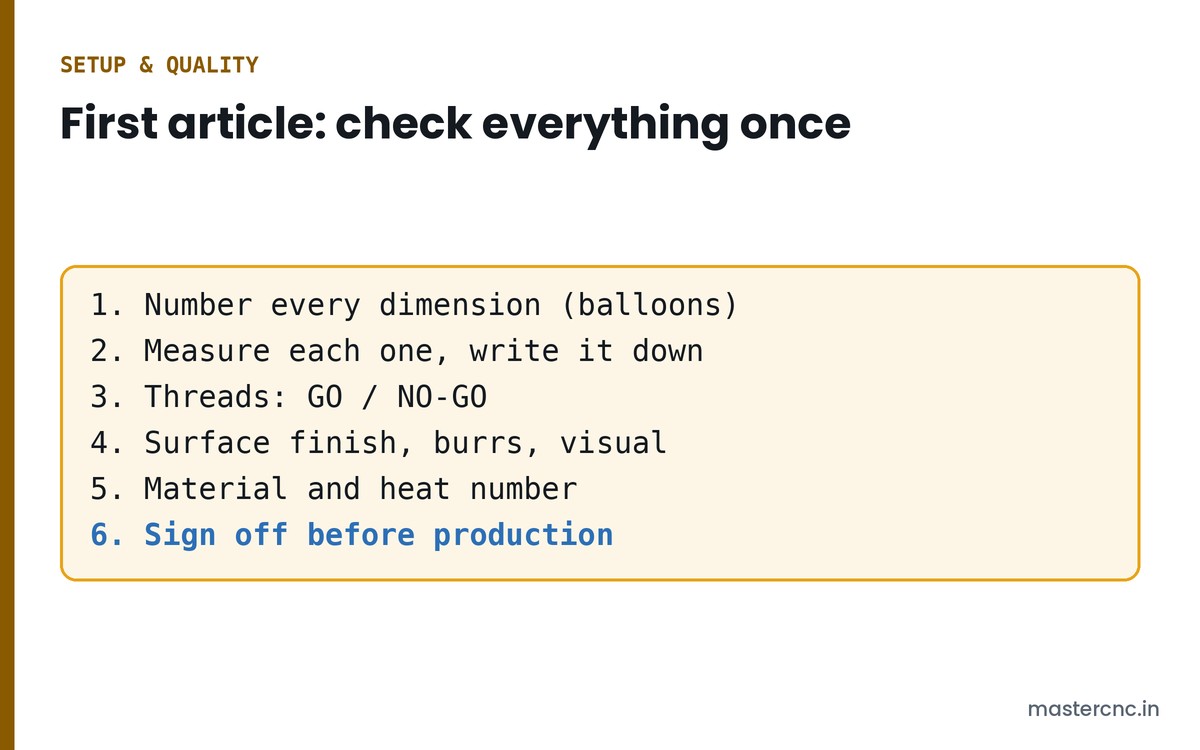
First article inspection: what to check
What a first article inspection on a CNC part should cover: every dimension on the drawing, tolerances and GD&T, threads, surface finish, material, visual and a written record.
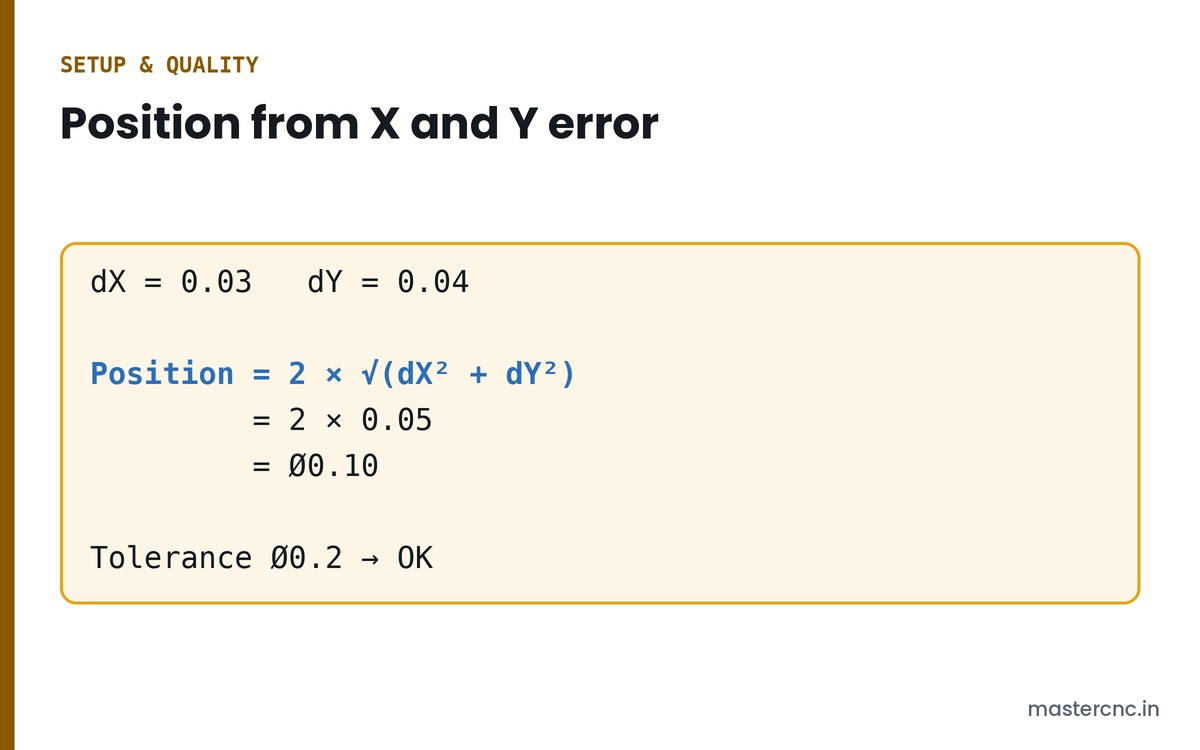
GD&T: position tolerance basics
What a position tolerance on a hole means, how basic dimensions and datums define the true position, how to calculate position from measured X and Y, and what MMC bonus tolerance adds.
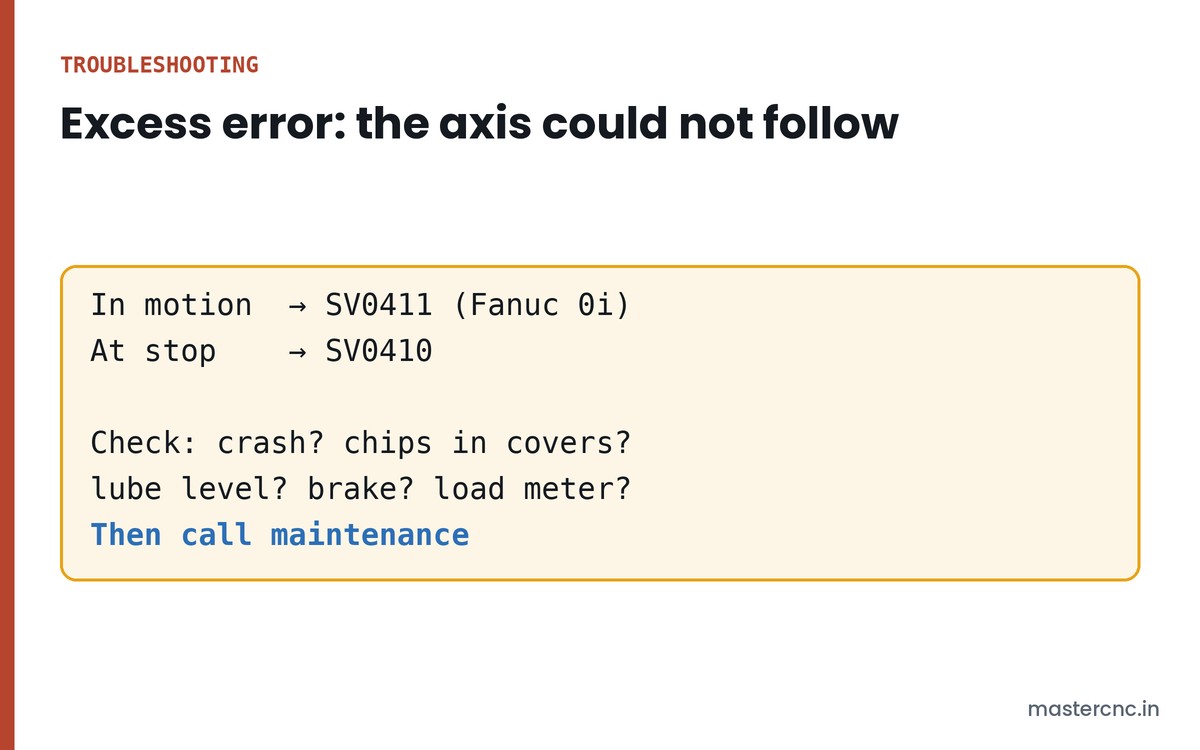
Servo excess error alarm: causes
What a servo excess error (position deviation) alarm means on a CNC machine, the mechanical and electrical causes, what an operator can safely check, and when to call maintenance.
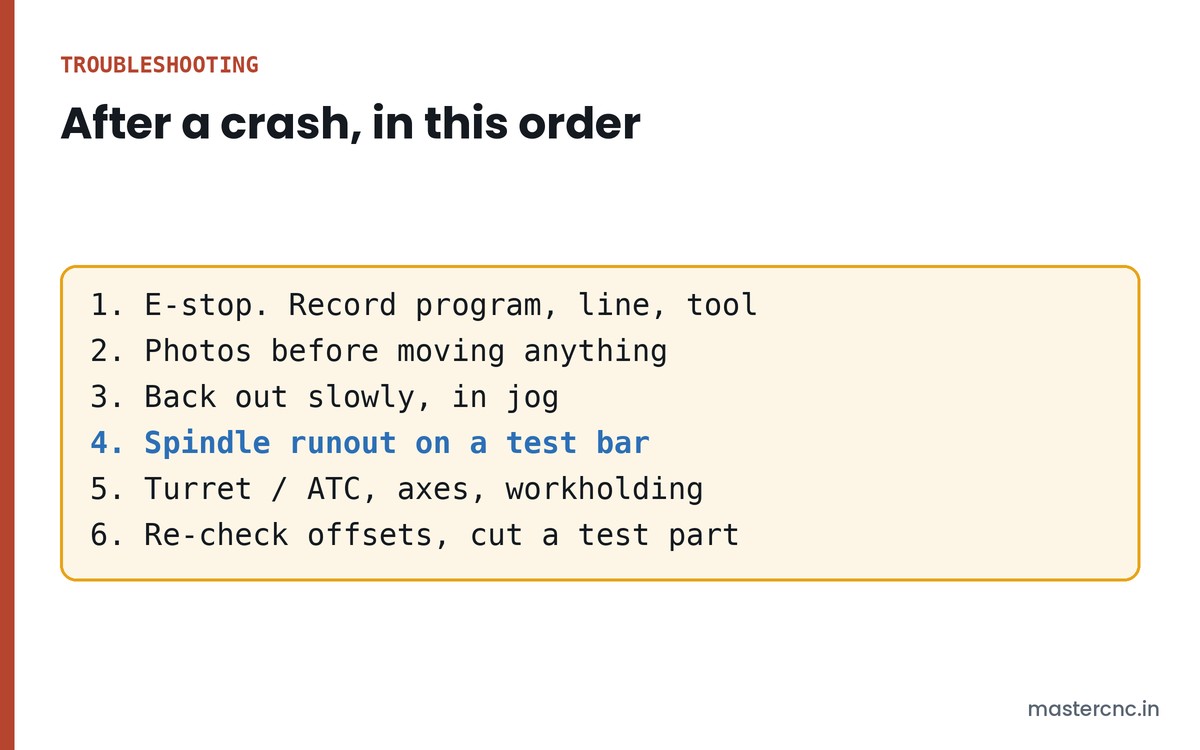
After a crash: what to check before running again
A checklist for after a CNC machine crash: what to record first, then the tool, holder, spindle runout, turret or tool changer, axis position, workholding, probe and a test cut.
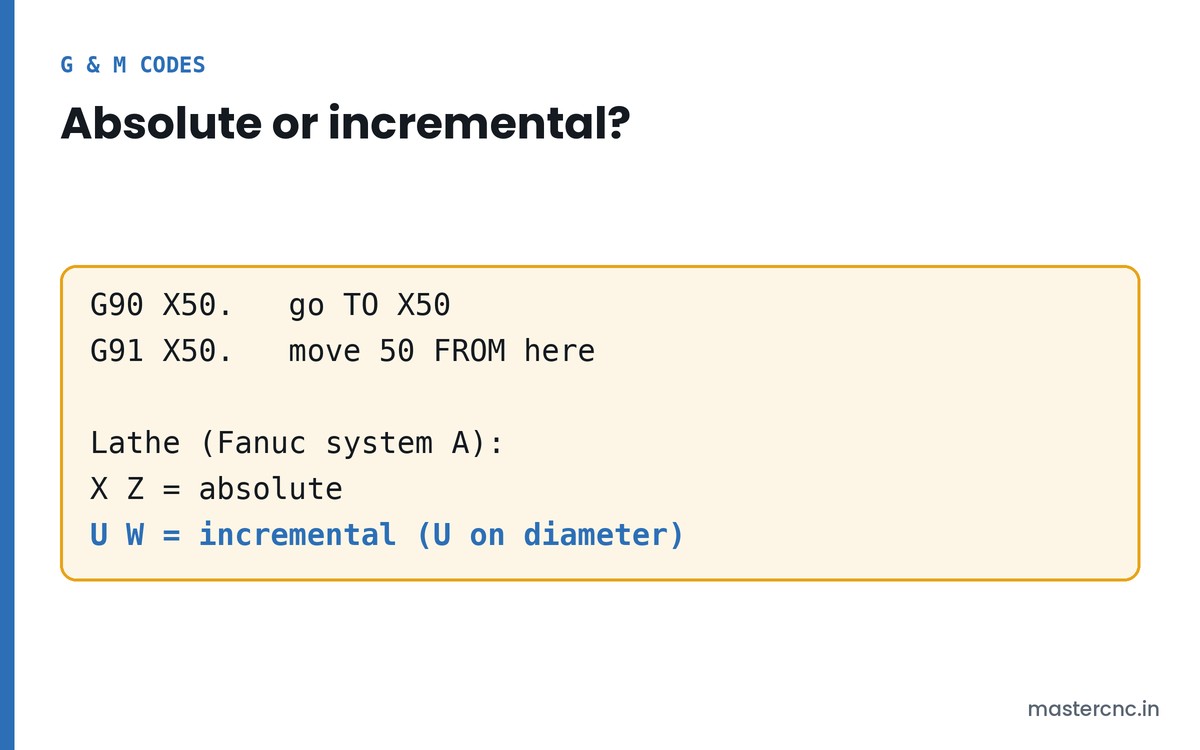
G90 vs G91: absolute and incremental (and U, W on a lathe)
The difference between absolute and incremental programming, G90 and G91 on a mill, U and W on a Fanuc lathe, when each is useful, and how a forgotten G91 causes crashes.
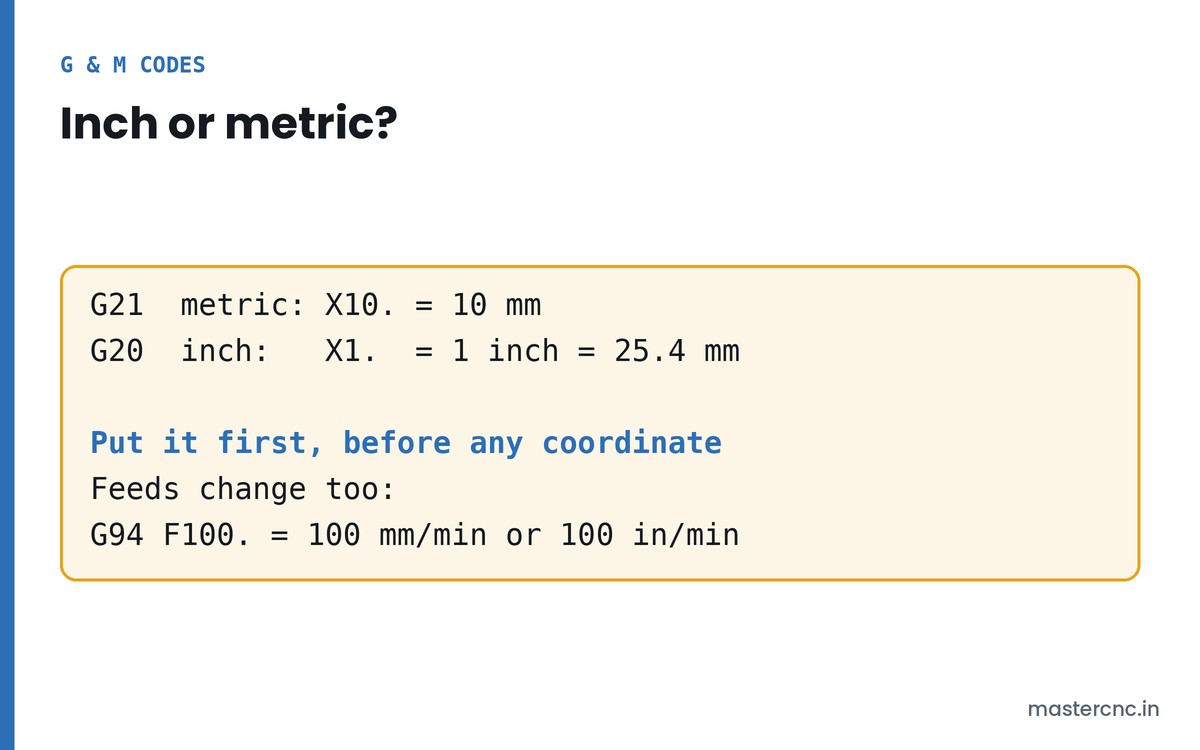
G20 and G21: inch and metric programs
What G20 (inch) and G21 (metric) change in a CNC program, where to put them, the decimal point trap, and why you should never switch units in the middle of a job.
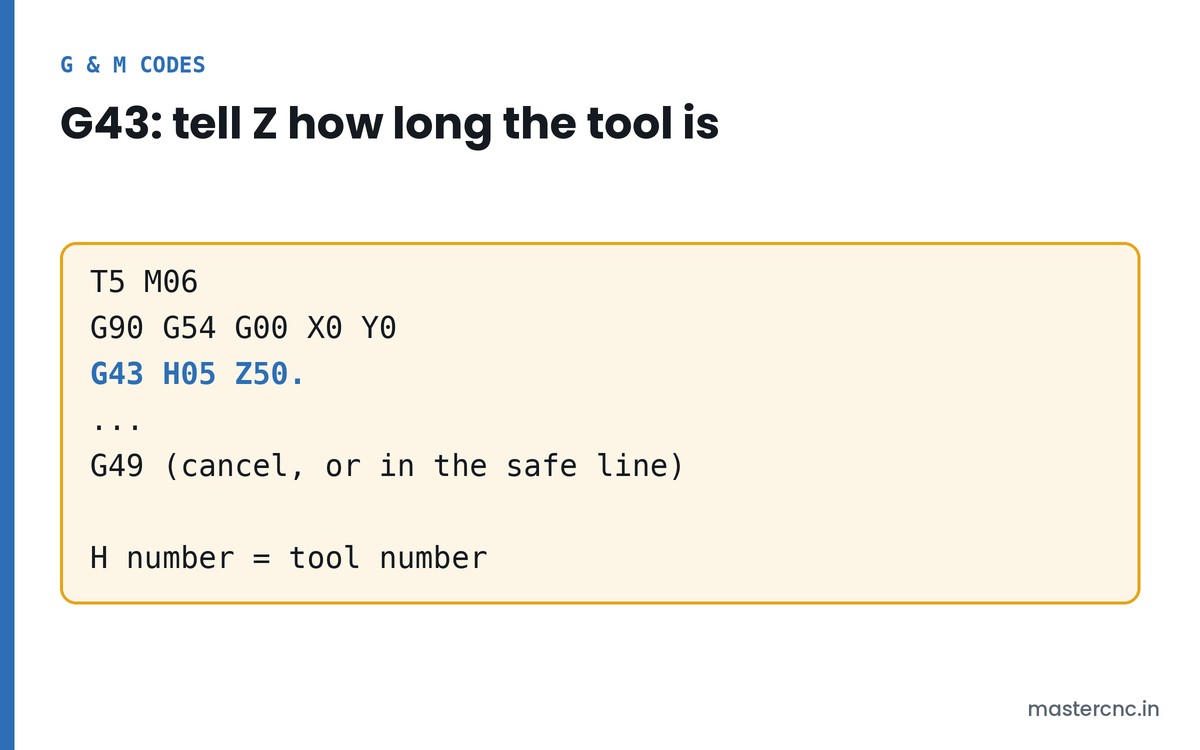
G43 tool length compensation and G49
How G43 H applies the tool length offset on a machining centre, why H must match the tool, where to put G43, how G49 cancels it, and the crashes a wrong or missing H causes.
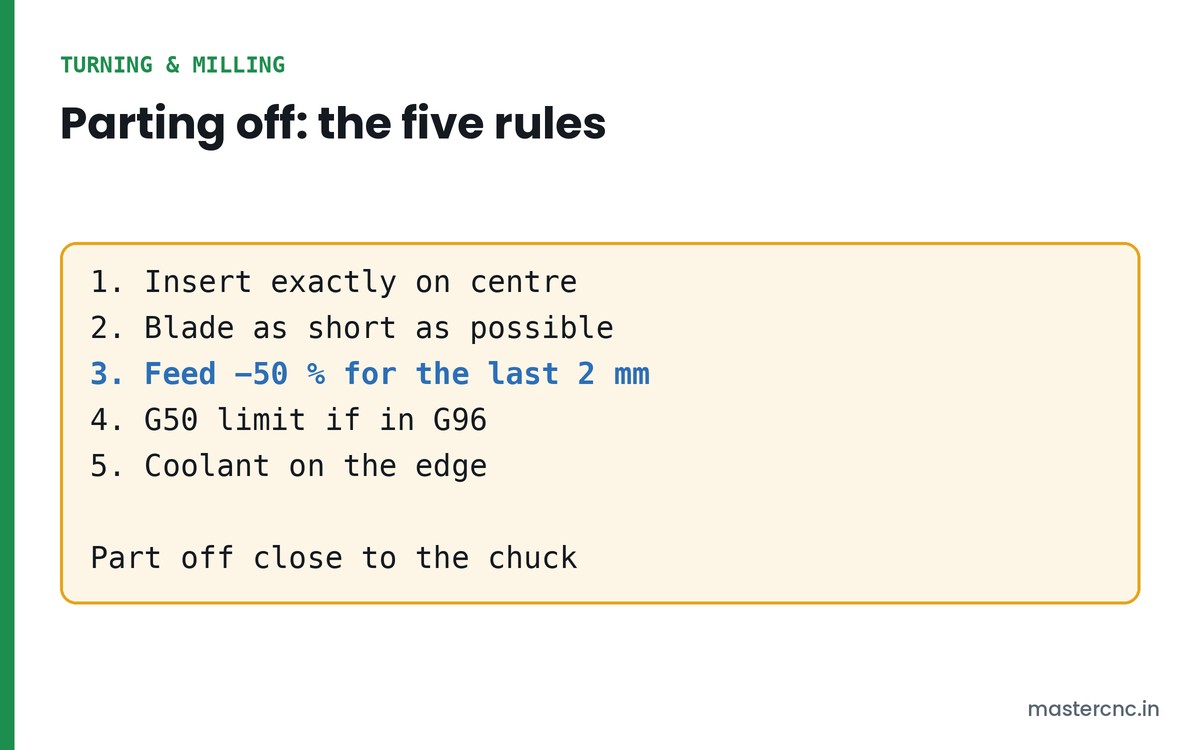
Grooving and parting off without breaking inserts
Practical rules for grooving and parting off on a CNC lathe: centre height, blade overhang, speed and feed near the centre, pips and burrs, chip control and part catching.
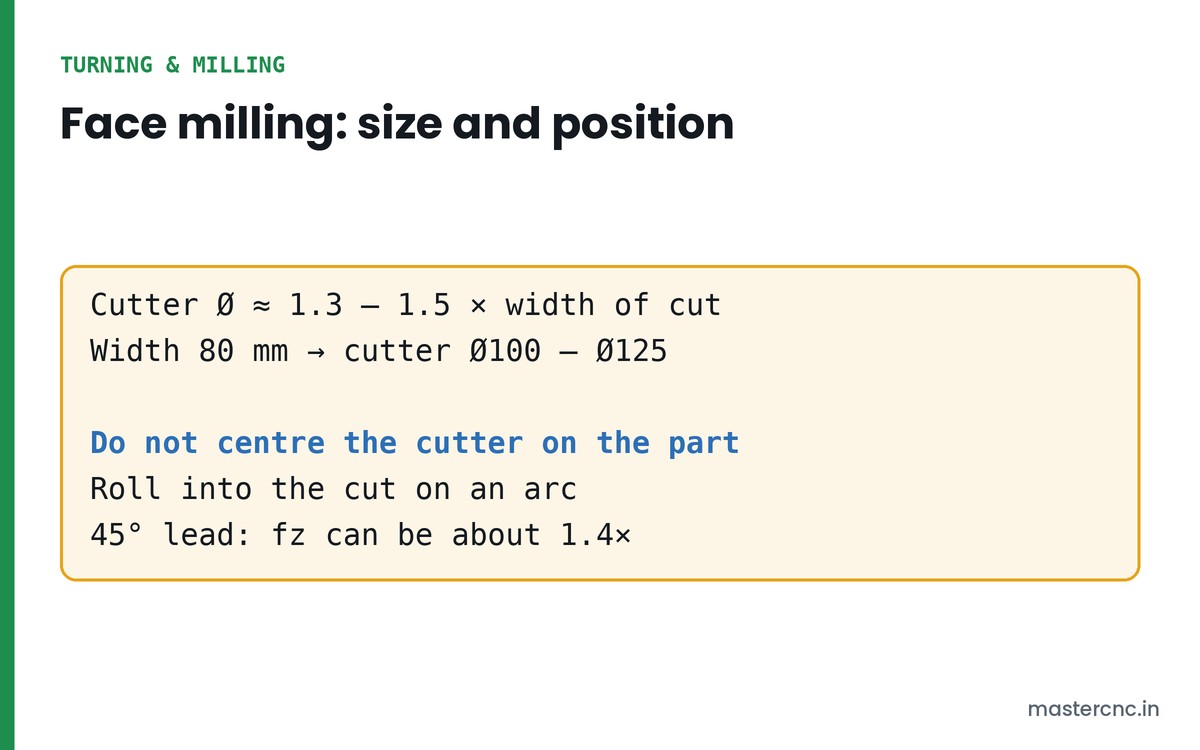
Face milling: cutter size, engagement and entry
How to choose a face mill diameter for the width of cut, where to position it, why rolling into the cut is kinder to inserts, and how the lead angle changes the feed per tooth.
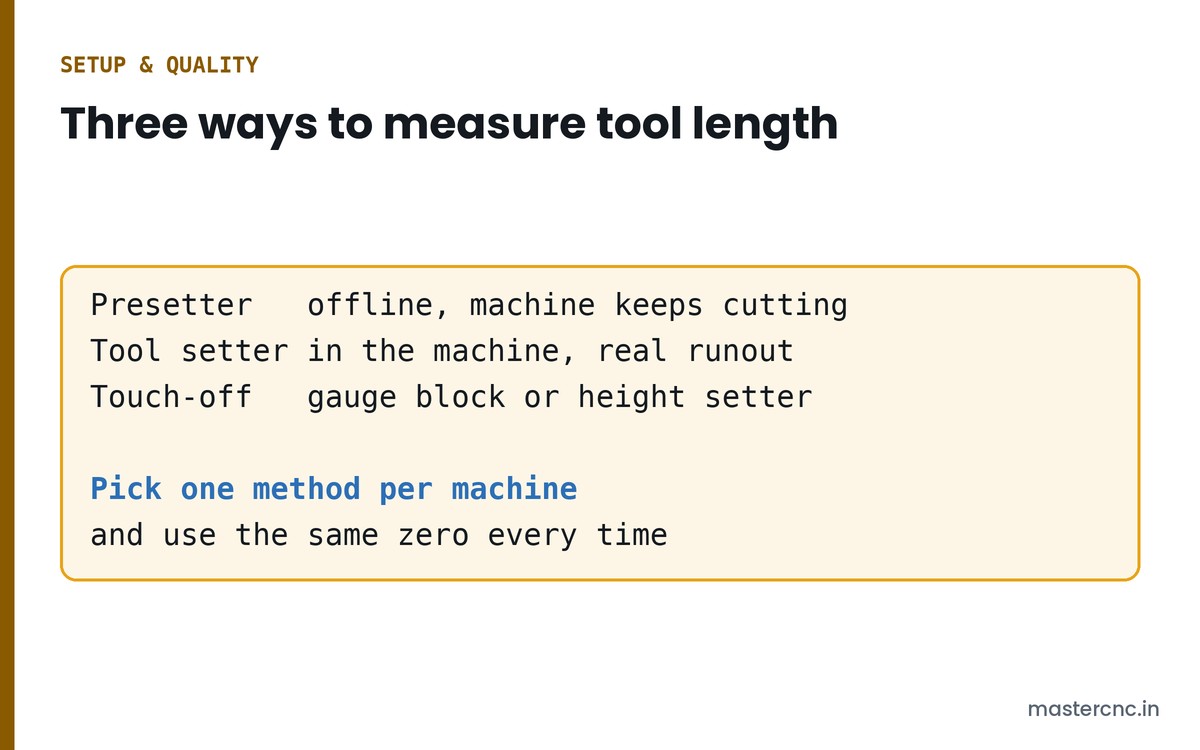
Measuring tool length: presetter vs machine setter
The three ways to measure tool length on a machining centre: offline presetter, contact or laser tool setter in the machine, and manual touch-off, with the pros and cons of each.
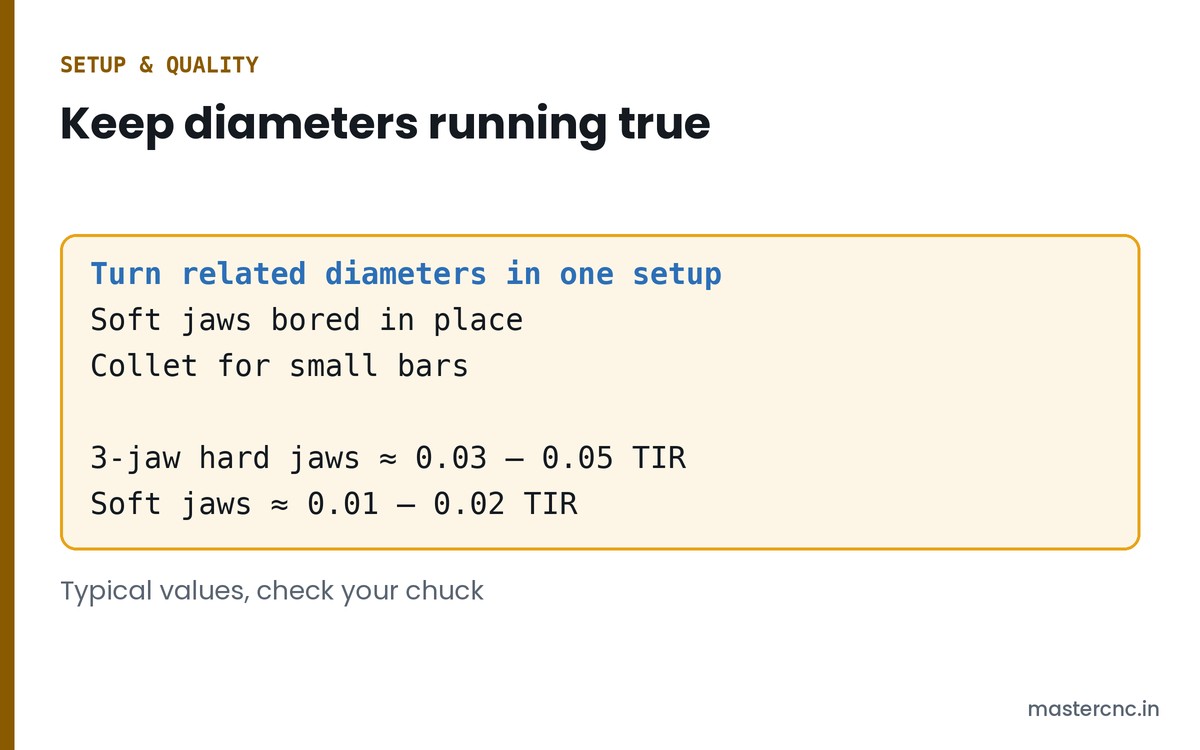
Runout and concentricity on turned parts
What circular runout, total runout and concentricity mean, how to measure runout with a dial indicator, and how to keep diameters running true across two operations on a lathe.
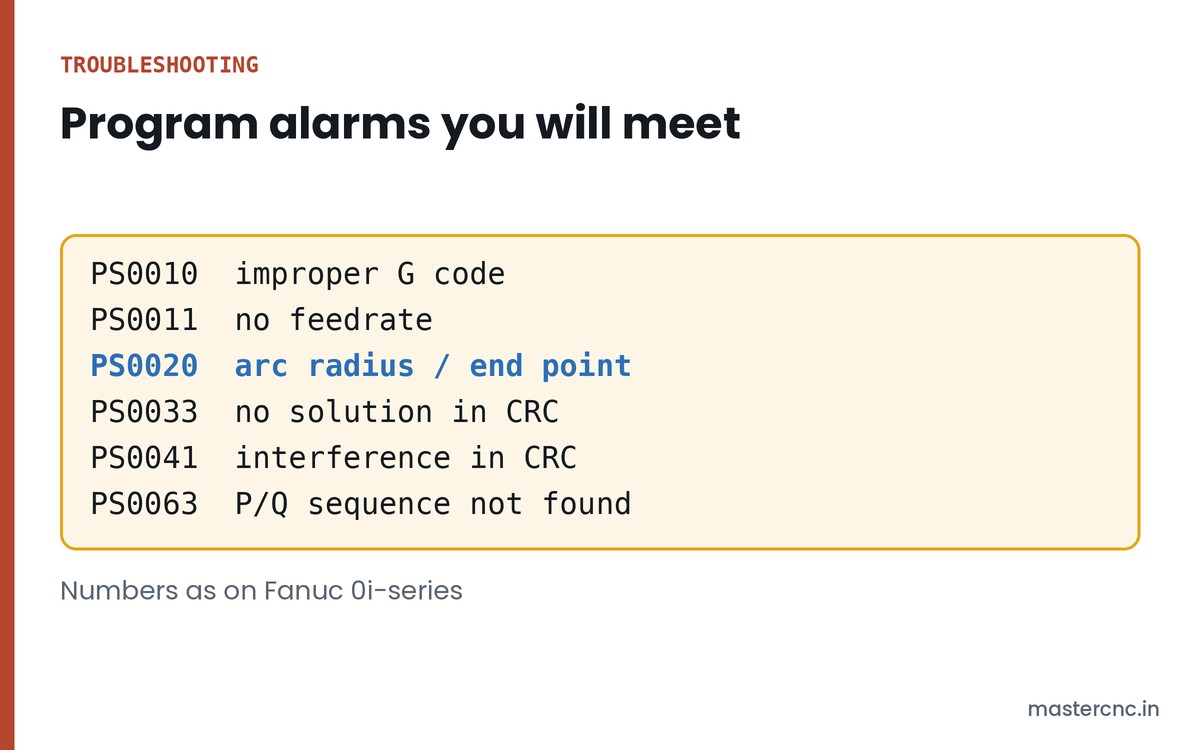
Common Fanuc program alarms and what they mean
The Fanuc program (PS) alarms operators see most: missing feed, improper G code, radius error, decimal point and offset alarms, cutter compensation and G71 cycle alarms, with what to check.
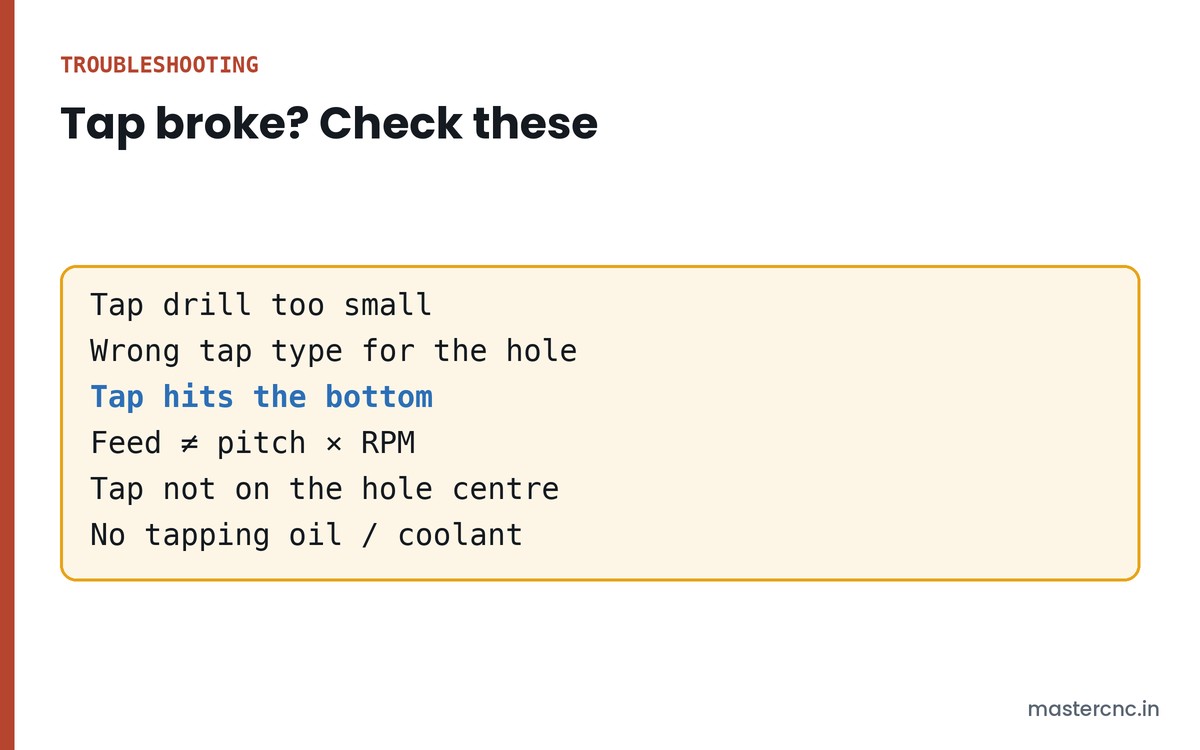
Why taps break: causes and fixes
The usual reasons taps break on CNC machines: wrong tap drill, chips in blind holes, wrong tap type, bottoming out, misalignment, wrong feed in rigid tapping and lack of lubrication.
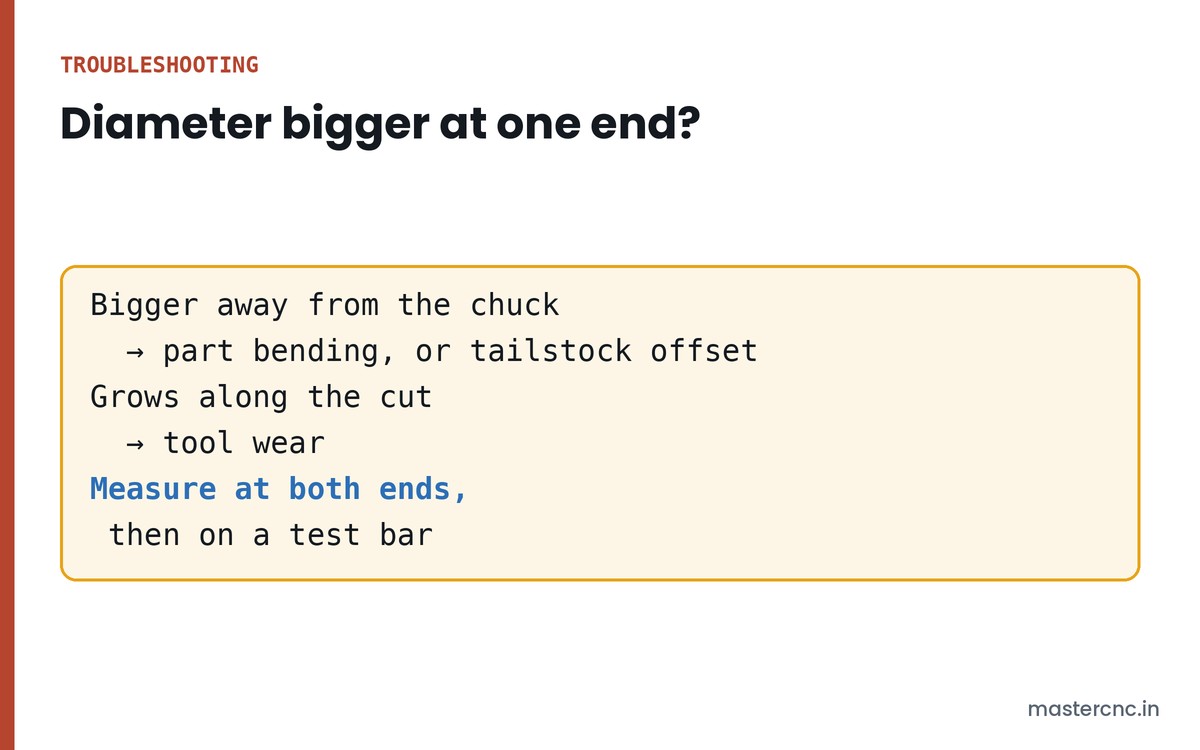
Taper on a turned part: causes
Why a turned diameter comes out bigger at one end: part deflection, tool wear along the cut, tailstock offset, machine alignment and heat, and how to tell which one you have.
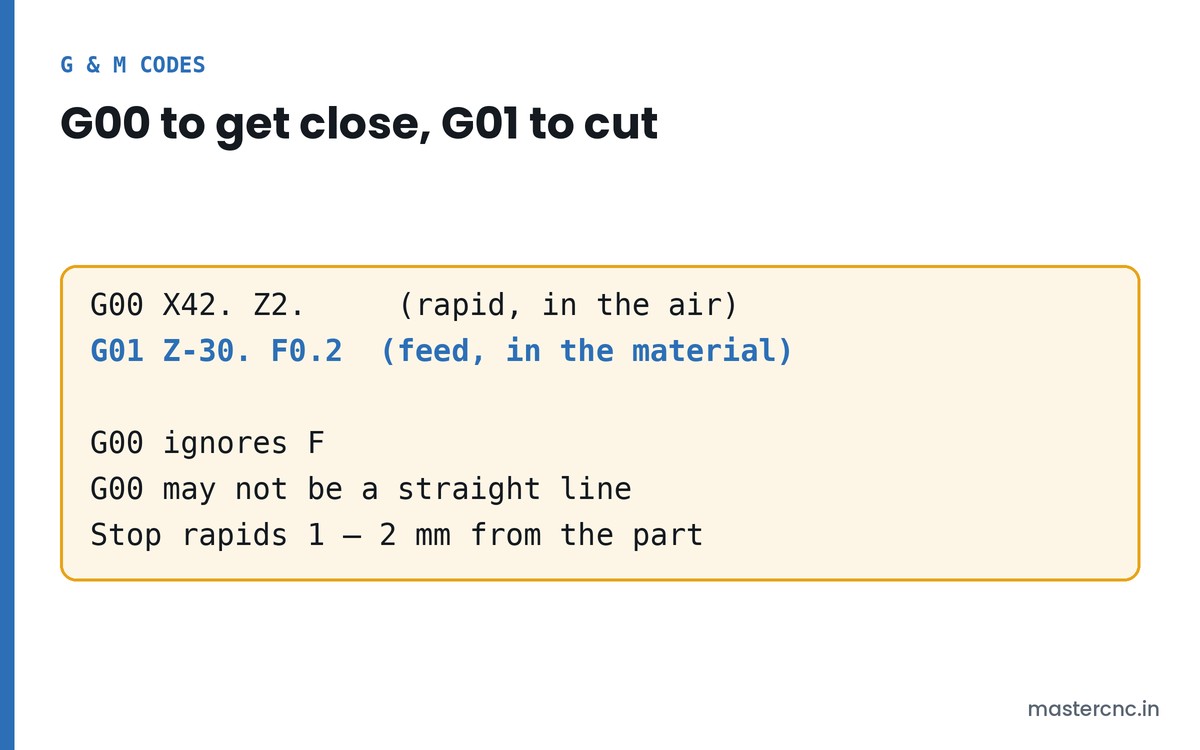
G00 vs G01: rapid and feed moves
The difference between G00 rapid positioning and G01 linear interpolation, why a rapid move may not be a straight line, safe approach distances and the habits that prevent crashes.
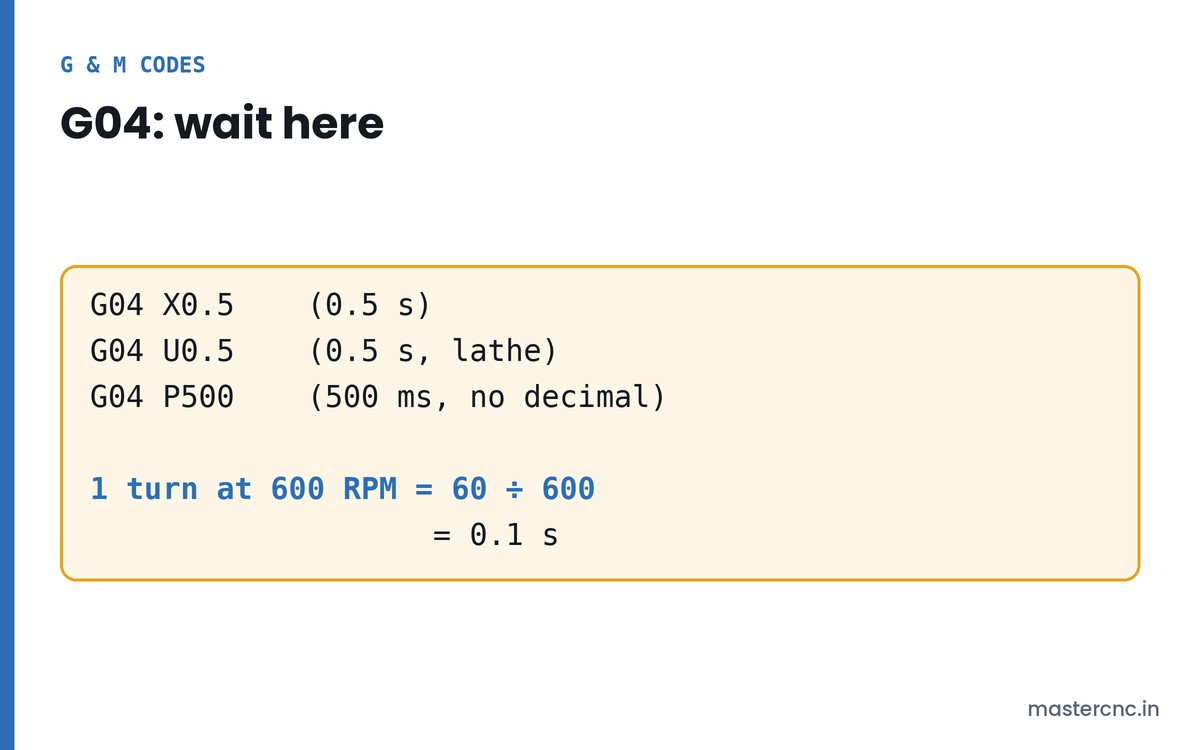
G04 dwell: seconds or revolutions
How to program a dwell with G04 on Fanuc lathes and mills (X, U and P), how long to dwell at the bottom of a groove or spot face, and the units mistake that makes a 1-second dwell last 1000 seconds.
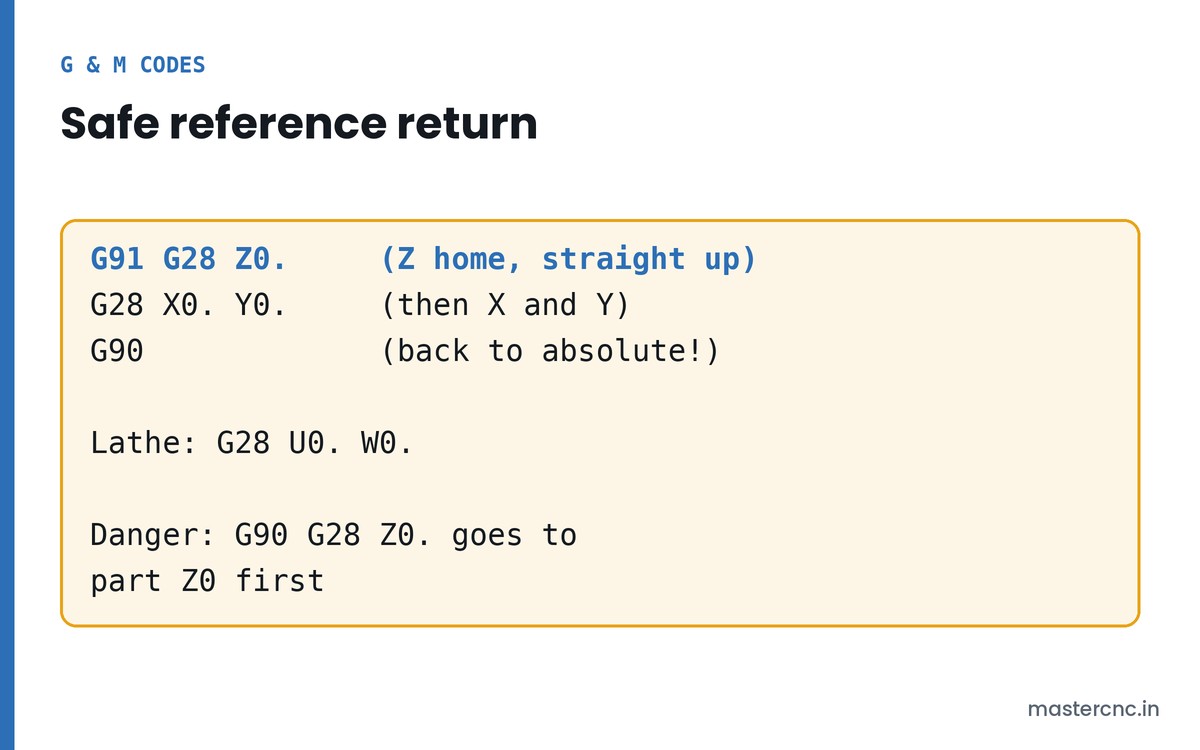
G28 and G30: returning to reference safely
How G28 and G30 work through an intermediate point, why G91 G28 Z0 is the safe form, the G90 trap that drives the tool into the part, and G53 as an alternative.
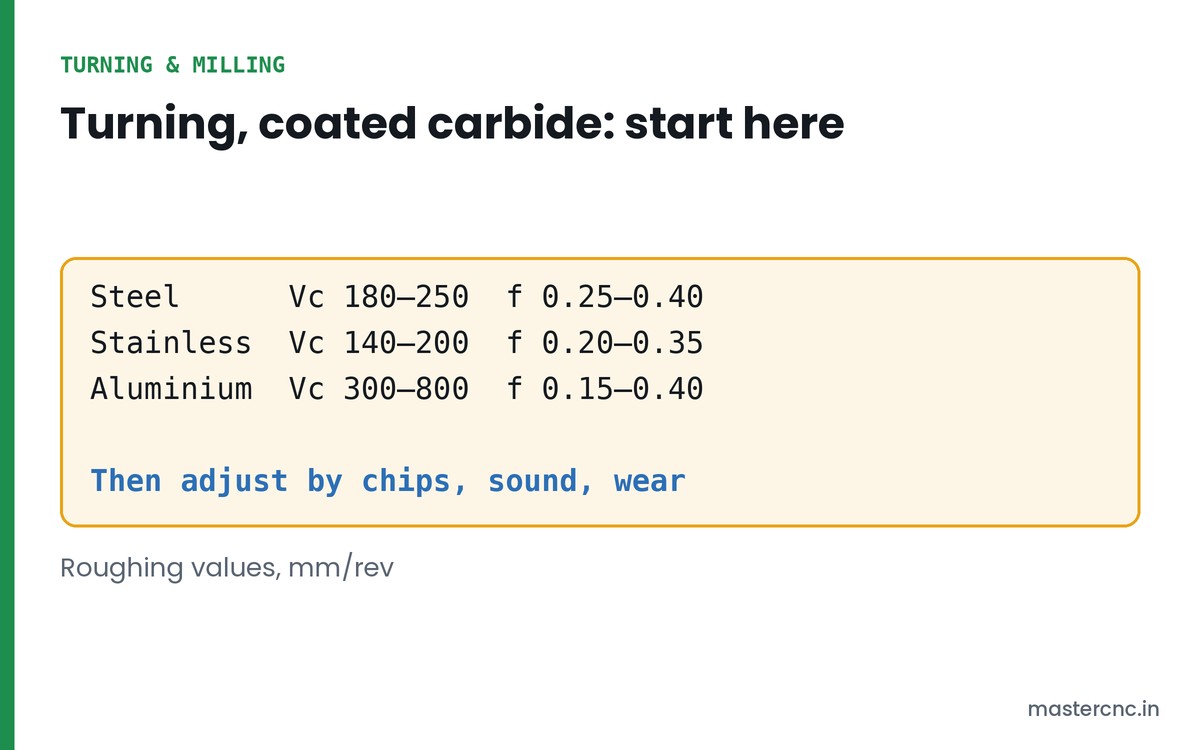
Starting cutting data: steel, stainless and aluminium
Starting cutting speeds, feeds and depths for turning, milling and drilling in steel, stainless steel and aluminium with carbide tools, and how to adjust from there.
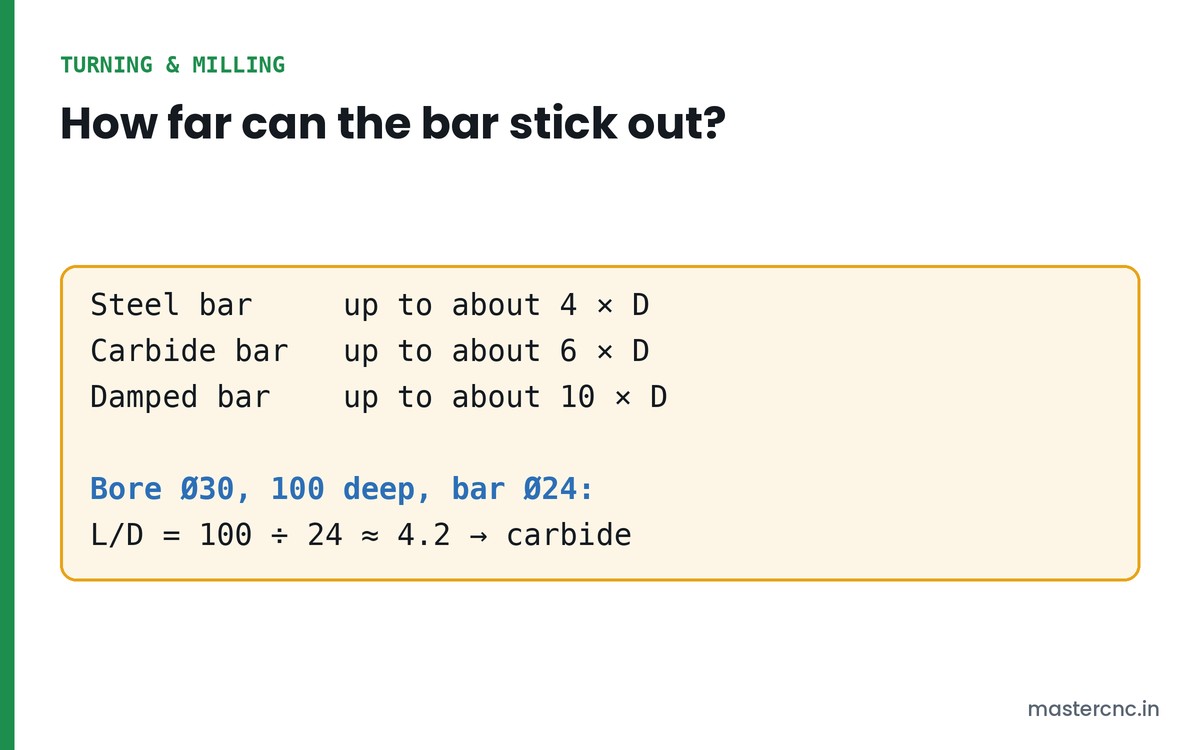
Boring bars: overhang ratio and avoiding chatter
How far a boring bar can stick out: steel, carbide and damped bar limits as a ratio of bar diameter, how to pick the bar size, and the insert and setup choices that stop chatter in deep bores.
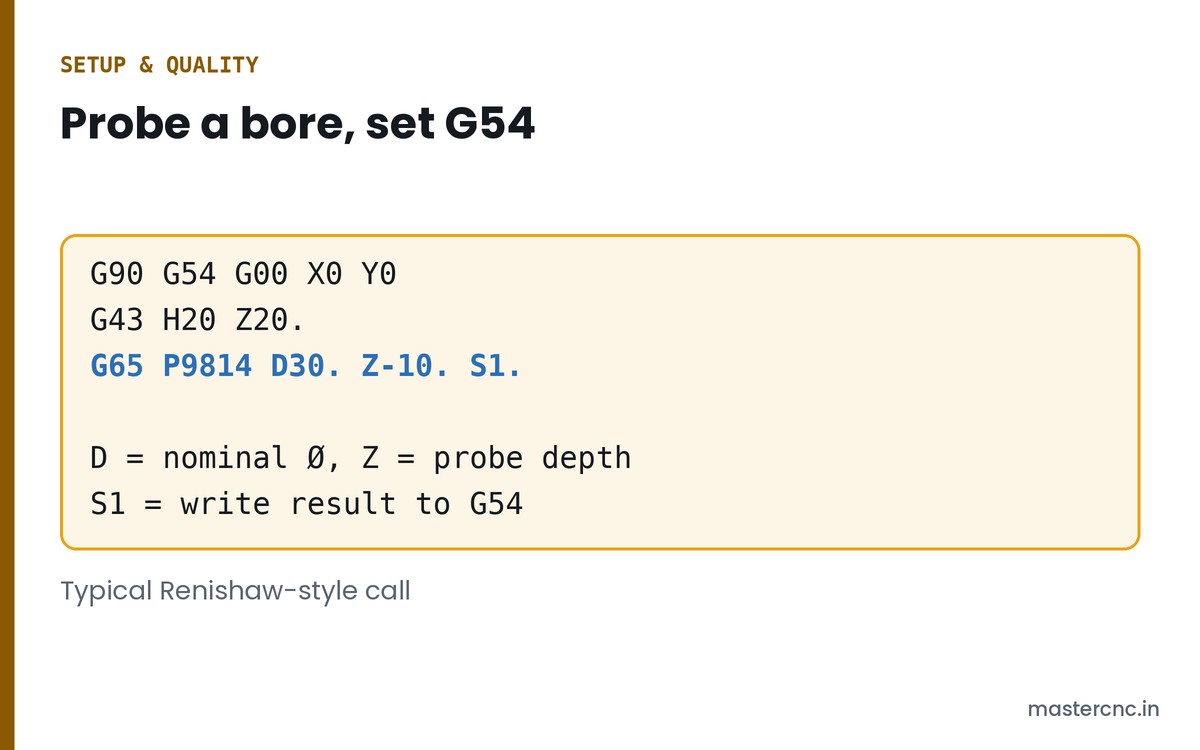
Finding a bore centre with a touch probe on a VMC
How a spindle touch probe finds the centre of a bore or boss and sets G54 automatically, with a typical probing macro call, plus the manual method with a dial test indicator.
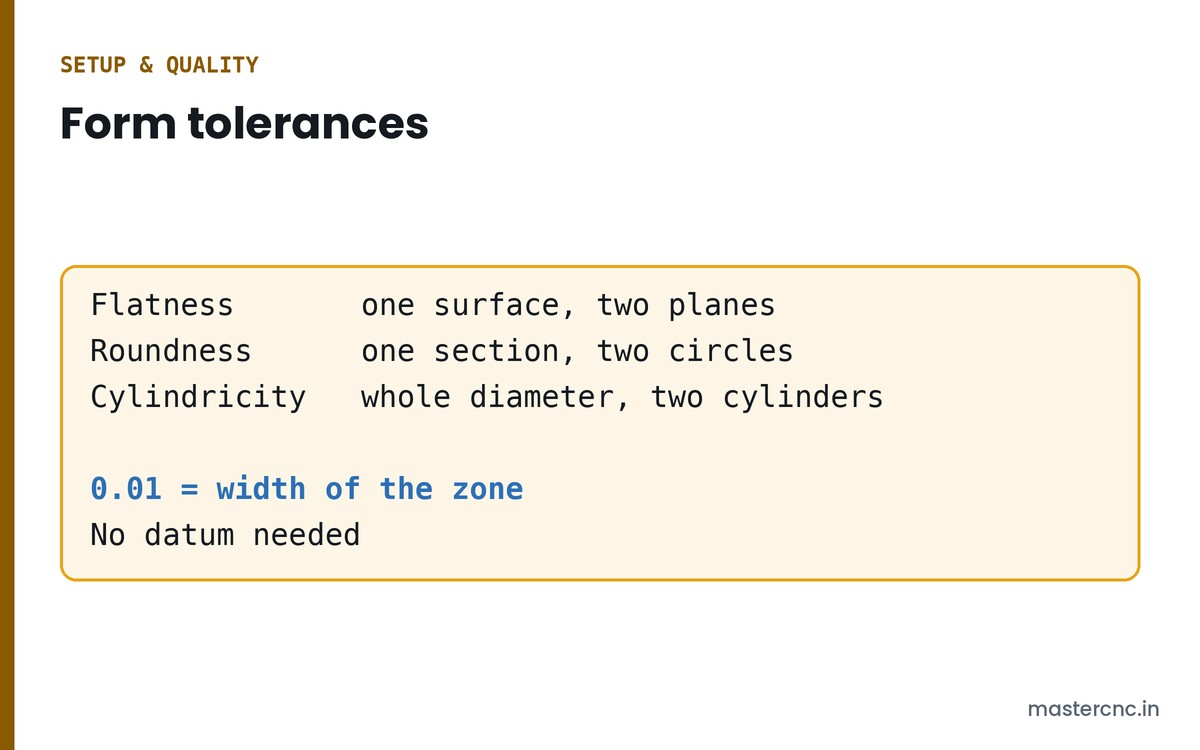
GD&T basics: flatness, roundness, cylindricity
What flatness, roundness (circularity) and cylindricity tolerances mean on a drawing, how to check them in the shop, and the machining causes when a part is out of form.
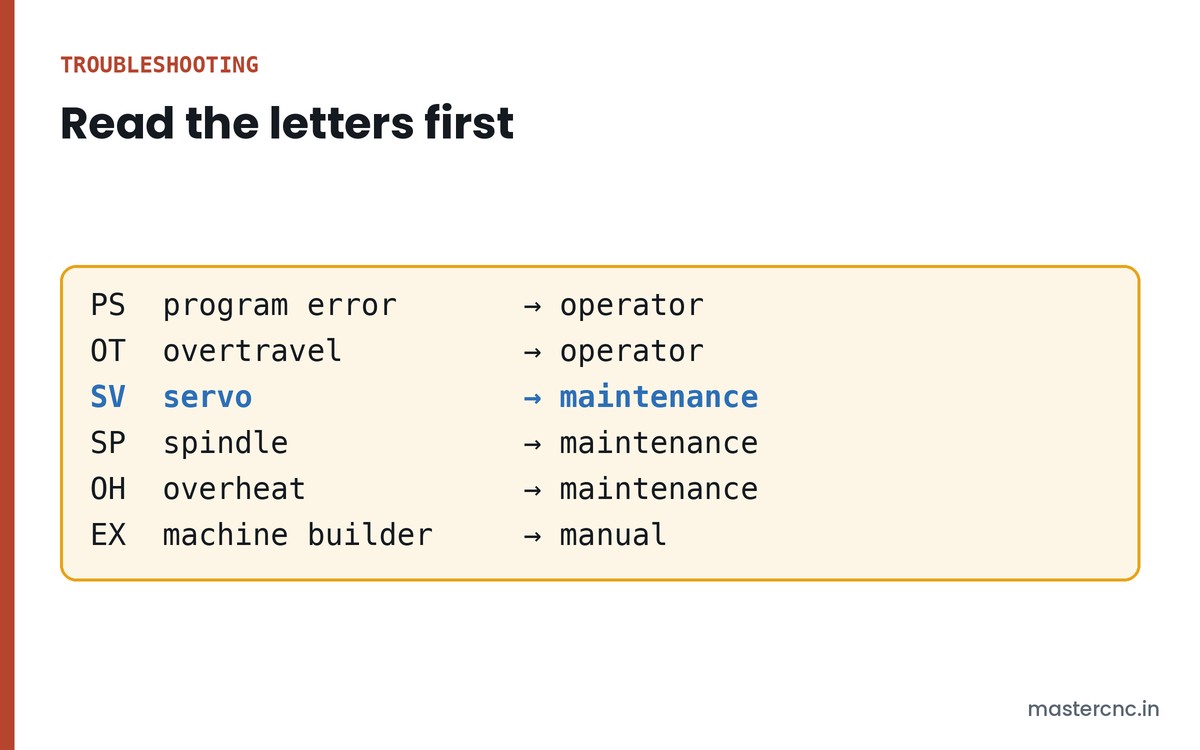
Fanuc alarm types: what PS, SV, OT, SP and OH mean
How Fanuc groups its alarms by letter: program (PS), servo (SV), overtravel (OT), spindle (SP), overheat (OH) and others, what each group usually means, and who should fix it.
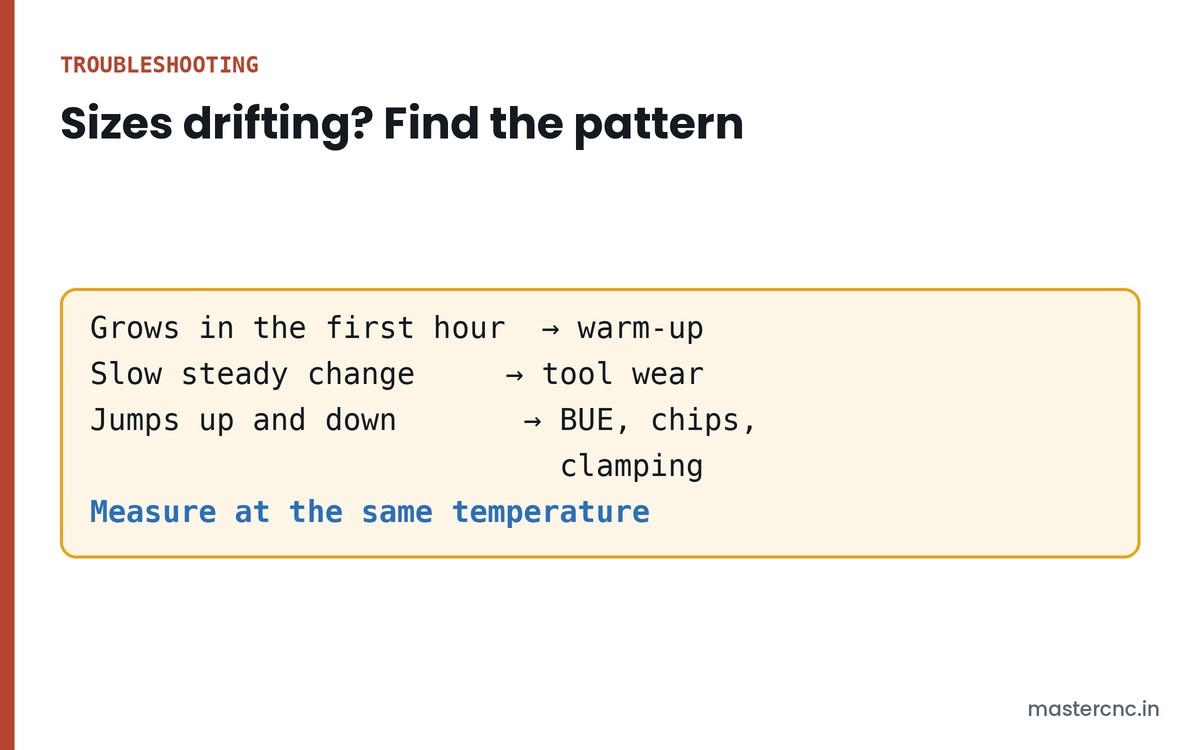
Part size changing during a batch
Why diameters and lengths drift during a production run: machine warm-up, tool wear, part and coolant temperature, built-up edge and workholding, and how to keep sizes stable.
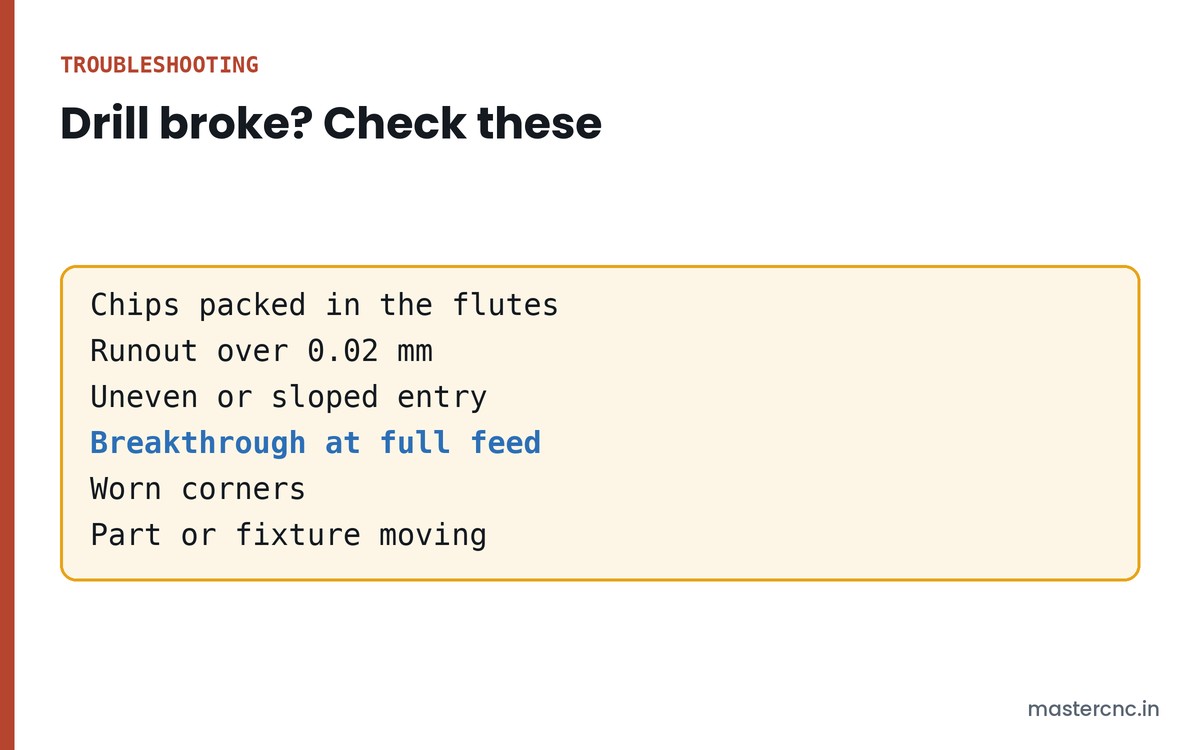
Why drills break: causes and fixes
Common reasons twist drills break on CNC machines: chip packing, wrong feed and speed, runout, uneven entry, breakthrough, worn drills and weak workholding, with a fix for each.
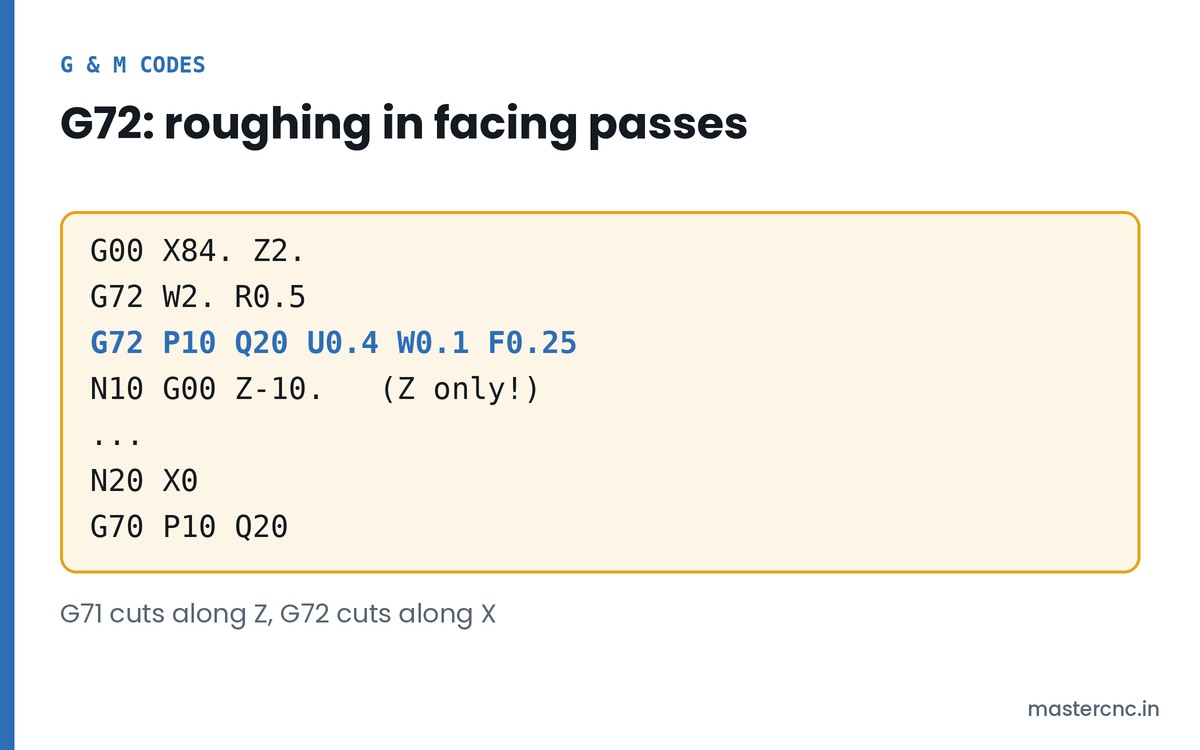
Fanuc G72 facing cycle vs G71
How the Fanuc G72 rough facing cycle works, when to use it instead of G71, the rule for the first profile block, and a full program for a stepped face finished with G70.
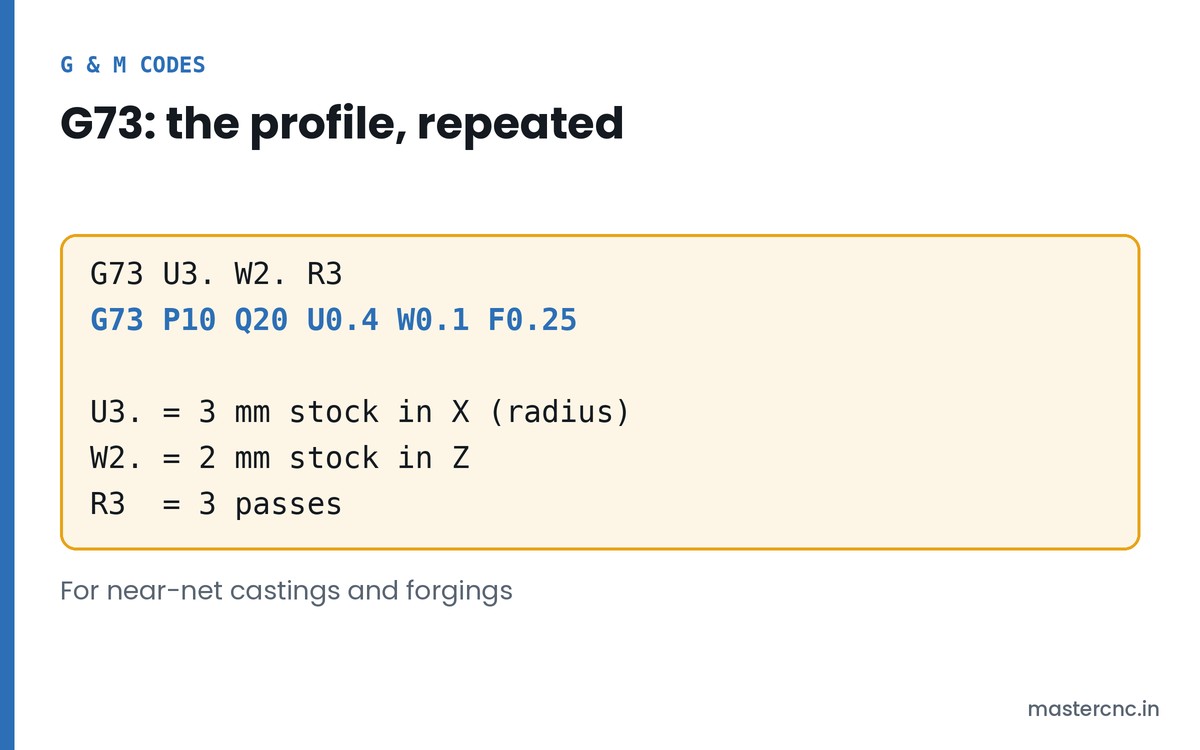
Fanuc G73 pattern repeat cycle for castings and forgings
How the Fanuc lathe G73 pattern repeating cycle copies the finished profile in steps, when it beats G71 on castings and forgings, and how to set U, W and R.
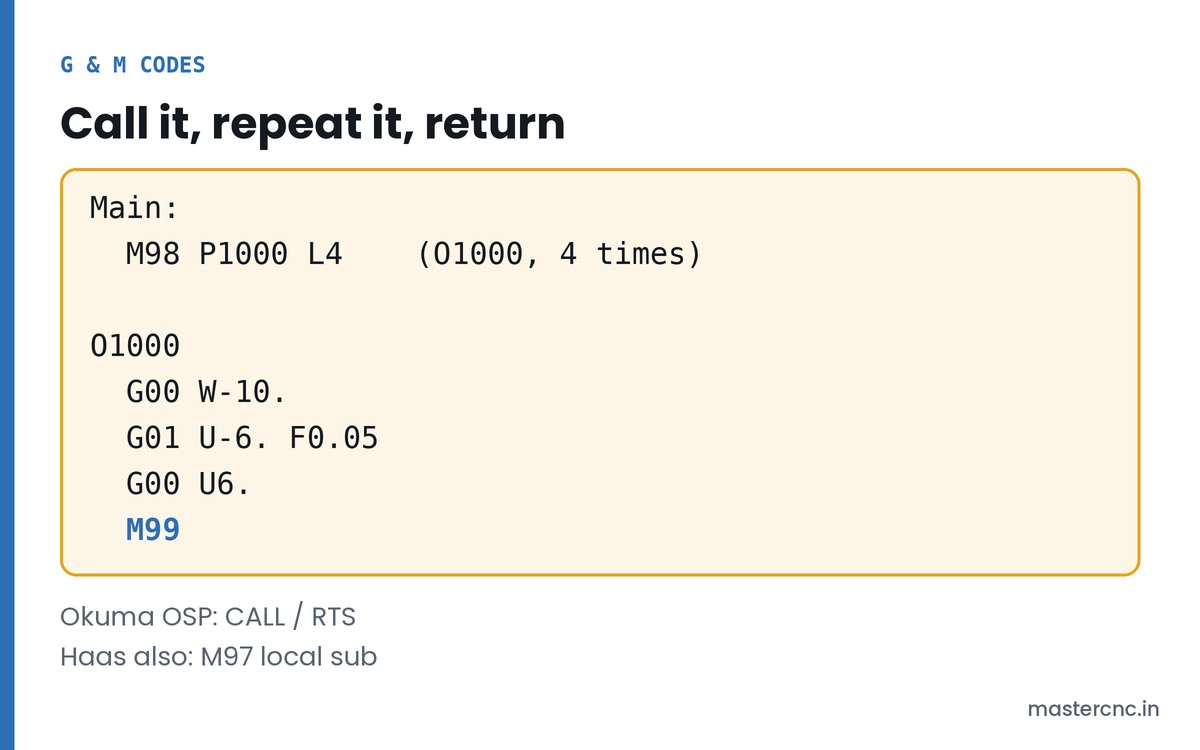
Subprograms with M98 and M99
How to call a subprogram on Fanuc with M98 and return with M99, repeating it a number of times, a practical example with incremental grooves, and the Okuma OSP and Haas equivalents.
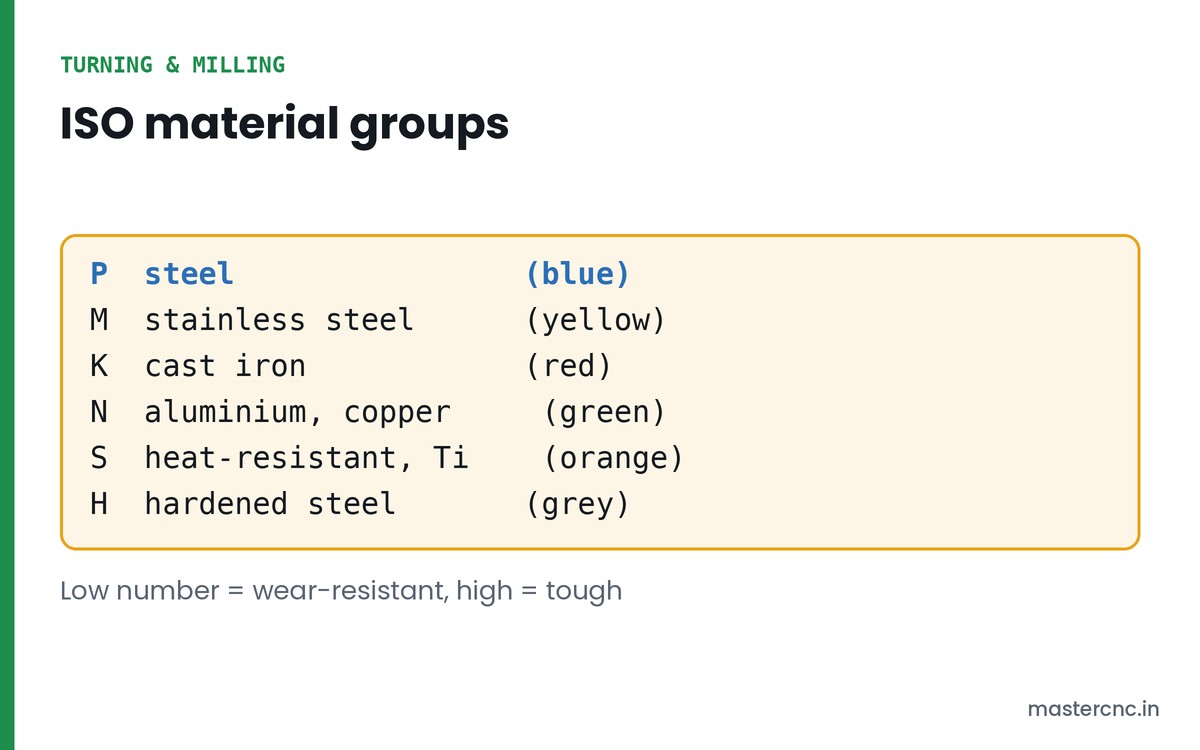
Insert grades: ISO P, M, K, N, S, H material groups
What the ISO material groups P, M, K, N, S and H mean, the colour codes, what grade numbers like P25 tell you, and CVD vs PVD coatings, so you can pick the right insert grade.
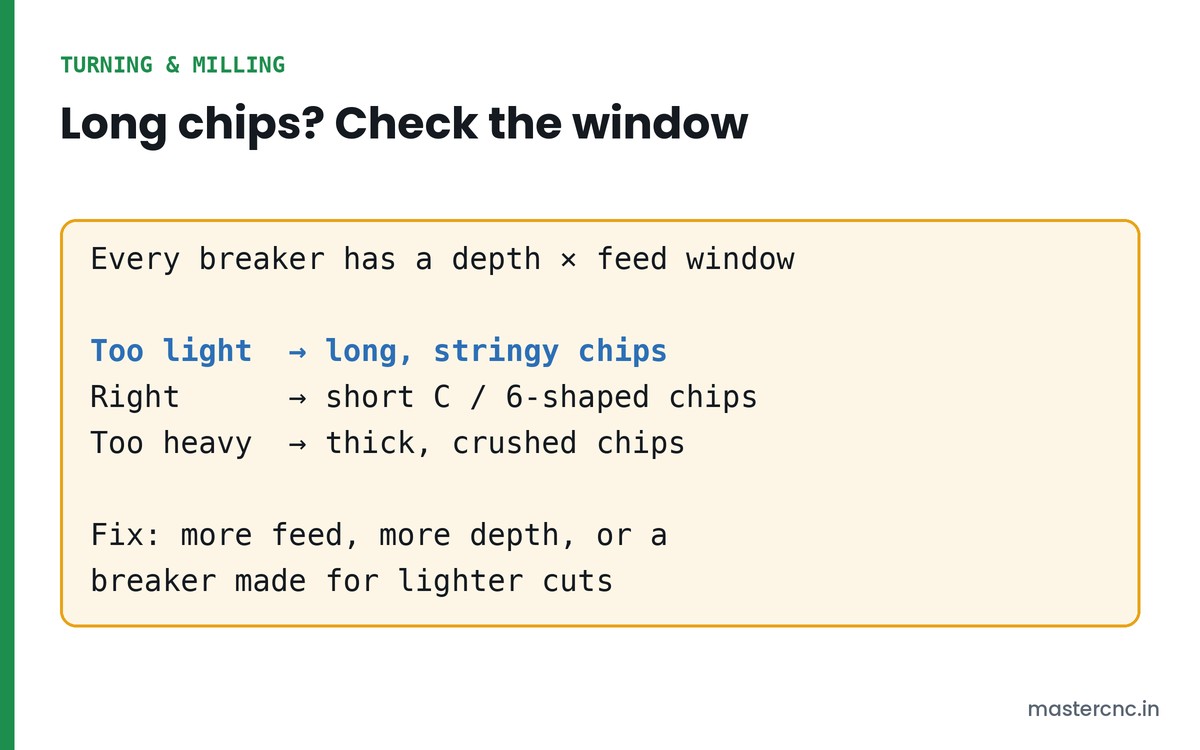
Chipbreakers: why chips wrap and how to fix it
How a chipbreaker works, what good and bad chips look like, the depth and feed window of each breaker, and what to change when chips come out long and wrap around the part.
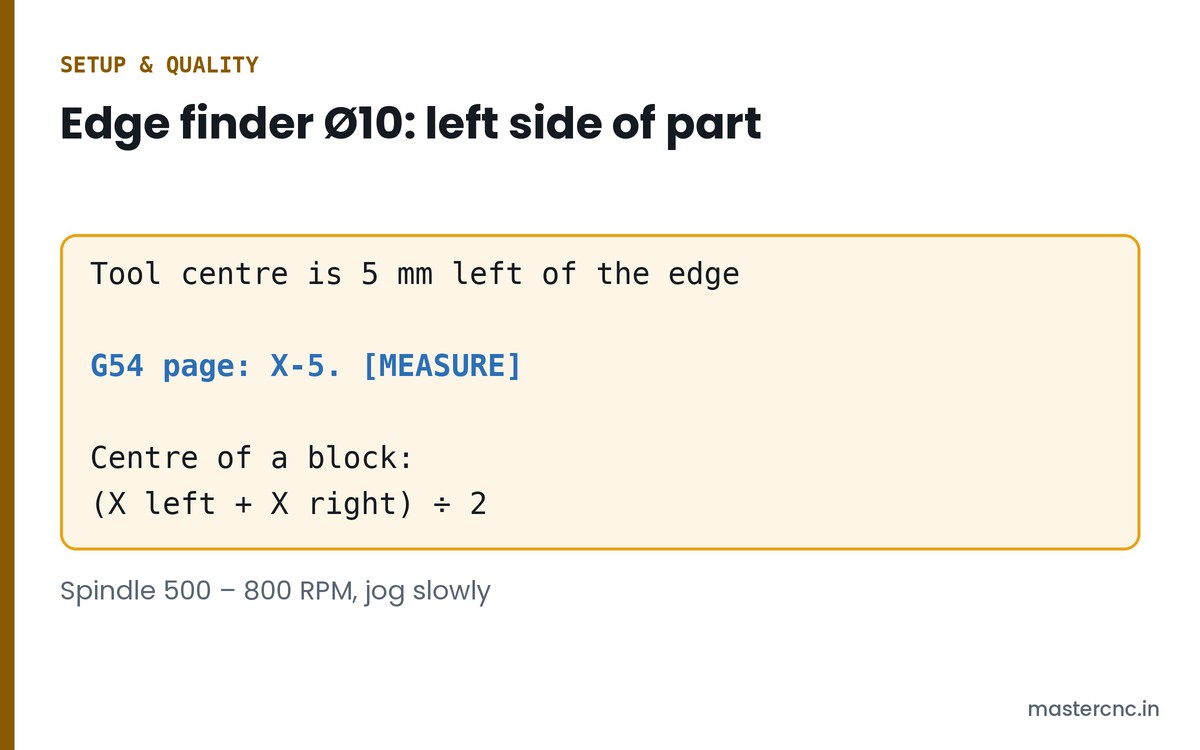
Setting a work offset on a VMC with an edge finder
Step by step: find X and Y with a mechanical edge finder, enter the value on the G54 page with the right sign, find the centre of a part, and set Z.
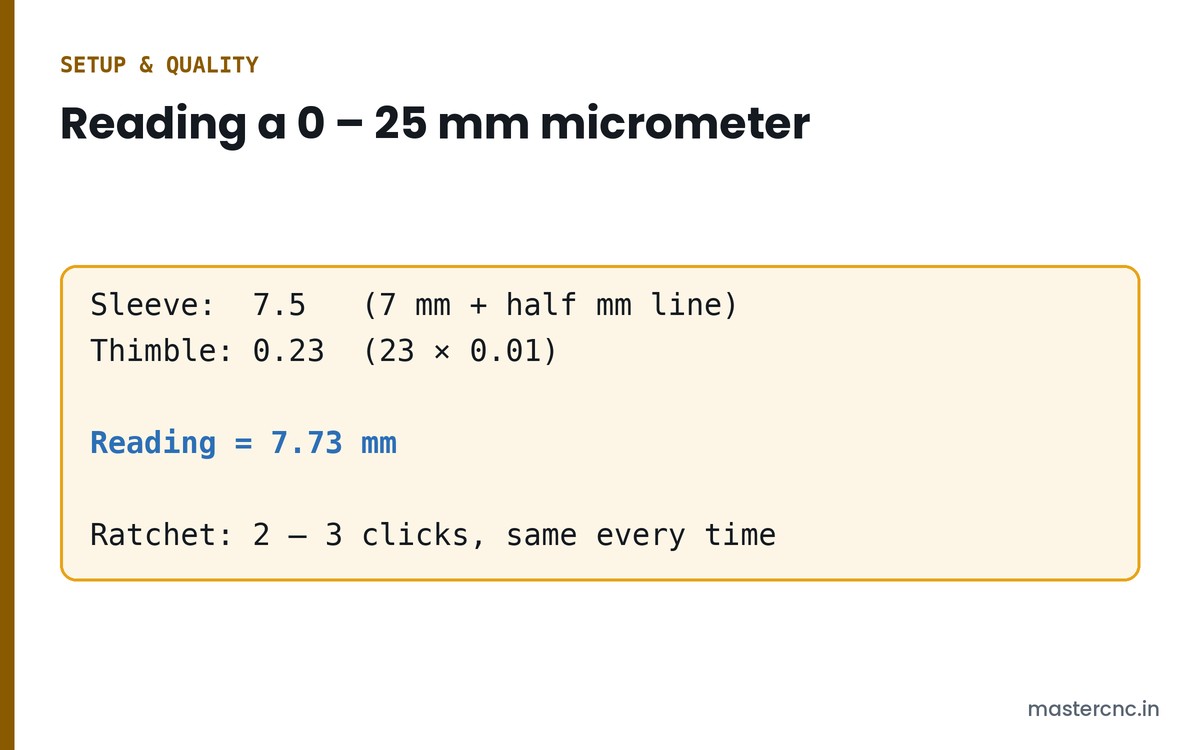
How to use a micrometer correctly
How to read a 0.01 mm outside micrometer, check zero, use the ratchet, measure round parts in two directions, and avoid the mistakes that cost several microns.
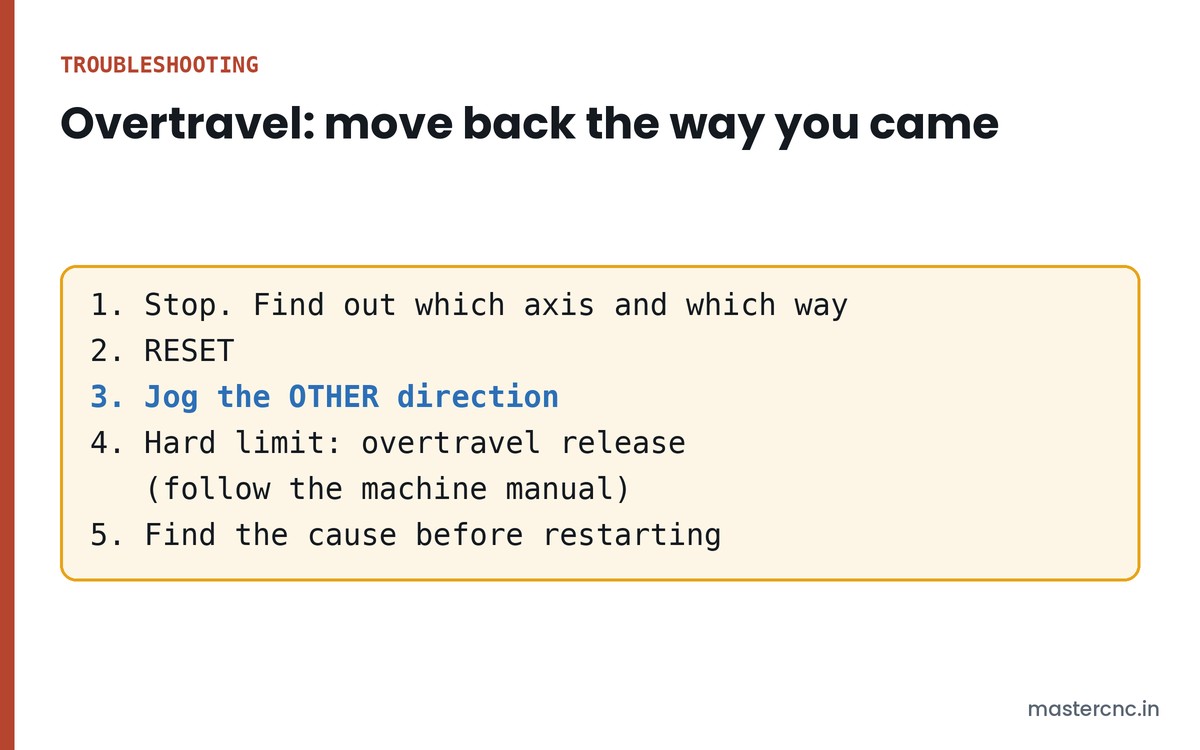
Overtravel alarm: how to recover safely
What a CNC overtravel alarm means, soft limits vs hard limit switches, how to move the axis back out safely, and the program and offset mistakes that cause overtravel.
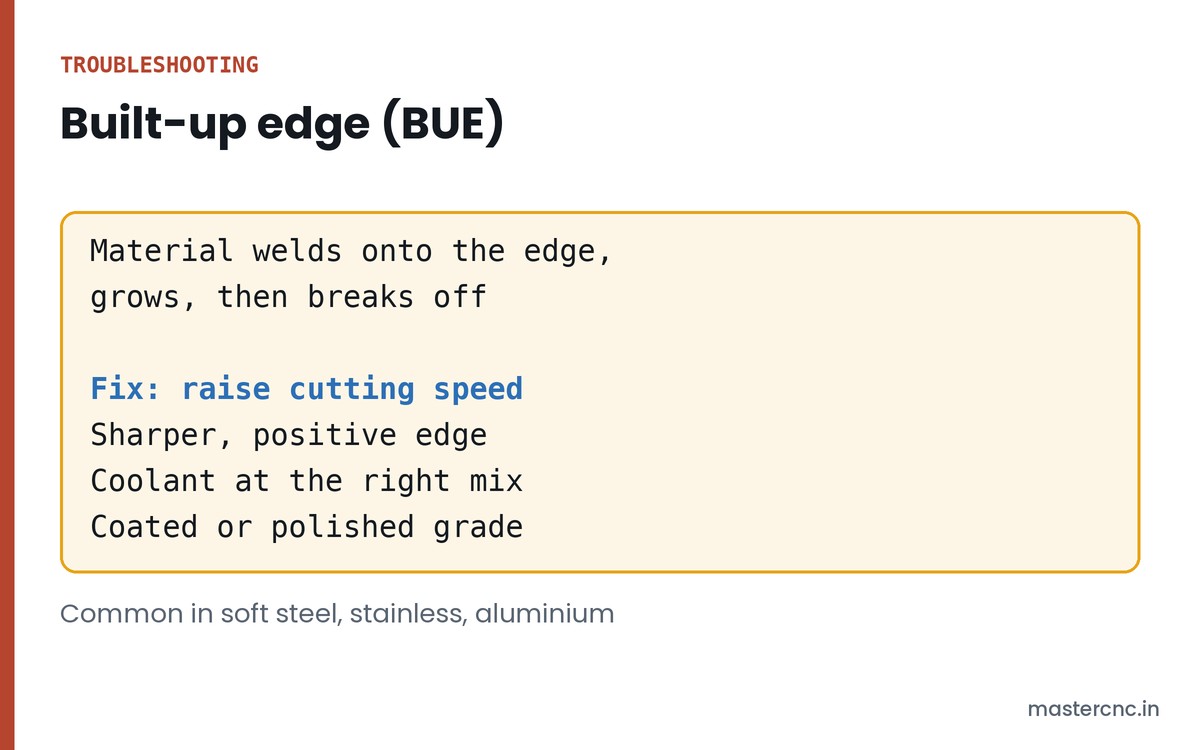
Built-up edge: what it is and how to stop it
What built-up edge (BUE) is, how to spot it on the insert and the part, which materials and cutting speeds cause it, and the changes that stop it.
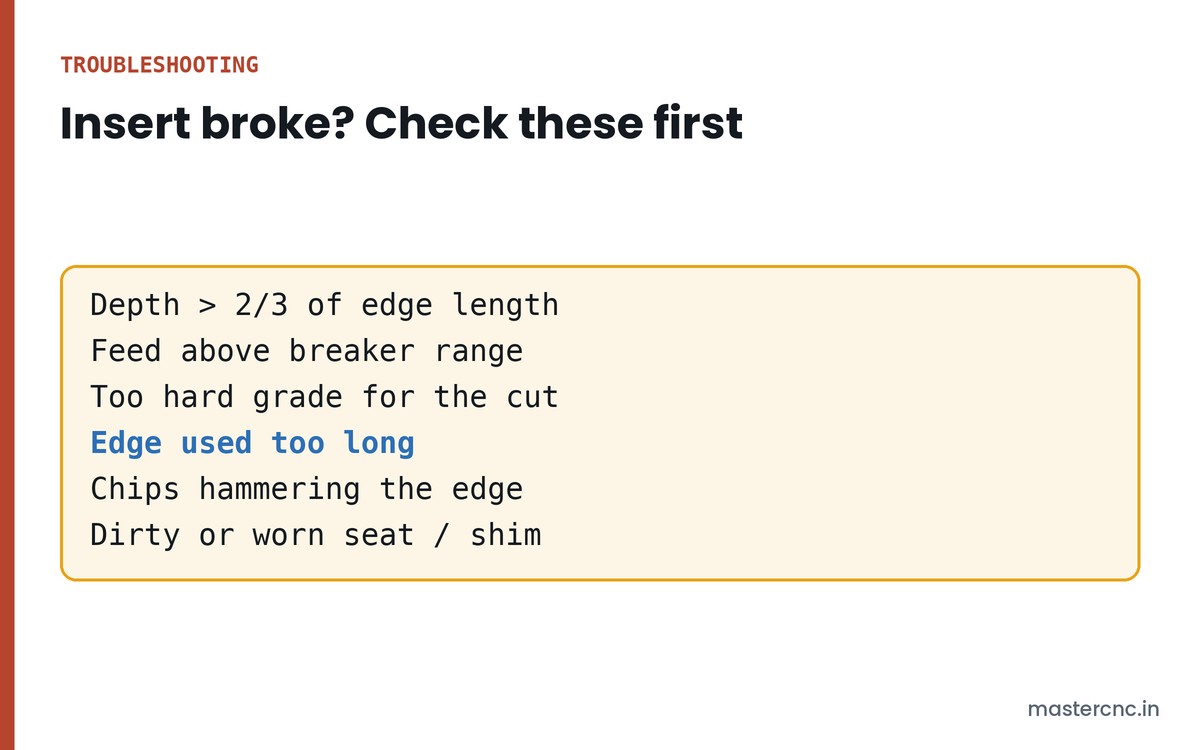
Why inserts break: common causes
The usual reasons turning inserts chip and break: depth of cut too big for the edge, feed too high, wrong grade, chip hammering, interrupted cuts, bad seating and worn edges, with a fix for each.
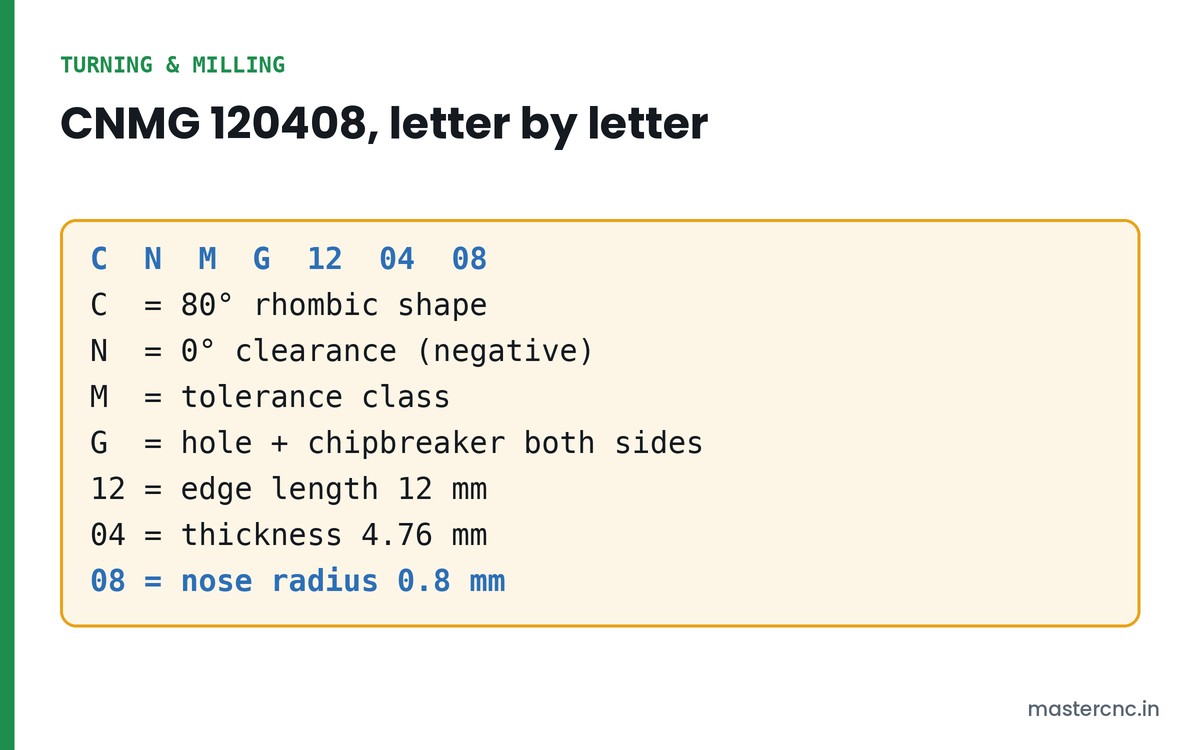
Insert codes explained: what CNMG 120408 means
How to read an ISO turning insert code letter by letter: shape, clearance angle, tolerance, hole and chipbreaker, size, thickness and nose radius, with common examples.
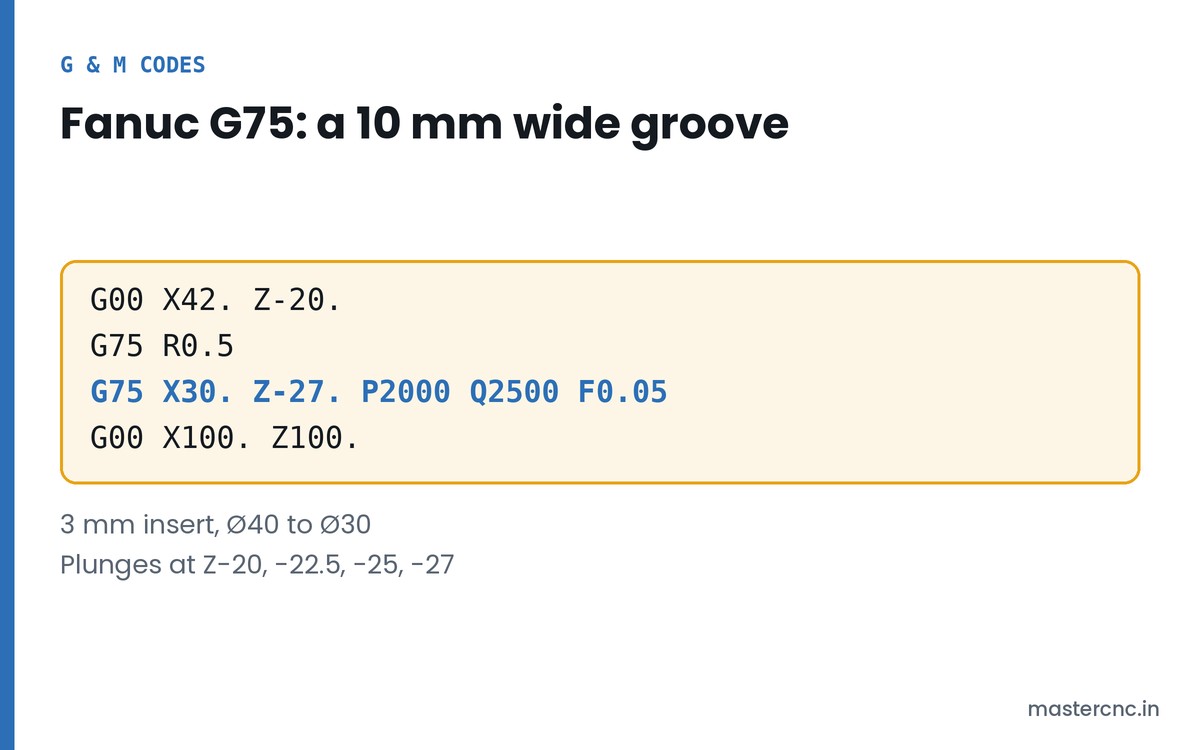
Fanuc G75 grooving cycle: OD grooves and part-off
How the two-block Fanuc G75 cycle works on a lathe: R, X, Z, P, Q and F explained, with programs for a single groove, a wide groove and a part-off.
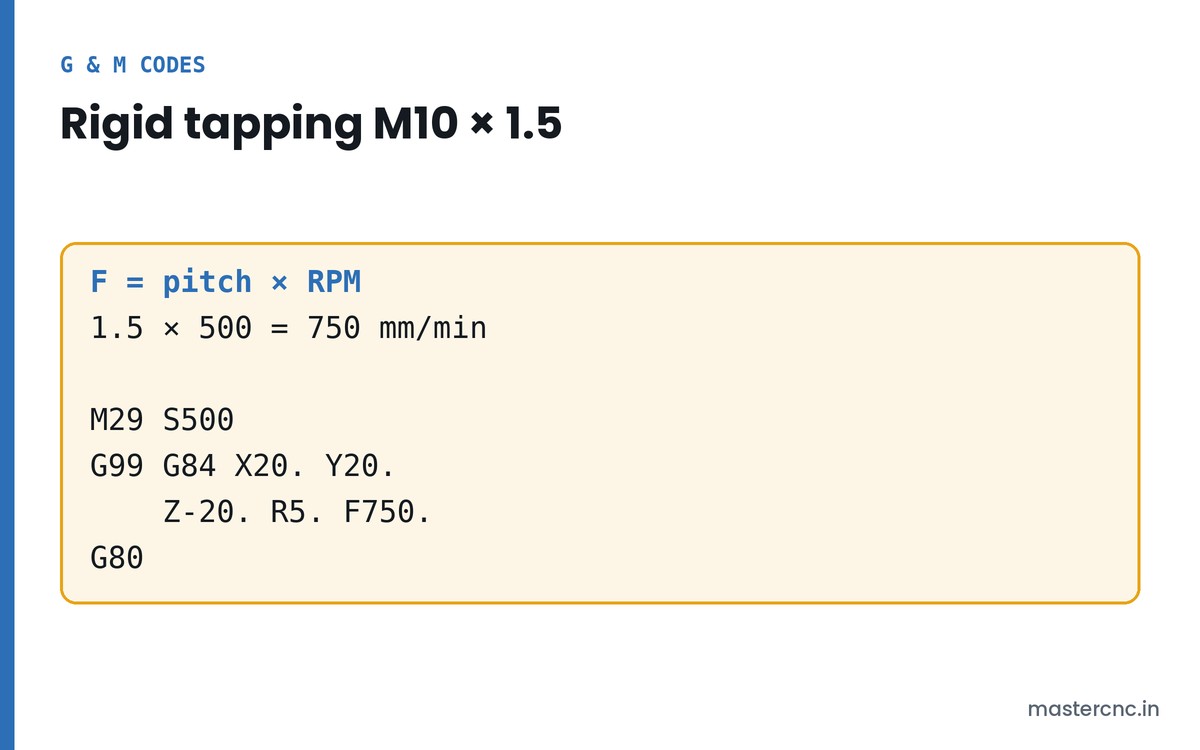
G84 rigid tapping: feed = pitch × RPM
How to program rigid tapping with G84 on a machining centre: M29, the feed formula, R and Z depth, G98 and G99, with a full M10 example and the mistakes that break taps.
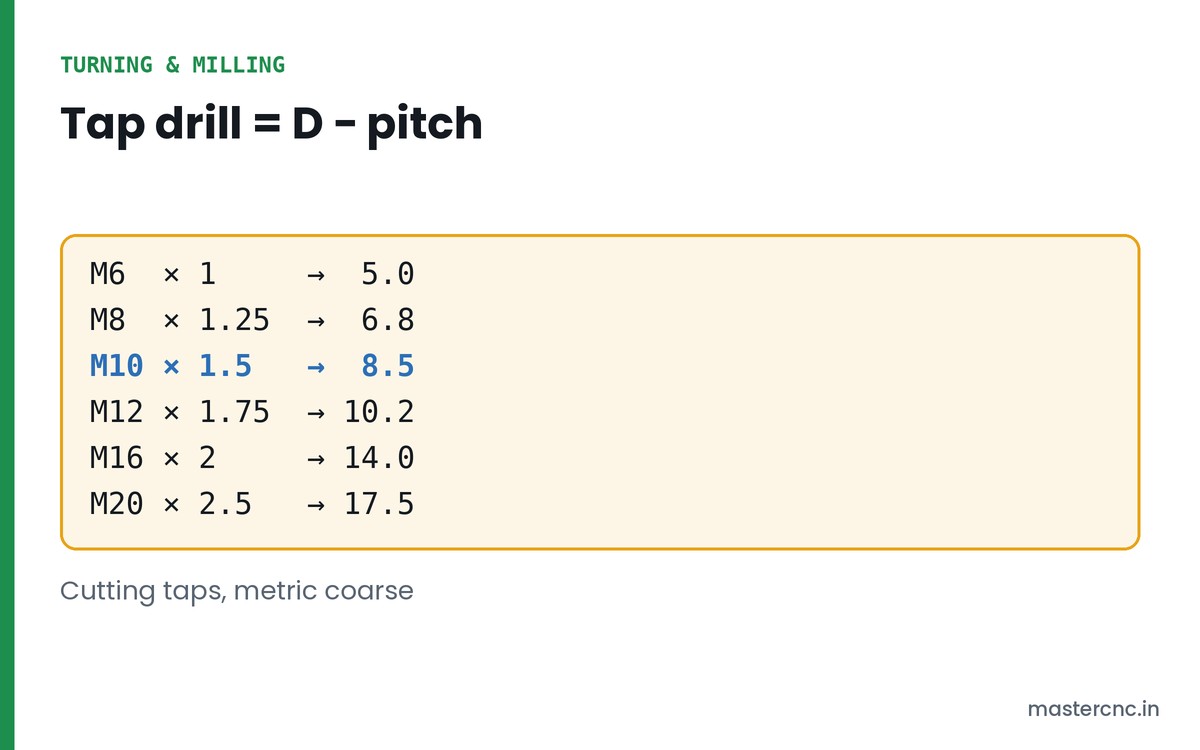
Tap drill sizes for metric threads (M3 to M24)
Tap drill sizes for metric coarse and common fine threads, the simple D minus P rule, drill sizes for form taps, and how deep to drill a blind hole.
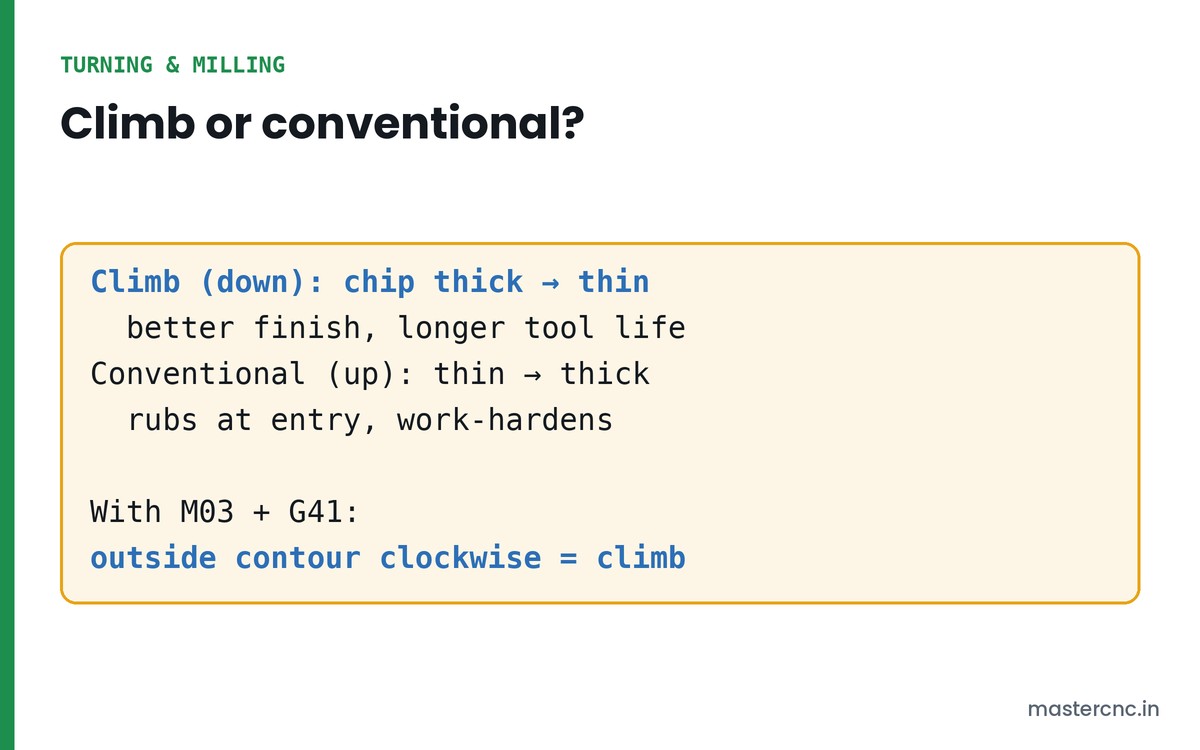
Climb milling vs conventional milling
The difference between climb (down) and conventional (up) milling, why CNC machines climb mill by default, when conventional is better, and how G41 and direction decide which one you get.
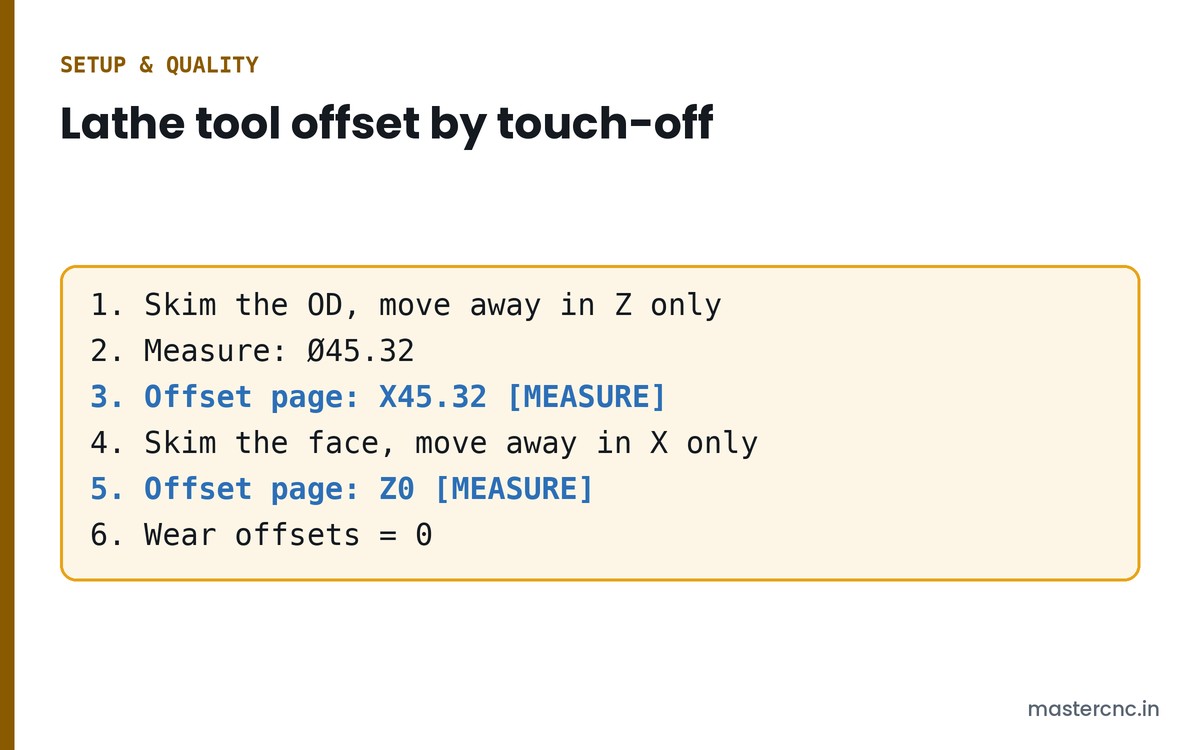
Setting tool offsets on a CNC lathe: the touch-off method
Step by step: how to set X and Z tool geometry offsets on a CNC lathe by cutting and measuring, the Fanuc MEASURE key, setting the work shift, and how to check it.
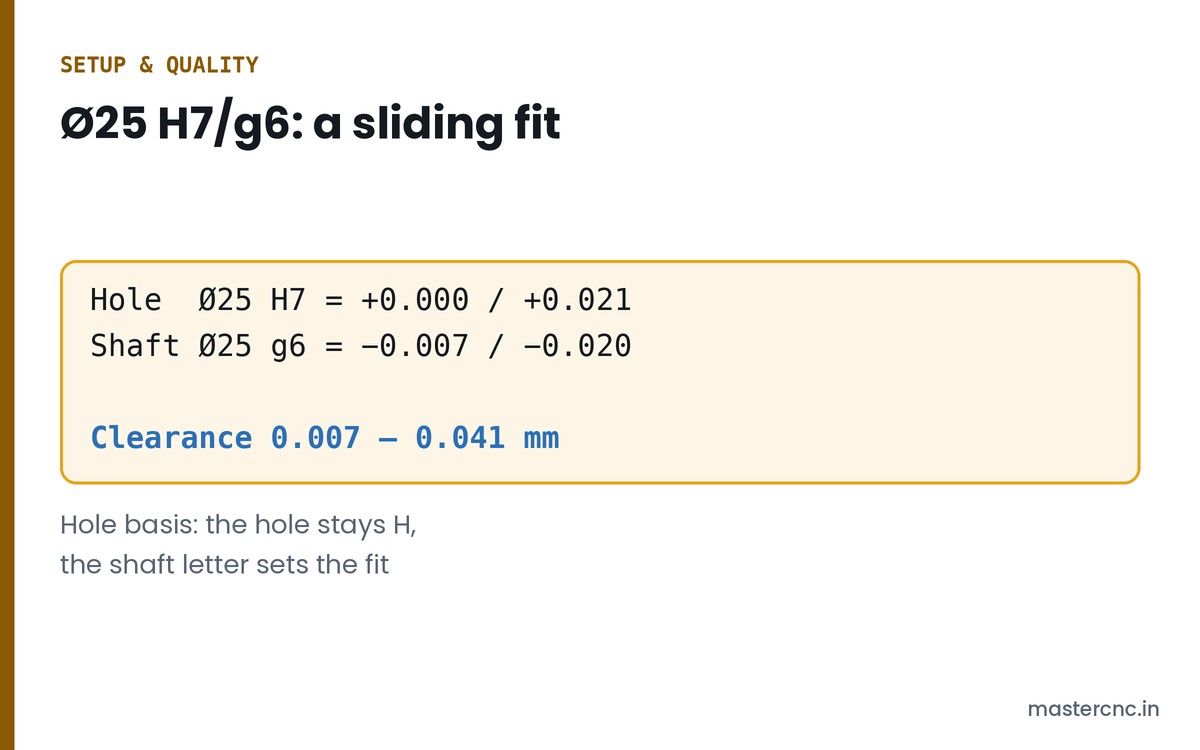
H7/g6 and other fits: ISO tolerances made simple
What H7, g6, k6 and p6 mean on a drawing, how hole-basis fits work, the limits for a 25 mm shaft and hole, and how to choose clearance, transition and press fits.
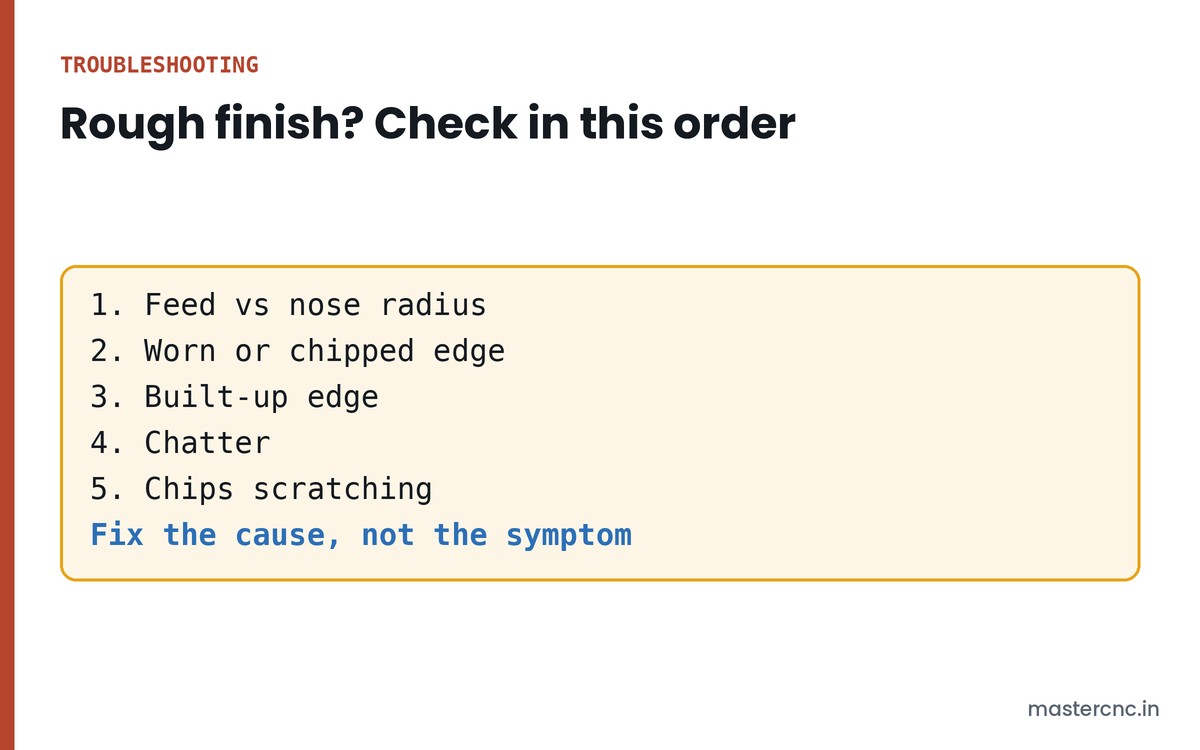
Poor surface finish: 10 causes and fixes
Ten common reasons a turned or milled surface comes out rough, from feed and nose radius to built-up edge, chatter and worn inserts, with the fix for each.
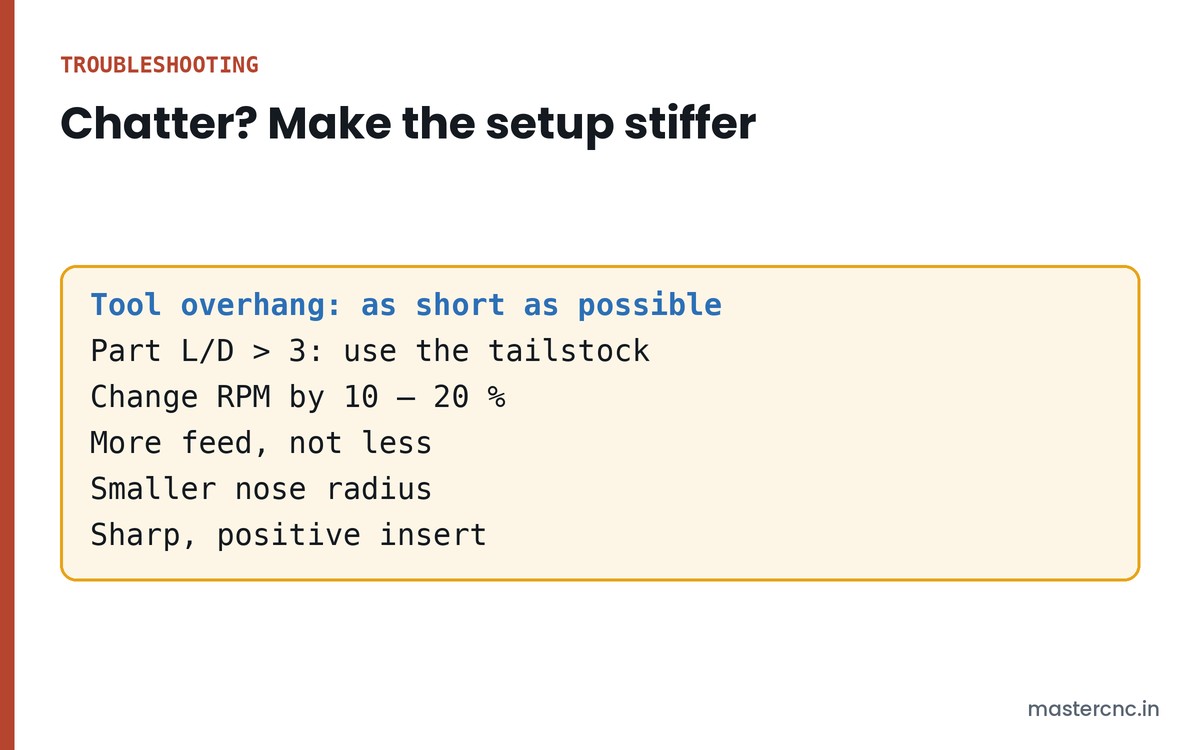
Chatter in turning: causes and fixes
Why a lathe chatters, how to tell chatter from other finish problems, and the fixes that work: overhang, workholding, speed, feed, nose radius, insert geometry and boring bars.
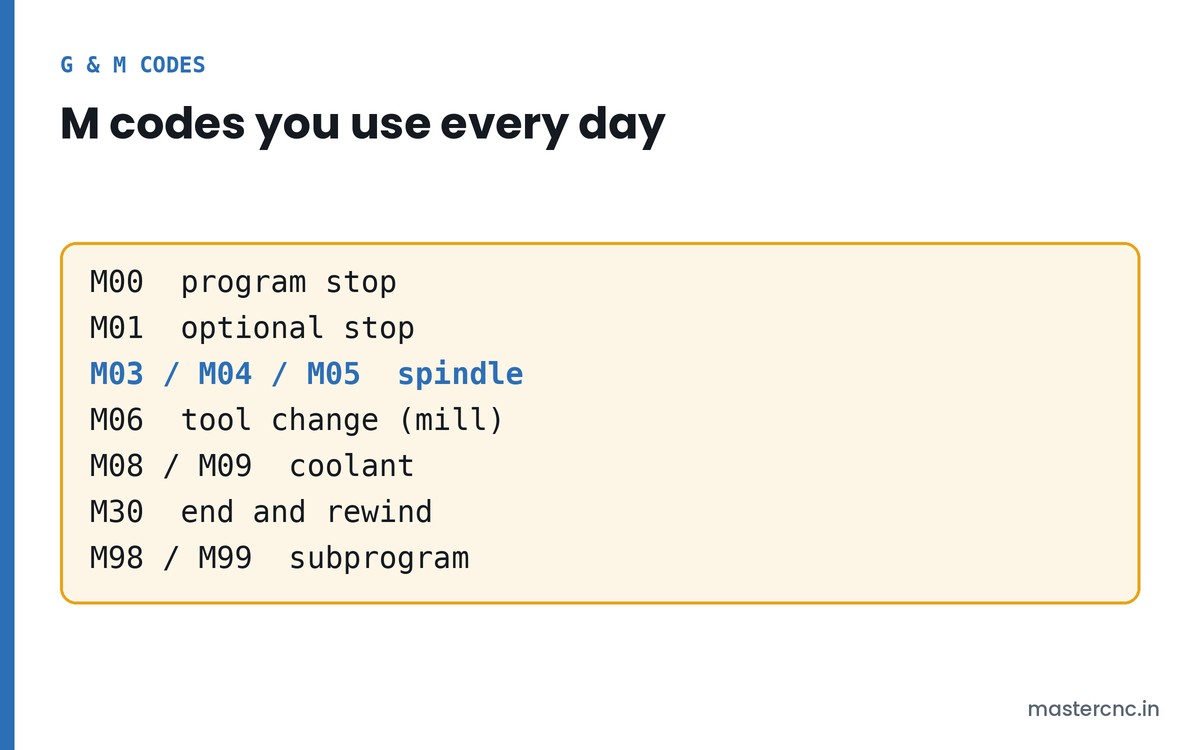
M codes every CNC operator should know
The common M codes on Fanuc-style lathes and machining centres: program stop and end, spindle, coolant, tool change, subprograms and rigid tapping, and why machine-builder M codes differ.
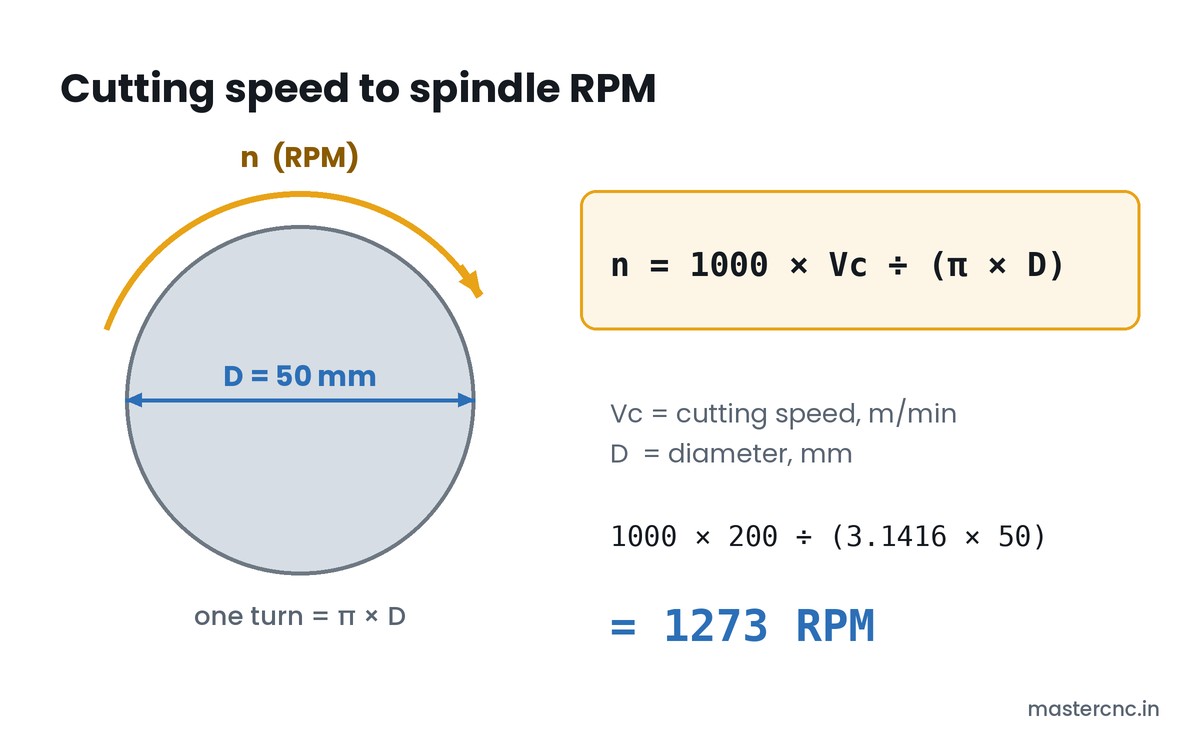
Cutting speed and spindle RPM: the formula, with examples
How to turn cutting speed (Vc, m/min) into spindle speed (RPM) and back, with worked examples for turning, milling and drilling, plus starting values for common materials.
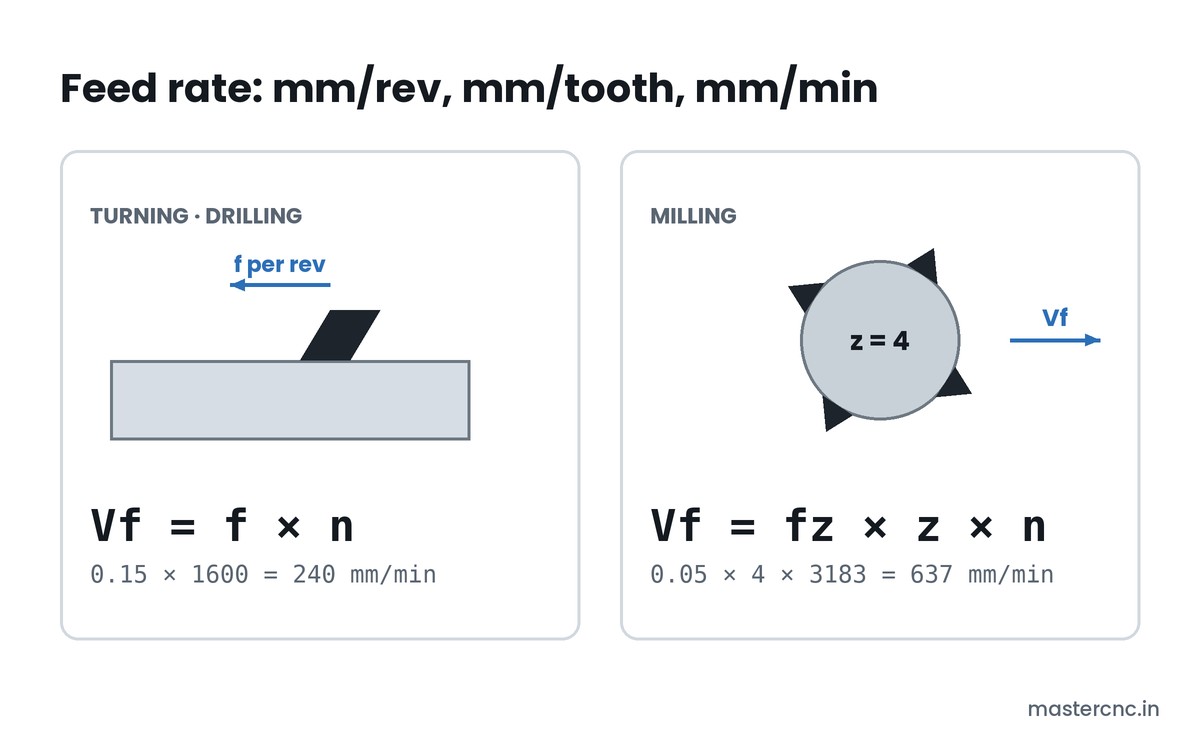
CNC feed rate: mm/rev or mm/min? Turning, milling and drilling
Feed per revolution, feed per minute and feed per tooth explained, with the formulas, the G codes that switch between them, and worked examples for turning, milling and drilling.
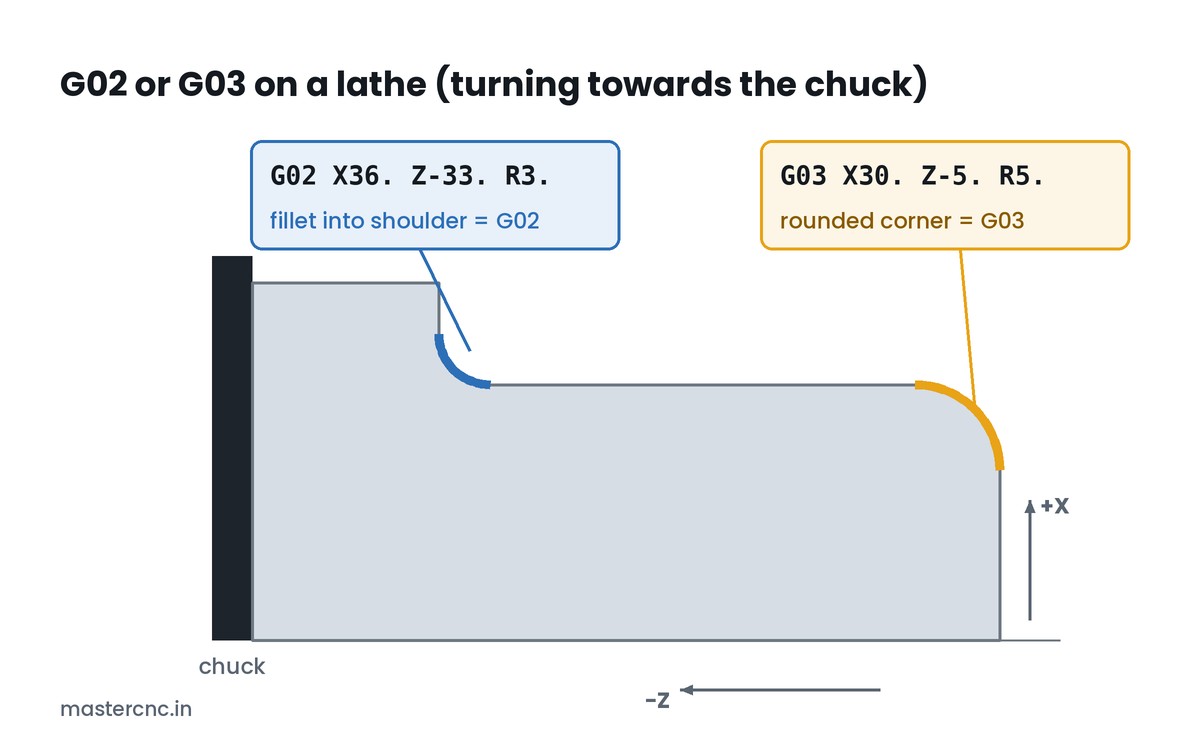
G02 and G03 arcs: which direction, and R or I and K?
How to pick G02 or G03 on a lathe and a machining centre, how to write an arc with R or with I, J and K, and the mistakes that cause radius alarms.
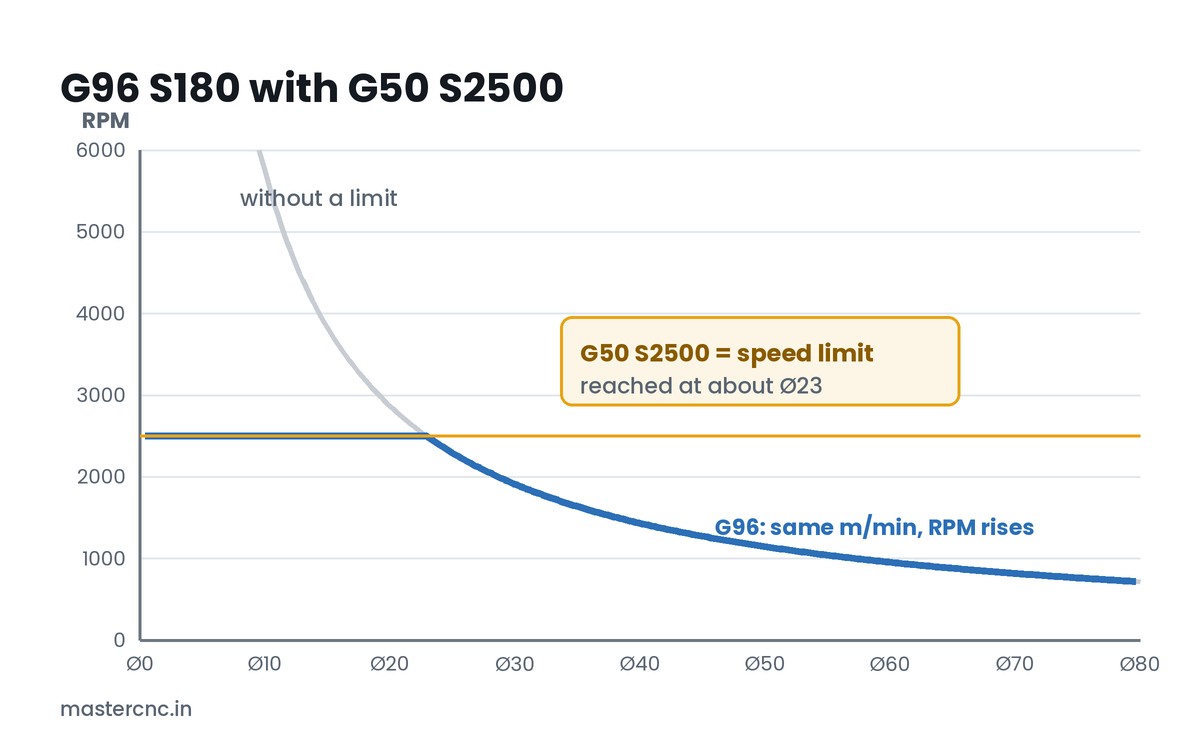
G96 constant surface speed and the G50 spindle limit
What G96 does on a CNC lathe, why the spindle speeds up as the diameter gets smaller, how to set a safe maximum speed with G50 S, and when to use G97 instead.
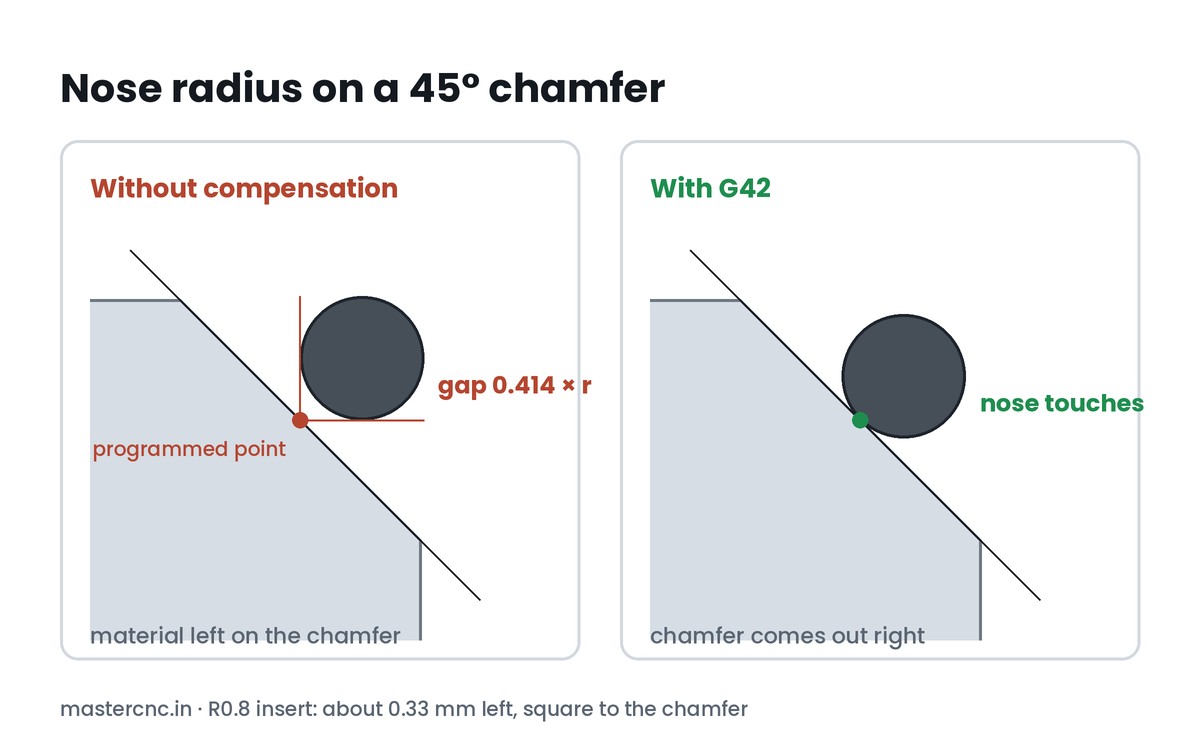
Tool nose radius compensation on a lathe: G41, G42 and G40
Why tapers, chamfers and radii come out wrong without nose radius compensation, how big the error is, and how to use G41, G42, the R and T offsets and G40 safely.
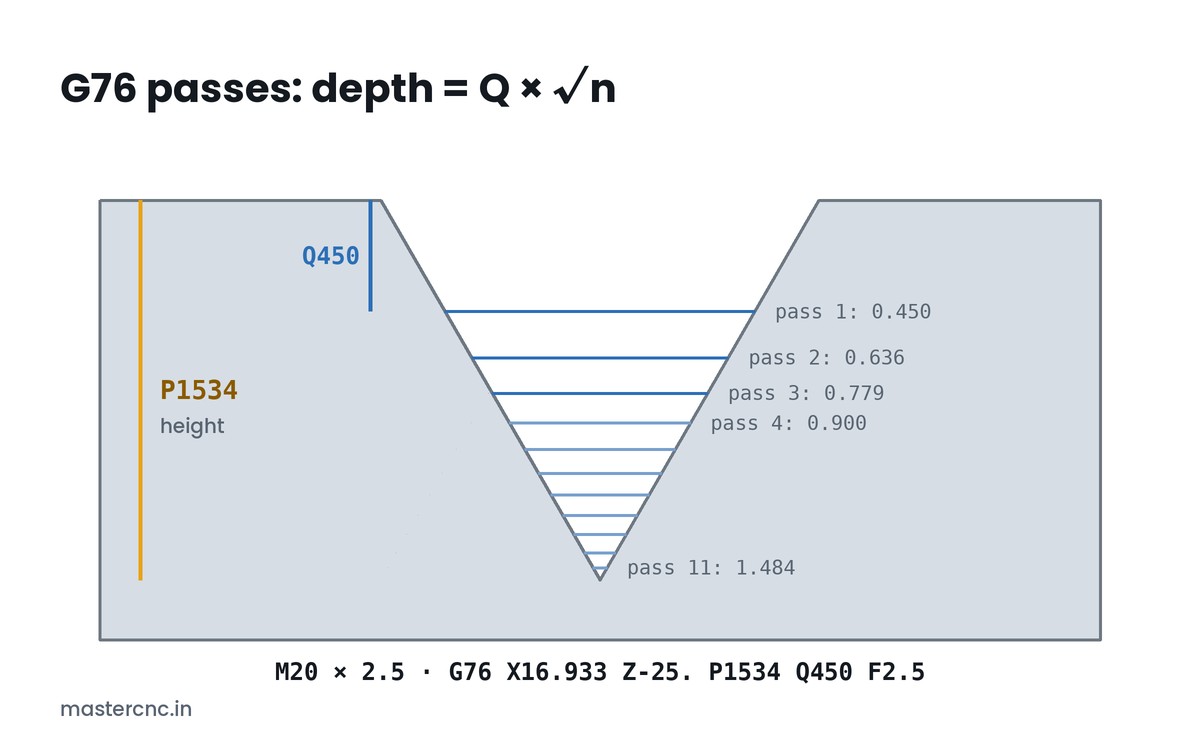
Fanuc G76 threading cycle explained, with an M20 × 2.5 example
The two-block Fanuc G76 thread cycle word by word: P, Q and R in both blocks, how to work out thread height and root diameter, the pass plan and the common mistakes.
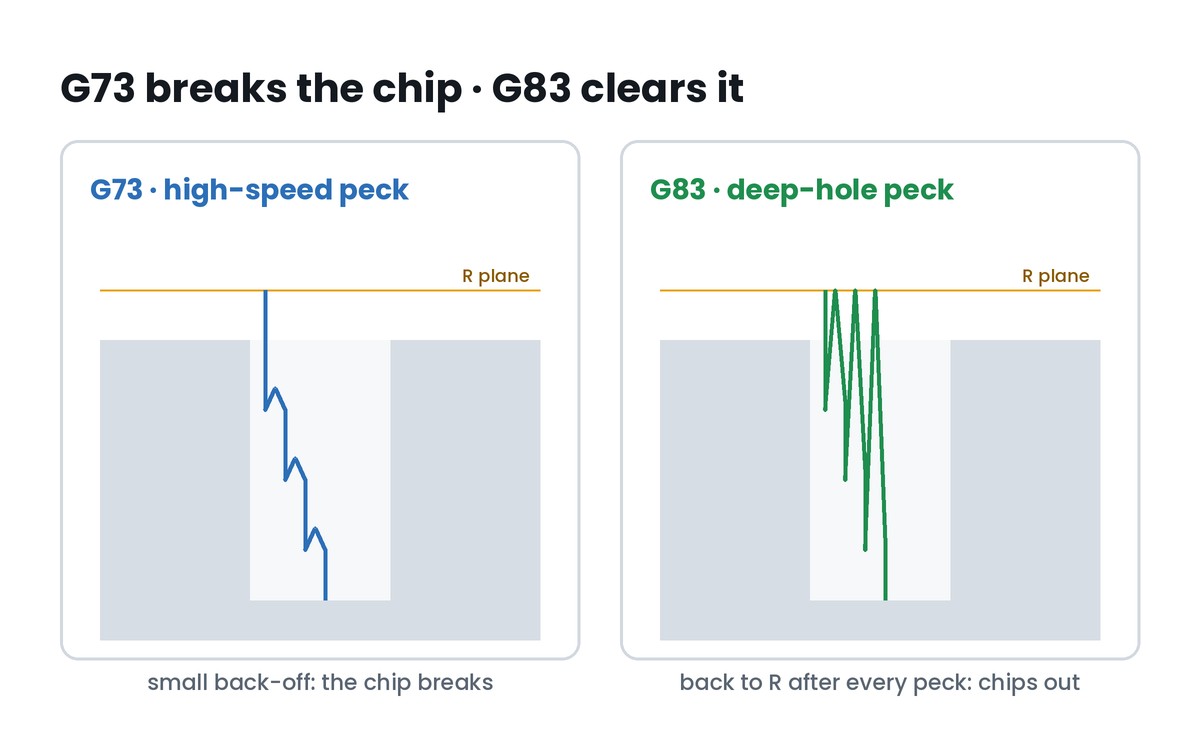
G83 vs G73 peck drilling: which one to use and why
The difference between the G83 deep-hole and G73 high-speed peck drilling cycles, how to choose Q and R, how deep to program Z for the drill point, and a full example.
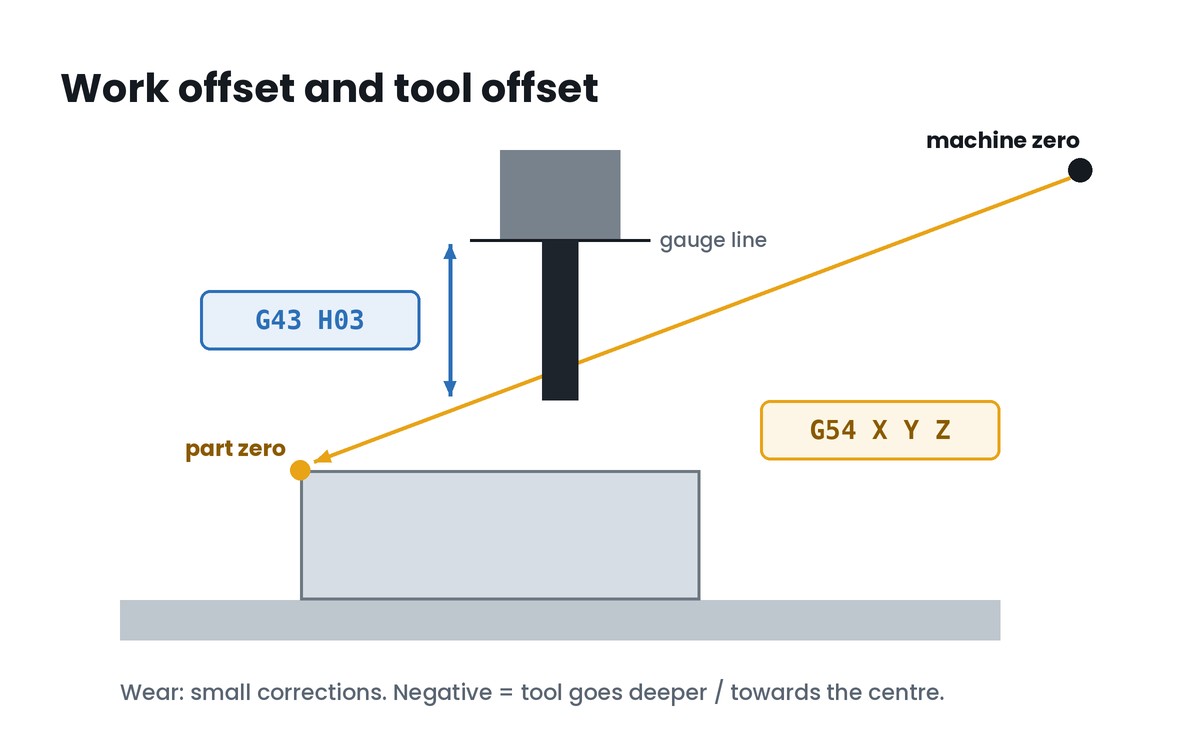
Work offset vs tool offset: G54, geometry and wear explained
What a work offset (G54) and a tool offset do on a machining centre and a lathe, the difference between geometry and wear, which sign to use for a correction, and a setter checklist.
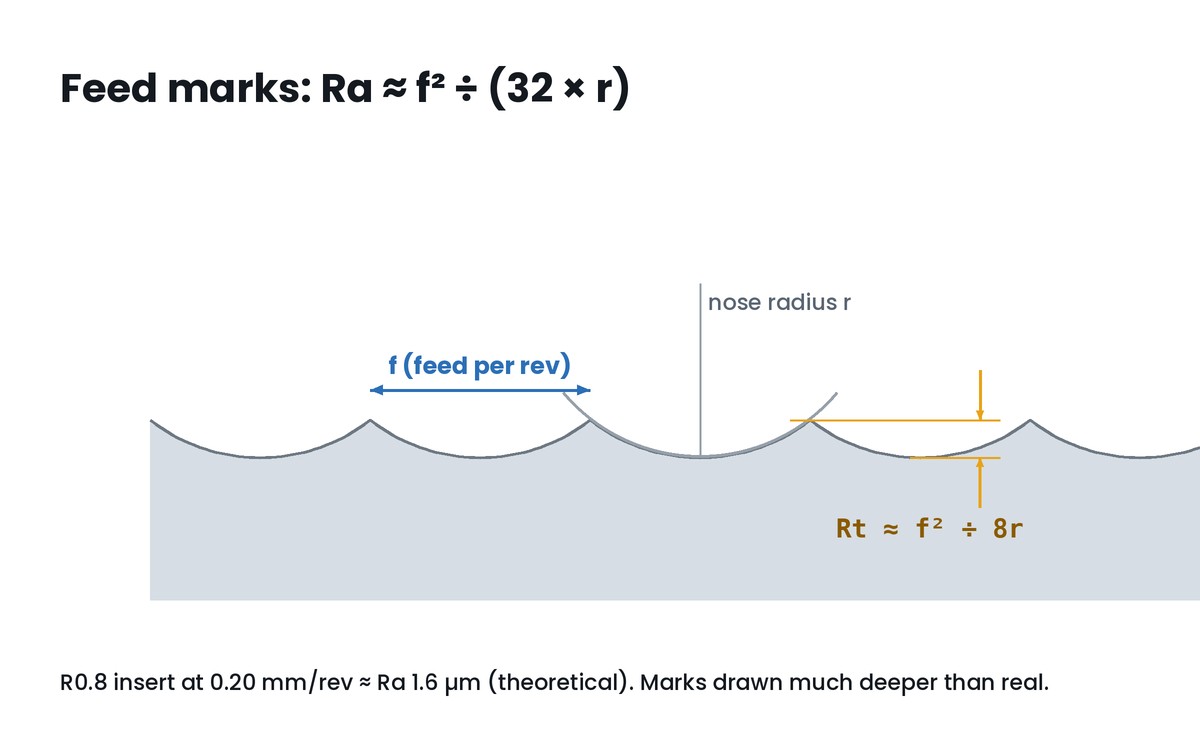
Surface roughness from feed and nose radius: the formula and a table
How feed per revolution and insert nose radius decide the theoretical surface finish on a lathe, the Ra formula, a ready table and how to pick the feed for Ra 0.8, 1.6 and 3.2.
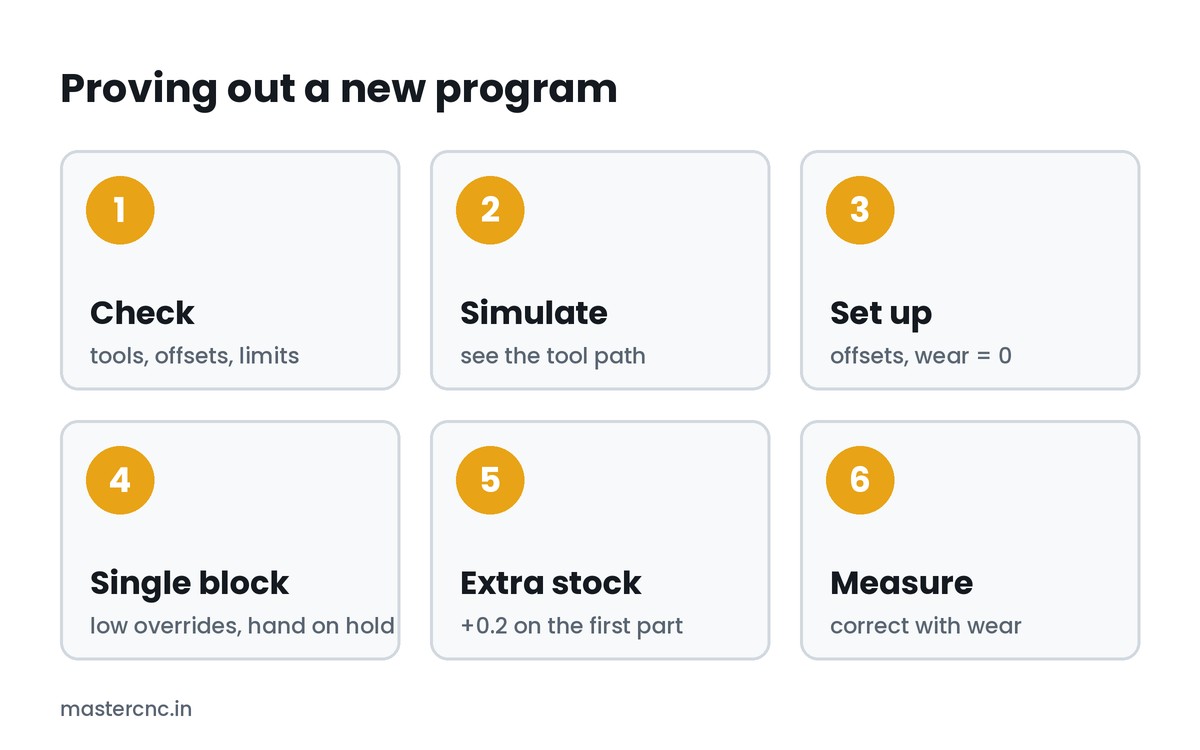
How to prove out a new CNC program safely: a step-by-step checklist
A practical checklist for running a new CNC program for the first time: checks before the machine, simulation, single block, rapid and feed override, optional stop, extra stock on the first part and measuring.

Introducing Master CNC: a free CNC helper for your phone
Master CNC is a free phone app for CNC operators and programmers: calculators, process sheet to program with simulation, program converter, G and M codes and lessons for Okuma OSP, Fanuc and Haas.
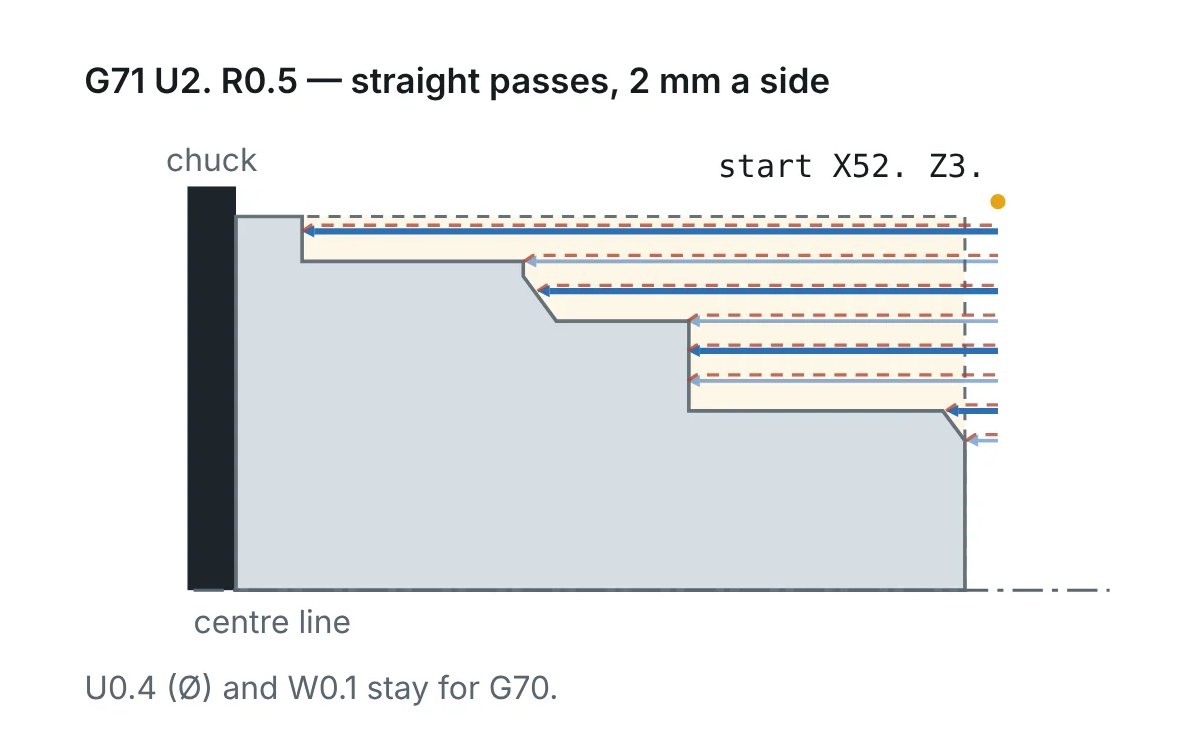
Turning program step by step: facing, G71 roughing and G70 finishing
A complete Fanuc-style lathe program for a stepped shaft from a 50 mm bar: facing, the two-block G71 roughing cycle, the P–Q contour and G70 finishing, block by block.
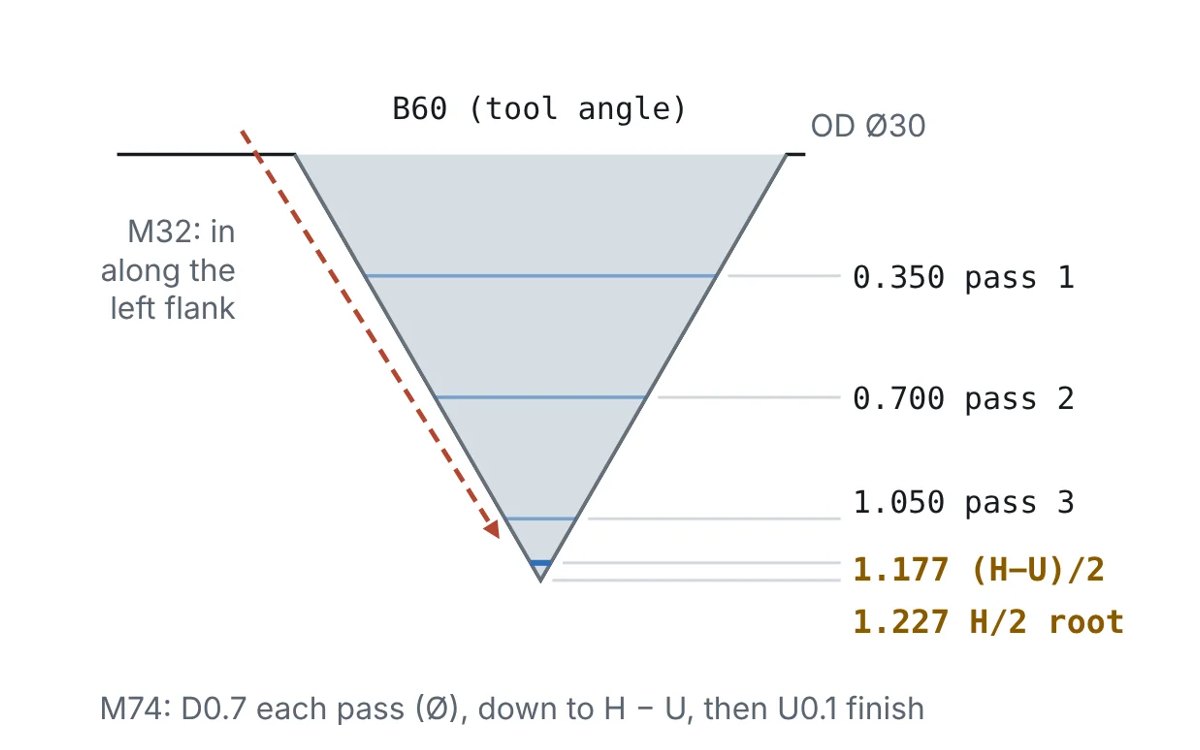
Okuma OSP G71 thread cycle, explained with an M30 × 2 example
How the one-block OSP G71 compound threading cycle works: every word, how to work out X and H, the pass plan and how it compares with Fanuc G76.
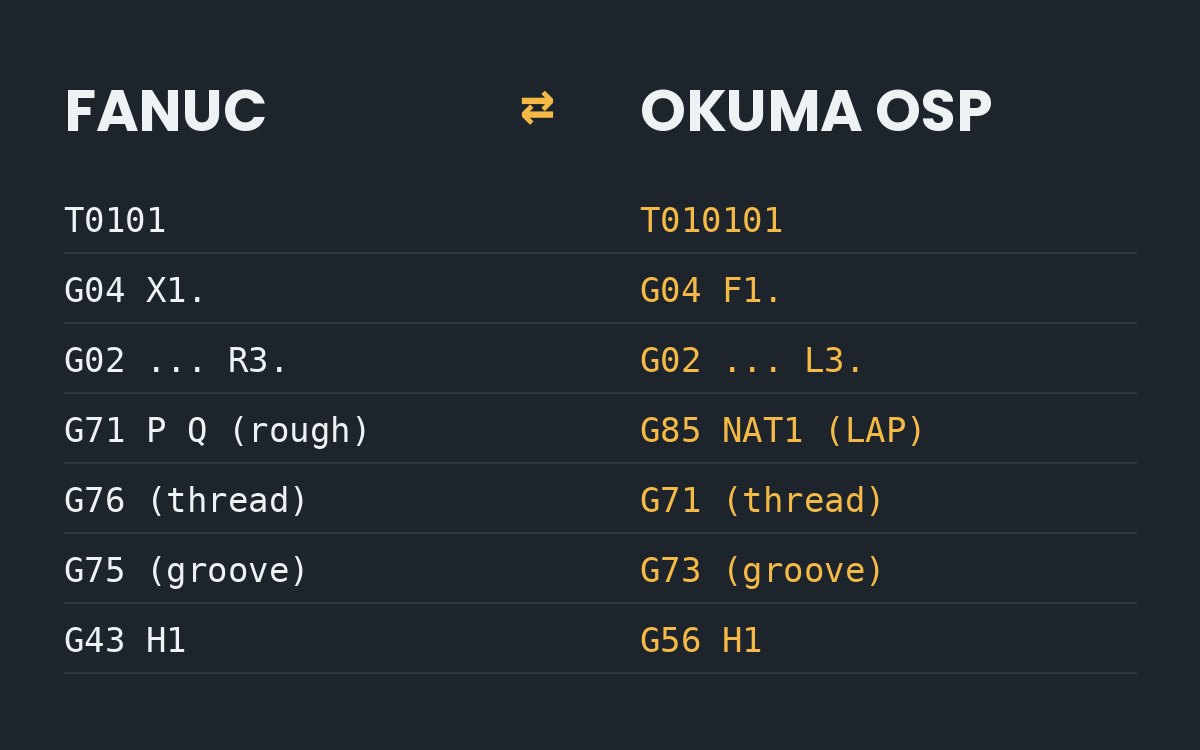
Fanuc vs Okuma OSP: the codes that are different
A side-by-side list of the lathe and machining-centre codes that change between Fanuc and Okuma OSP: tool call, dwell, arcs, roughing, threading, grooving, length offset and hole cycles.