Master
Coolant concentration: why it matters
Water-soluble coolant is mostly water with a few percent of concentrate. That small percentage decides whether parts rust, tools last, chips stick and operators get skin problems. It changes every day, so it needs checking.
Why it matters
| Too weak | Too strong |
|---|---|
| Rust on parts and machine | Foam |
| Poor lubrication, built-up edge, short tool life | Sticky residue on parts and machine |
| Bacteria grow, bad smell | Skin irritation |
| Wasted money |
Measuring with a refractometer
- Take a sample from the tank, not from the nozzle after it ran a long time.
- Put a few drops on the refractometer prism and close the cover.
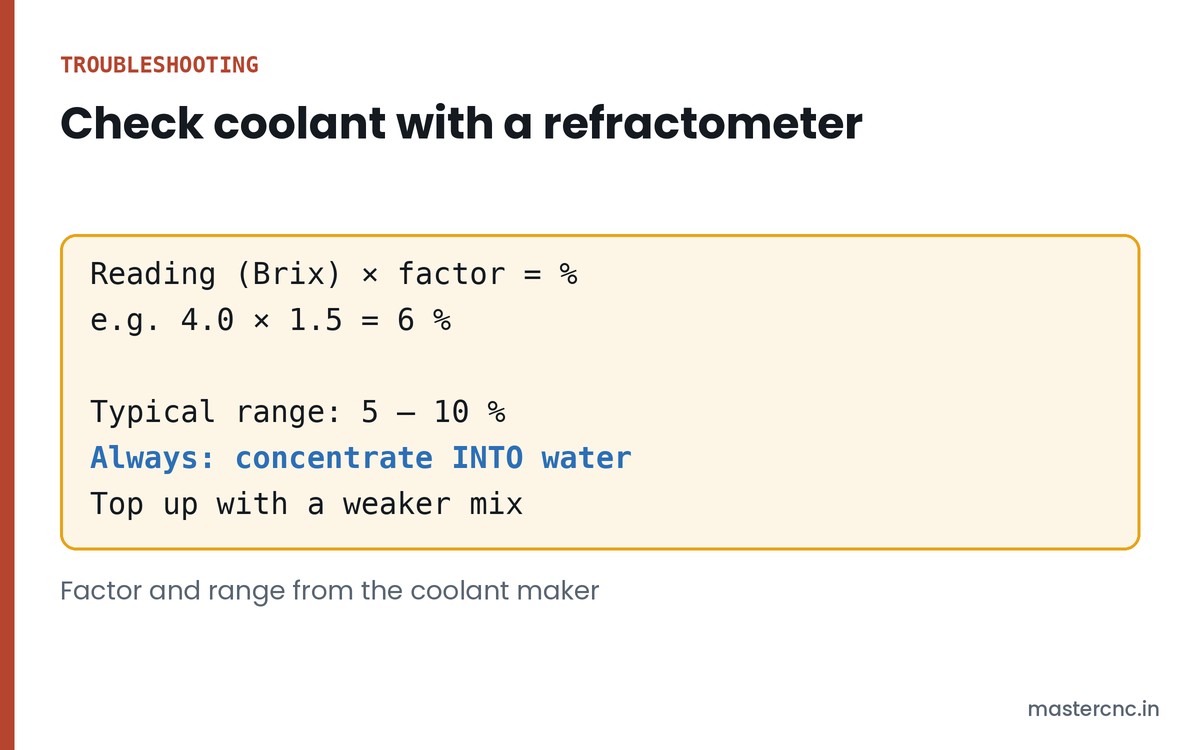
- Read the scale (Brix) against the light.
- Multiply by the factor the coolant maker gives for that product: for example 4.0 × 1.5 = 6 %.
Clean and zero the refractometer with clean water regularly. Tramp oil in the coolant makes the reading too high.
Typical ranges
Many general machining coolants run around 5 – 8 %, and 8 – 10 % or more for difficult materials and heavy operations such as tapping and broaching. Use your coolant maker's recommended range.
Mixing and topping up
- Always add concentrate to water, never water to concentrate, or the emulsion does not form properly. A mixer or proportioner does it best.
- Water evaporates, concentrate does not. Topping up with the full-strength mix makes the tank stronger and stronger. Top up with a weaker mix (often 1 – 2 %) as your readings show.
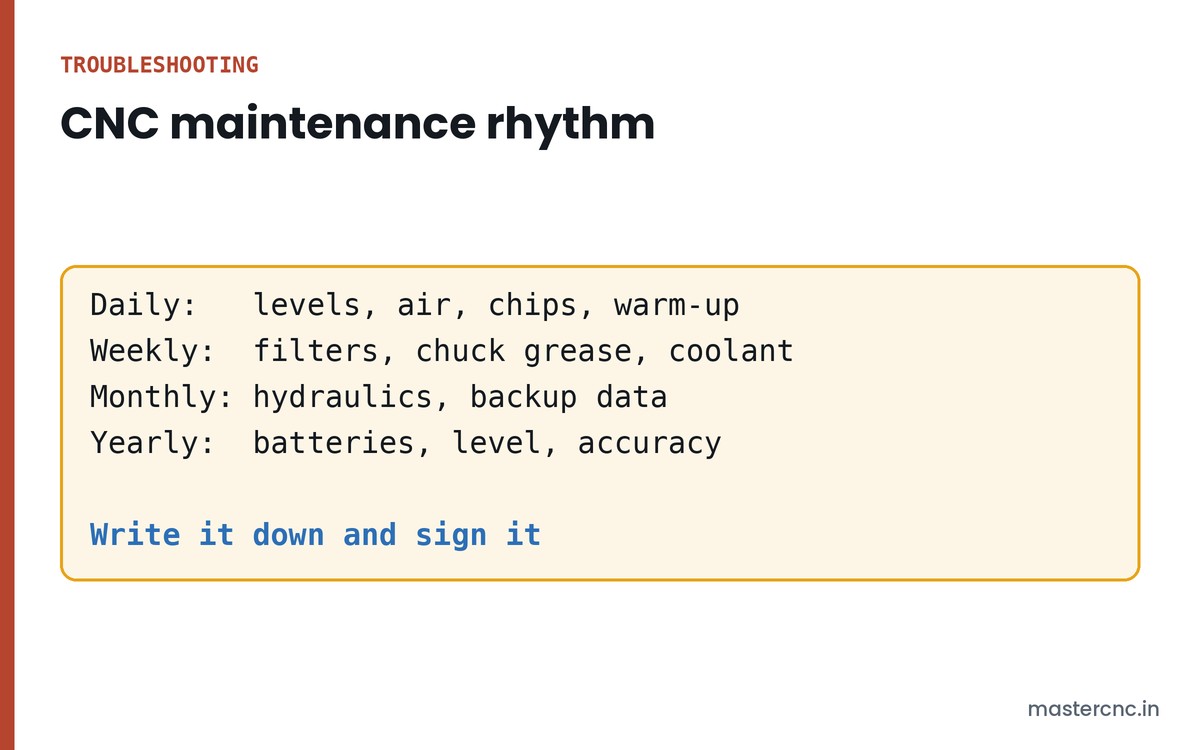
- Check at least weekly, daily on busy machines.
A healthy tank
- Skim tramp oil (way lube and hydraulic oil leaks) regularly.
- Keep chips and fines out with good filtration.
- Keep the coolant moving: tanks that stand still over a weekend grow bacteria (the "Monday morning smell").
- Clean the tank and change the coolant when it is badly contaminated.
Common mistakes
- Topping up with plain water only, or with full-strength coolant only.
- Guessing the concentration from the colour.
- Ignoring tramp oil.
Follow the coolant maker's data sheet and safety data sheet for ranges, mixing and handling, and wear gloves if your skin reacts.
Calculators, process sheet to program, simulation, codes and lessons. Free to start, no sign-in, on phone and laptop.
Open the app