Master
G84 rigid tapping: feed = pitch × RPM
In rigid tapping the control moves Z exactly one pitch for every turn of the spindle, in and out. The tap holder can be solid, the thread is accurate, and you can tap faster than with a floating holder. The one rule you must get right is the feed.
The feed formula
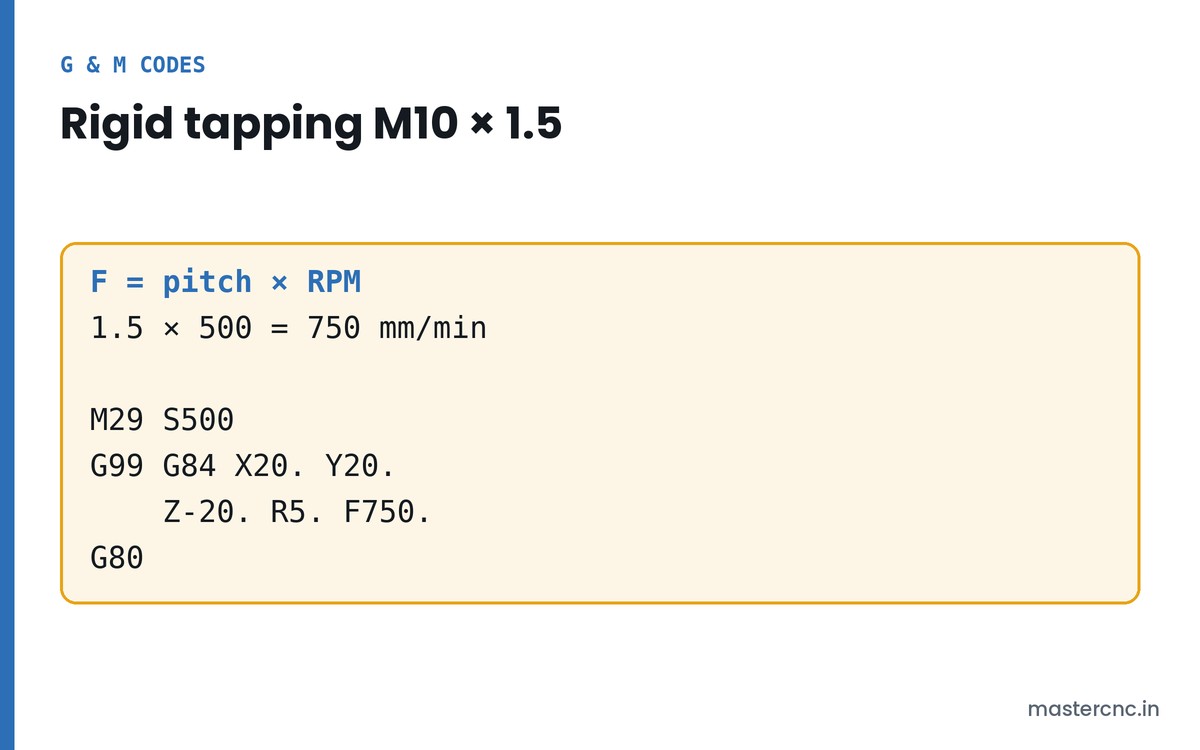
G94 (mm/min): F = pitch × RPM
G95 (mm/rev): F = pitch
For an M10 × 1.5 tap at 500 RPM: 1.5 × 500 = F750 in G94. If you change the speed, change the feed by the same ratio. In G95 you simply write F1.5, which is why some programmers prefer it for tapping.
A full example on a Fanuc machining centre
Two M10 × 1.5 holes, 14 mm useful thread, tap point at Z-20, already drilled Ø8.5.
T5 M06  (M10X1.5 TAP)
G90 G54 G00 X20. Y20.
G43 H05 Z50.
M29 S500  (RIGID TAP)
G99 G84 X20. Y20. Z-20.
    R5. F750.
X60.
G80
G00 Z100.
- M29 S_ puts the spindle in rigid tapping mode. On most Fanuc mills it goes in the block before G84. Some machines switch rigid tapping on by parameter, so M29 is not needed: check your machine.
- R5. is the start plane, 5 mm above the part. The tap must reach full speed before it enters.
- Z-20. is the depth of the tap point, not the depth of full thread (see below).
- G99 returns to R between holes, G98 to the start height. G80 cancels the cycle.
Left-hand taps use G74, the counter-tapping cycle, with the spindle in reverse.
How deep is Z?
The first threads on a tap are a lead chamfer: they do not cut a full thread. For a blind hole:
Z = full thread + chamfer
chamfer, plug tap:   3 – 5 P
chamfer, bottoming:  1.5 – 2 P
For 14 mm full thread with a plug tap (about 4 pitches = 6 mm): Z-20, as in the example. Then the drill must go deeper still, with room for chips. That is why the drilled hole is usually several millimetres deeper than the tap.
Speeds
Tapping speeds are low. Typical starting values for HSS-E taps: steel 10 – 20 m/min, stainless 5 – 10 m/min, aluminium 20 – 40 m/min. Use the tap maker's data and convert with the RPM formula. Big taps need lower RPM: the spindle must stop and reverse at the bottom, and it overshoots more at high speed.
Common mistakes
- Feed not equal to pitch × RPM. The tap is stretched or squeezed and breaks or cuts an oversize thread.
- Feed or spindle override not at 100 %. Many controls lock overrides in G84, but not all.
- Tap drill too small. See the tap drill size table.
- Hole not deep enough. The tap hits the bottom or the packed chips.
- Using a spiral-point tap in a blind hole. It pushes chips forward; blind holes need spiral-flute taps.
Check the M29 rules and the G84 format in your machine's manual: they differ between builders. Prove the first hole in single block with the tap above the part.
Calculators, process sheet to program, simulation, codes and lessons. Free to start, no sign-in, on phone and laptop.
Open the app