Master
Cutting speed and spindle RPM: the formula, with examples
Every tool catalogue gives you a cutting speed, but the machine wants a spindle speed. The link between the two is one short formula. Here it is, with three examples you can check on a calculator.
Cutting speed and spindle speed are not the same thing
- Cutting speed (Vc) is how fast the cutting edge moves along the material, in metres per minute (m/min). This is what the tool maker tells you.
- Spindle speed (n) is how many turns the spindle makes per minute (RPM, or min⁻¹). This is what you write after
Sin the program.
The same spindle speed gives a very different cutting speed on a big diameter and a small one. That is why you always start from Vc and the diameter.
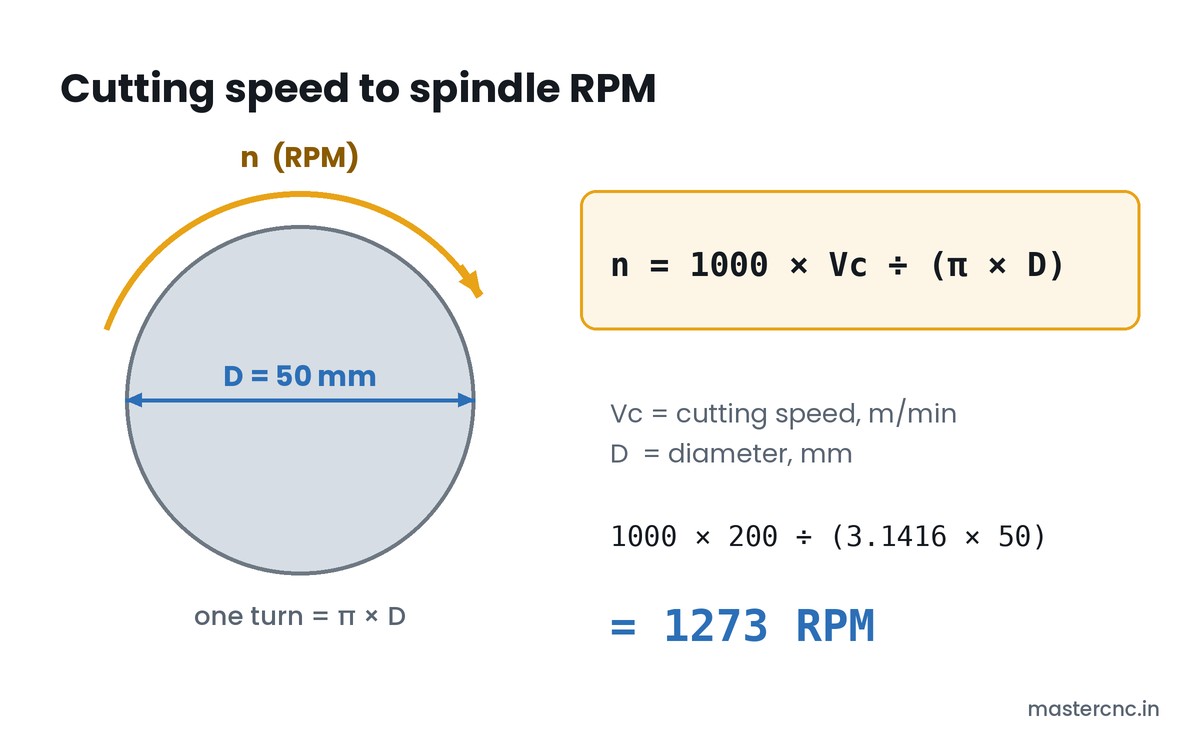
The formula
n  = 1000 × Vc ÷ (π × D)   (RPM)
Vc = π × D × n ÷ 1000      (m/min)

D  = diameter in mm
π  = 3.1416
D is the diameter of the part on a lathe, and the diameter of the tool on a mill or drill.
The 1000 is there because Vc is in metres and D is in millimetres. In inch shops the same formula is RPM = 12 × SFM ÷ (π × D), with D in inches and SFM in surface feet per minute.
Example 1: turning a 50 mm bar
Steel, carbide insert, the catalogue says Vc = 200 m/min.
n = 1000 × 200 ÷ (3.1416 × 50)
  = 200000 ÷ 157.08
  = 1273 RPM
On a lathe the diameter changes as you cut. That is why lathes use G96 (constant cutting speed) for turning and facing: the control does this sum for every diameter. More on that in a later post.
Example 2: a 12 mm end mill
Carbide end mill in steel, Vc = 120 m/min.
n = 1000 × 120 ÷ (3.1416 × 12)
  = 120000 ÷ 37.70
  = 3183 RPM
Example 3: an 8 mm HSS drill
HSS drill in mild steel, Vc = 25 m/min.
n = 1000 × 25 ÷ (3.1416 × 8)
  = 25000 ÷ 25.13
  = 995 RPM
Going the other way: what Vc am I really running?
An old program has S800 for a 40 mm part. Is that sensible?
Vc = 3.1416 × 40 × 800 ÷ 1000
   = 100.5 m/min
Fine for HSS, slow for a carbide insert in steel. This check is often the quickest way to find why a tool wears fast or cuts badly.
Starting values
These are typical starting values for coated carbide. Always use the values for your insert grade from the tool maker's catalogue, then adjust on the machine.
| Material | Turning Vc (m/min) | Milling Vc (m/min) |
|---|---|---|
| Mild steel | 180 – 280 | 150 – 250 |
| Alloy steel | 150 – 220 | 120 – 200 |
| Stainless steel | 120 – 200 | 100 – 160 |
| Cast iron | 150 – 250 | 150 – 250 |
| Aluminium | 300 – 800 | 300 – 1000 |
HSS tools run much slower: roughly 20 – 35 m/min in steel.
Three things to remember
- Start from the catalogue Vc and the real diameter, never from an RPM copied from another job.
- Stay under the maximum speed of the machine, the chuck and the tool holder.
- Too fast burns the edge; too slow rubs, builds up and chips the edge. Listen and look at the chips.
The Master CNC app does this in the Calculators tab: type Vc and D and the RPM updates as you type, in mm or inch. Values here are starting points: check your tool catalogue and machine limits before cutting.
Calculators, process sheet to program, simulation, codes and lessons. Free to start, no sign-in, on phone and laptop.
Open the app