Master
After a crash: what to check before running again
Every machinist sees a crash sooner or later. What you do in the next half hour decides whether it was a broken tool or a damaged spindle that ruins every part for the next month. Go through this list before running production again.
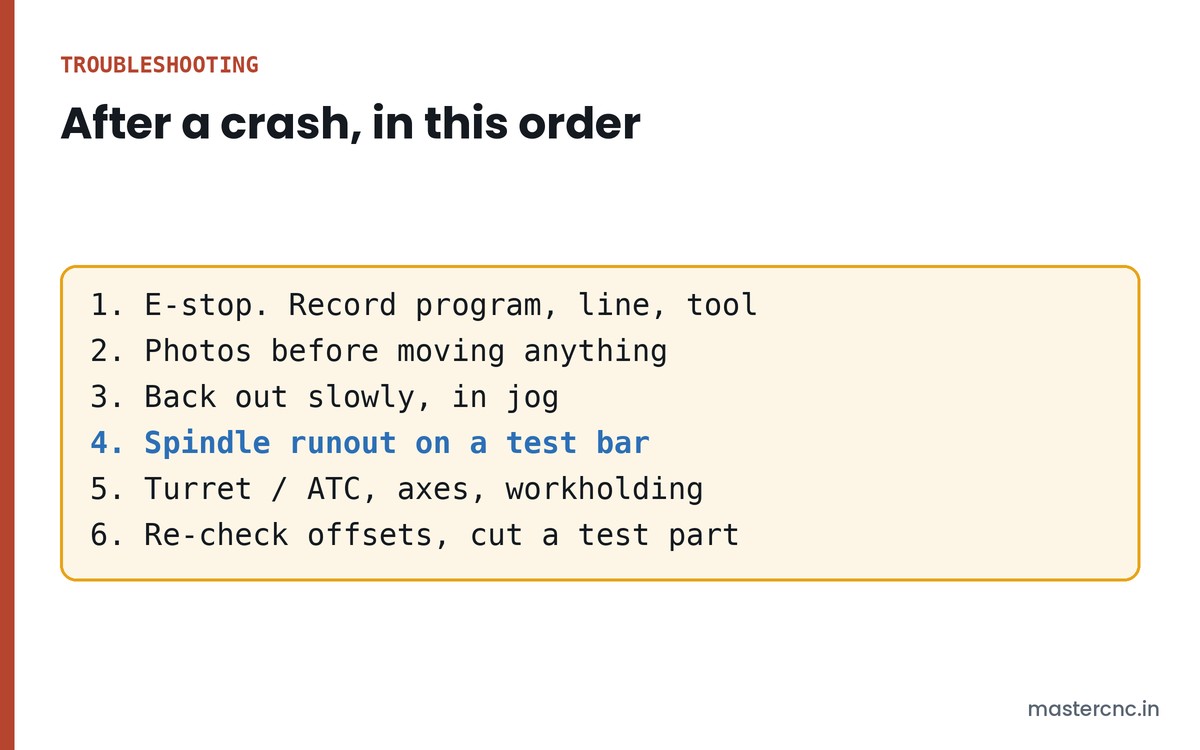
1. Stop and record
- Press emergency stop or feed hold. Do not reset yet.
- Write down the program, the block, the tool, the offsets and the work offset in use.
- Take photos of the position and the screen.
This is how you find the cause later. Once you reset and move, it is gone.
2. Back out carefully
In jog or handwheel mode, slowly move the axis that caused the crash away, in the direction it came from. Watch for anything pulling or bending. If the axis is jammed or a servo alarm stays, call maintenance.
3. The tool and holder
Replace the broken tool. Check the holder for cracks, a bent shank and damage to the taper. A crashed holder is often scrap even if it looks fine.
4. Spindle runout
Put a test bar or a precise holder in the spindle and check runout with a dial indicator, near the nose and at a distance (for example 150 – 300 mm). Compare with the machine's specification or a value recorded when the machine was healthy. A rise in runout means bearing or spindle damage.
5. Turret or tool changer
- Lathe: check turret indexing, that tools still sit on centre height and on the right X and Z offsets.
- Machining centre: check the tool changer arm and the spindle orientation; watch a few tool changes slowly.
6. Axes and workholding
- Do a reference return and check that positions repeat.
- Check the chuck, jaws, vise or fixture for movement and damage.
- Check the tailstock and steady rest if they were involved.
7. Probe and offsets
Re-calibrate a spindle probe or tool setter that was near the crash. Re-check the tool and work offsets involved.
8. Find the cause
Program error, wrong offset, wrong tool, wrong work offset, a missed G43 or a wrong restart? Fix the cause, not just the damage, and tell the team.
9. Test cut
Run a test part and check it completely, as for a first article.
Common mistakes
- Resetting before recording what happened.
- Running on with a crashed holder.
- Not checking spindle runout: the damage shows up later as bad finish and short tool life.
- Keeping quiet about it. A reported crash is a lesson; a hidden one happens again.
Your machine builder may have a specific post-crash procedure, and some damage needs a service engineer. When in doubt, ask before running.
Calculators, process sheet to program, simulation, codes and lessons. Free to start, no sign-in, on phone and laptop.
Open the app