Master
CNC feed rate: mm/rev or mm/min? Turning, milling and drilling
The same F word in a program can mean millimetres per revolution or millimetres per minute. Mix them up and F0.2 becomes a feed of 0.2 mm a minute, or F200 tries to move 200 mm every turn. Here is how the three feeds fit together.
Three ways to say feed
| Feed | Symbol | Unit | Used for |
|---|---|---|---|
| Feed per revolution | f | mm/rev | Turning and drilling |
| Feed per tooth | fz | mm/tooth | Milling (what the catalogue gives) |
| Feed per minute (table feed) | Vf | mm/min | Milling, and moves with the spindle stopped |
The formulas
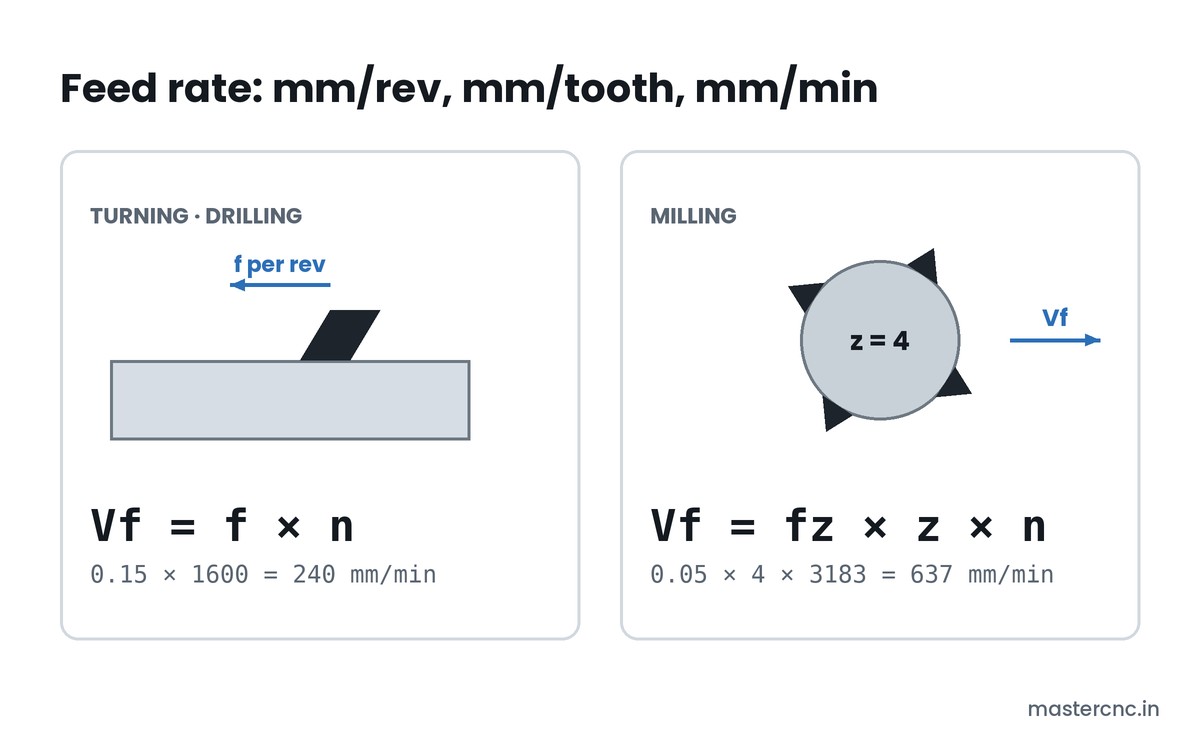
Turning, drilling:  Vf = f × n
Milling:            Vf = fz × z × n

f  = feed per rev (mm/rev)
fz = feed per tooth (mm)
z  = number of teeth (flutes)
n  = spindle speed (RPM)
Which G code sets the unit
| Control | mm/rev | mm/min |
|---|---|---|
| Fanuc lathe (G-code system A) | G99 | G98 |
| Fanuc machining centre | G95 | G94 |
| Okuma OSP lathe | G95 | G94 |
A lathe normally powers on in feed per rev, a machining centre in feed per minute. Check the state at the top of every program, because the last program may have changed it.
Example 1: turning
Finishing a 40 mm diameter at 1600 RPM with f = 0.15 mm/rev:
Vf = 0.15 × 1600 = 240 mm/min
In the program you write F0.15 in mm/rev. The 240 mm/min is useful to work out cutting time: a 60 mm long cut takes 60 ÷ 240 = 0.25 min = 15 s.
Example 2: milling
A 12 mm, 4-flute carbide end mill at 3183 RPM, catalogue fz = 0.05 mm:
Vf = 0.05 × 4 × 3183
   = 637 mm/min   → F637.
Change to a 2-flute cutter at the same speed and the same fz, and the feed halves to 318 mm/min. This is why you should always start from fz, not from an F copied from another tool.
Example 3: drilling
An 8 mm drill at 995 RPM with f = 0.15 mm/rev:
Vf = 0.15 × 995 = 149 mm/min
On a machining centre you write F149. in G94. On a lathe drilling on the centre line, you can stay in feed per rev and write F0.15.
Feed and finish
On a lathe, the feed per rev and the insert nose radius decide the theoretical surface finish. Bigger feed = rougher surface. A later post covers that formula.
Common mistakes
- Wrong mode: F0.2 in mm/min barely moves; F200 in mm/rev will alarm or crash. Put G98/G99 (or G94/G95) near the top of the program.
- Forgetting the teeth: using fz as the table feed on a 4-flute cutter makes it four times too slow, and the cutter rubs.
- Feed per rev with the spindle stopped: in mm/rev nothing moves when the spindle is not turning. Use mm/min for moves with a stopped spindle.
The Master CNC app has feed rate and cutting time calculators for turning, milling and drilling. Start from the catalogue values for your tool and check the program with a dry run before cutting.
Calculators, process sheet to program, simulation, codes and lessons. Free to start, no sign-in, on phone and laptop.
Open the app