Master
What a good setup sheet includes
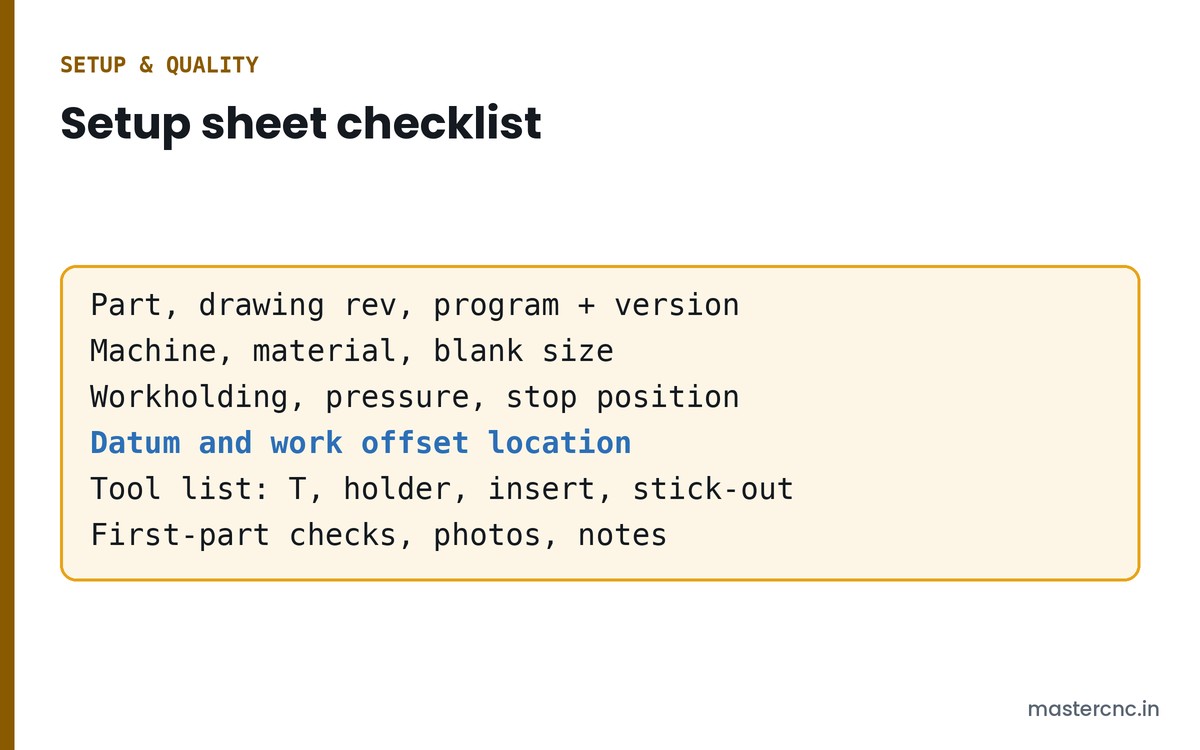
A good setup sheet lets any setter repeat a job months later without guessing. It saves time on every repeat order and prevents the mistakes that happen when "the person who knows" is not on shift.
What to include
The job
- Part number and drawing revision.
- Program number, and its version or date.
- Machine (and any special options needed).
- Material grade and blank size or bar diameter, cut length.
Workholding
- Chuck or vise, jaw type (hard, soft, which set), collet size.
- Clamping pressure and speed limit.
- Stop position or part stick-out from the jaws.
- Tailstock or steady rest settings.
- A photo of the part clamped.
Datums and offsets
- Where the work offset is (for example "Z0 = finished face, X0 Y0 = left front corner of part, fixed jaw").
- Which offsets the program uses (G54, G55…).
Tool list
| T | Description | Holder | Insert / grade | Notes |
|---|---|---|---|---|
| T0101 | Rough OD | 95° holder | CNMG 120408 + grade | R0.8, tip 3 |
| T0303 | Groove 3 mm | Grooving blade | 3 mm insert | Z on left corner |
Add stick-out lengths for boring bars and drills, and the nose radius and tip direction for turning tools (see nose radius compensation).
Checks and notes
- Critical dimensions and how to check them (gauge, frequency).
- First-part instructions (see first article).
- Known issues and tricks: "turn the far end first", "reduce feed at part-off".
- Deburring and handling.
Keep it alive
- Update it every time something changes, and date the change.
- Keep it with the program, on paper at the machine or digitally.
- Photos are worth a page of text: clamping, tool positions, the finished part.
Templates help: one format for the whole shop means everyone knows where to look.
Try it in Master CNC
Calculators, process sheet to program, simulation, codes and lessons. Free to start, no sign-in, on phone and laptop.
Open the app