Master
Fanuc G76 threading cycle explained, with an M20 × 2.5 example
G76 cuts a whole thread from two lines of program: it plans every pass, cuts along one flank and finishes with spring passes. The words look cryptic because most of them are in microns. Here is every word, with a complete M20 × 2.5 example.
The two blocks
G76 P(m)(r)(a) Q(dmin) R(d)
G76 X(U) Z(W) R(i) P(k) Q(Δd) F(L)
First block
| Word | Meaning | Example |
|---|---|---|
P m | Number of finish (spring) passes, 2 digits | 02 |
P r | Chamfer (pull-out) at the end, in 0.1 × lead, 2 digits | 00 = none |
P a | Tool angle, 2 digits | 60 |
Q | Minimum depth of cut, µm (radius) | Q50 = 0.05 mm |
R | Finish allowance, mm (radius) | R0.05 |
Second block
| Word | Meaning |
|---|---|
X / Z | Root diameter and end of the thread |
R | Taper: radius difference start to end (leave out for a straight thread) |
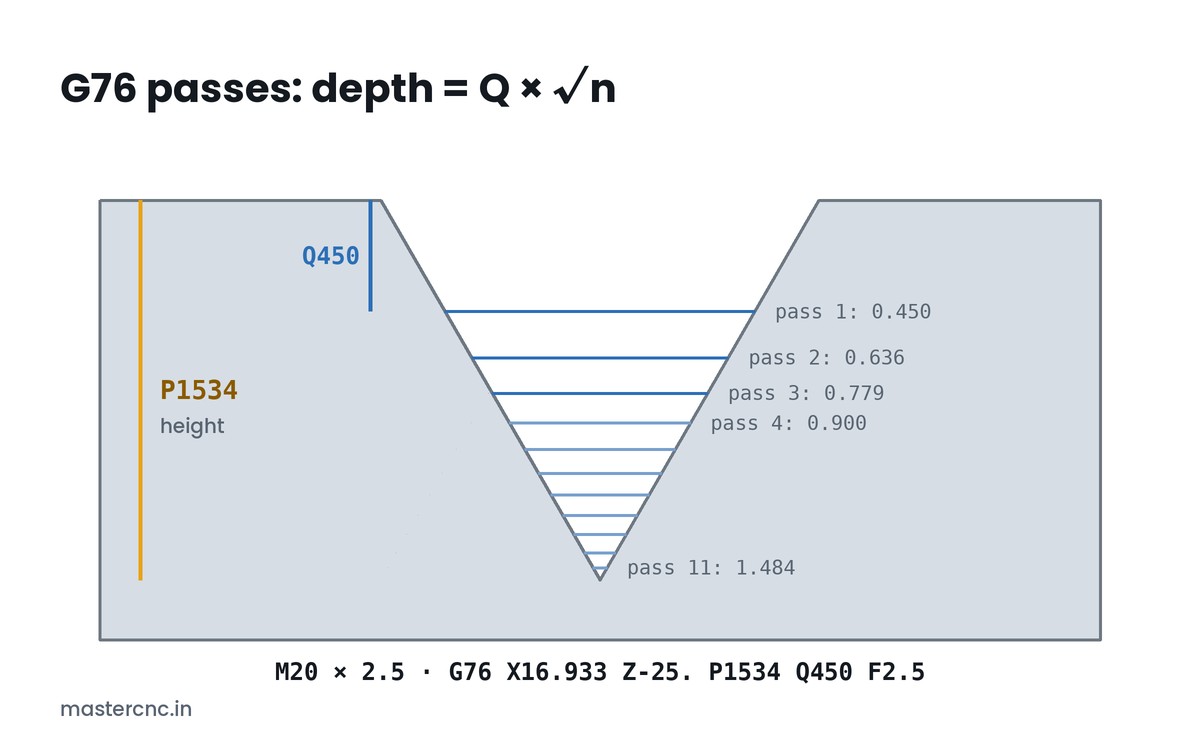
P | Thread height, µm (radius) |
Q | Depth of the first cut, µm (radius) |
F | Lead (the pitch, for a single-start thread) |
Example: M20 × 2.5 outside thread, 25 mm long
1. Thread height and root diameter
A common shop value for the depth of an outside metric thread is 0.6134 × pitch:
height = 0.6134 × 2.5 = 1.534 mm
P      = 1534  (µm, radius)
root X = 20 − 2 × 1.534
       = 16.933
2. The program
T0303
G97 S1000 M03
G00 X24. Z7. M08
G76 P020060 Q50 R0.05
G76 X16.933 Z-25. P1534 Q450 F2.5
G00 X60. Z50. M09
G97 S1000: a fixed RPM, as every thread cycle needs. 1000 RPM on Ø20 is about 63 m/min. Check the speed for your insert and that your machine can feed 2.5 × 1000 = 2500 mm/min.Z7.: start about three leads in front of the part, so the Z axis is up to speed before the thread starts.P020060: 2 spring passes, no pull-out chamfer, 60° insert.Q450: the first cut is 0.45 mm deep (radius).
3. How the passes are planned
The depth after pass n is Q × √n, so each pass removes about the same area of metal:
pass 1: 0.450   pass 2: 0.636
pass 3: 0.779   pass 4: 0.900
pass 5: 1.006   ... pass 11: 1.484
The rough passes stop at height − R = 1.484 mm. Then one pass takes the last 0.05 mm, and the 2 spring passes run at full depth. A pass is never thinner than the minimum in block 1 (Q50 = 0.05 mm).
Internal and taper threads
- Internal: X is the major diameter of the nut thread (bigger than the start point). P and Q stay positive.
- Taper: add R in block 2, the difference in radius between the start and the end of the thread.
Common mistakes
- Decimal points in P and Q. Write them as plain integers in µm.
Q450, notQ0.45. - Diameter instead of radius. P and Q are radius values; only X is a diameter.
- G96 left on. Always G97 before threading.
- Older controls use a one-block G76 with different words. Check which format your control expects.
On Okuma OSP the same job is done by the one-block G71 thread cycle, with diameter values in mm.
Thread height depends on the standard and on your insert. Check the first part with a ring gauge or thread mic, and run the cycle once with the override low.
Calculators, process sheet to program, simulation, codes and lessons. Free to start, no sign-in, on phone and laptop.
Open the app