Master
G83 vs G73 peck drilling: which one to use and why
Both cycles drill a hole in steps (pecks). The difference is what the drill does between steps: G73 backs off a tiny amount to break the chip; G83 comes all the way out to clear it. Choosing the right one saves drills and time.
The block (Fanuc-style machining centre)
G99 G83 X__ Y__ Z__ R__ Q__ F__
G99 G73 X__ Y__ Z__ R__ Q__ F__
G80   (CANCEL)
| Word | Meaning |
|---|---|
X Y | Hole position |
Z | Bottom of the hole (the drill tip) |
R | R plane: where rapid stops and feed starts, a little above the surface |
Q | Depth of each peck, always positive |
F | Feed |
G98 / G99 | After the hole, go back to the start height / to the R plane |
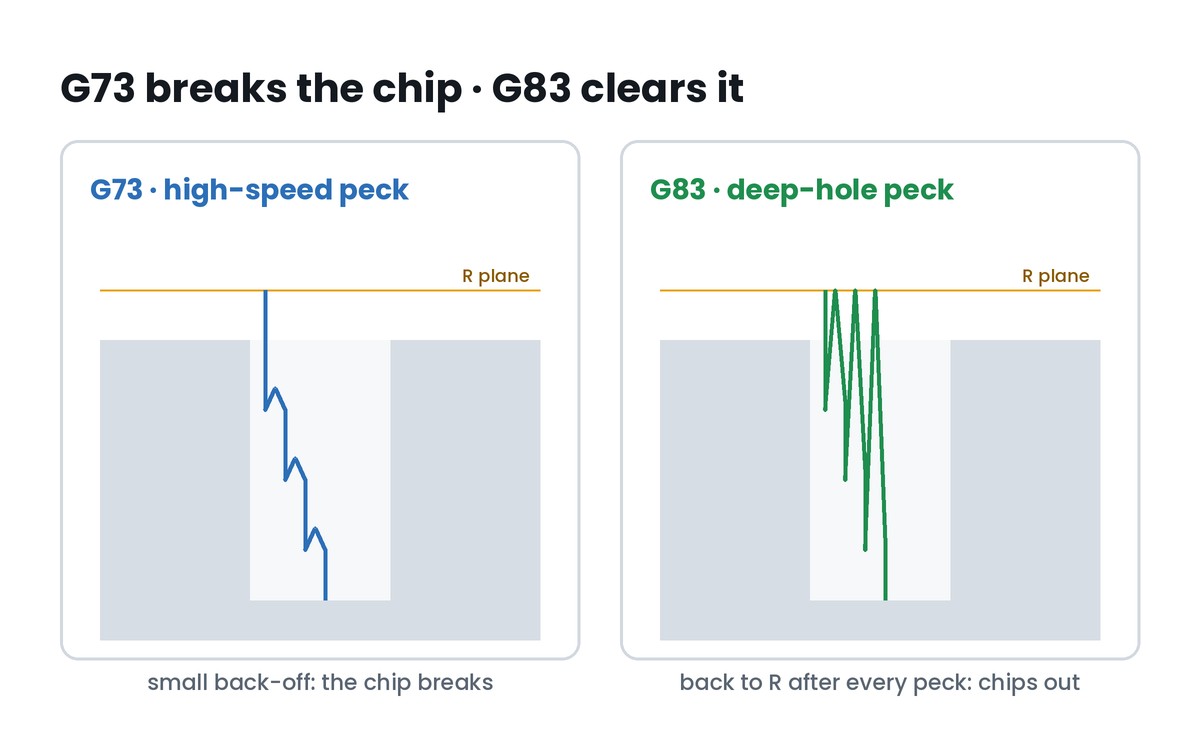
G73: high-speed peck (chip breaking)
After each peck the drill backs off a small distance (set by a parameter, often a few tenths of a mm), then carries on. The chip breaks, but it stays in the hole. It is fast because the drill hardly leaves the cut.
G83: deep-hole peck (chip clearing)
After each peck the drill comes all the way out to the R plane, then rapids back down to just above the last depth and feeds on. Chips come out and coolant gets to the tip. It is slower but much safer in deep holes.
Which one to use
| Hole depth | Usual choice |
|---|---|
| Up to about 3 × D | G81 (no peck), or G73 if the chips are long and stringy |
| About 3 to 5 × D | G73 |
| Deeper than about 5 × D | G83 |
These are rules of thumb for HSS and solid carbide drills without coolant through the tool. A through-coolant carbide drill is often run without pecking: follow the tool maker's advice.
Choosing Q, R and Z
- Q: start with about 1 × the drill diameter, and use less as the hole gets deeper or the material gets stickier.
- R: 1 to 2 mm above the surface, and above any clamps if you return to R between holes.
- Z and the drill point: the point of a 118° drill is about 0.3 × D long. For a full-diameter depth of 30 mm with an 8 mm drill: 30 + 0.3 × 8 = 32.4, so
Z-32.4.
Example: three holes, Ø8, 30 mm deep
T3 M06
G90 G54 G00 X20. Y20. S995 M03
G43 Z50. H03 M08
G99 G83 X20. Y20. Z-32.4 R2. Q8. F149.
X60.
G98 X100.
G80 G00 Z100. M09
- The first two holes return to R2 (G99), so the drill does not climb up to Z50 between holes.
- The last hole returns to Z50 (G98) before moving away.
- Speed and feed come from the cutting speed and feed rate examples: 995 RPM and 0.15 mm/rev = 149 mm/min.
Watch the decimal point
Write Q8. with a decimal point. On many controls a Q without a decimal point is read in the smallest unit, so Q8 could mean 0.008 mm: thousands of tiny pecks. Check your manual.
On Okuma OSP machining centres the return level is chosen with M codes (M53, M54, M52) instead of G98 and G99. See the code differences post.
Check the hole depth and the R plane in simulation, then run the first hole in single block with the rapid override low.
Calculators, process sheet to program, simulation, codes and lessons. Free to start, no sign-in, on phone and laptop.
Open the app