Master
G96 constant surface speed and the G50 spindle limit
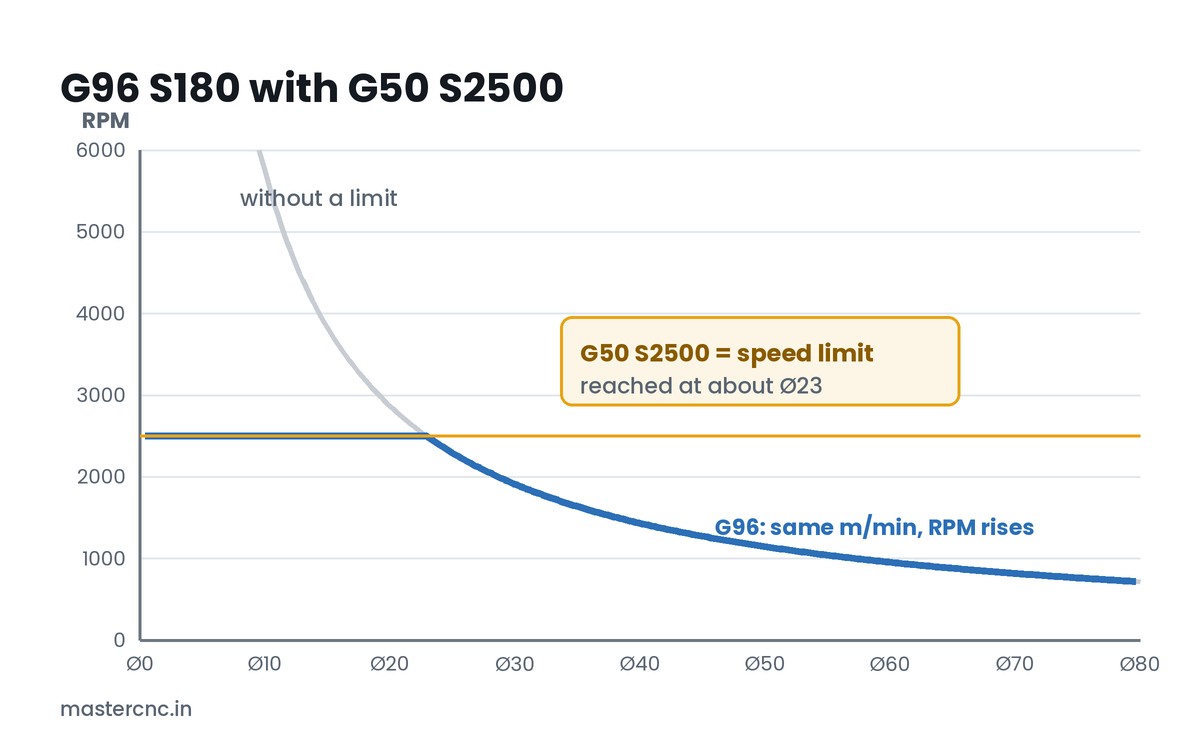
With G96 the lathe keeps the cutting speed the same on every diameter: the spindle turns faster as the tool moves towards the centre. That gives a better finish and tool life, but near the centre the speed shoots up. G50 S is the limit that stops it.
What G96 does
In G96, the S word is a cutting speed in m/min, not an RPM. The control works out the spindle speed for the current X position all the time, with the same formula as in the cutting speed post:
n = 1000 × Vc ÷ (π × D)
Here is what G96 S180 asks for while facing an 80 mm bar:
| Diameter | Spindle speed asked for |
|---|---|
| Ø80 | 716 RPM |
| Ø40 | 1432 RPM |
| Ø20 | 2865 RPM |
| Ø10 | 5730 RPM |
| Ø2 | 28 648 RPM |
At the centre the number goes towards infinity. Without a limit, the spindle would run to its maximum speed with a big chuck and a heavy part in it.
G50 S: the maximum spindle speed
G50 S2500
G96 S180 M03
G00 X84. Z0 M08
G01 X-1.6 F0.2
G50 S2500 means: in G96, never go above 2500 RPM. In this example the spindle reaches 2500 RPM at about Ø23 and stays there to the centre:
D = 1000 × 180 ÷ (π × 2500)
  = 22.9 mm
How to choose the limit
Take the lowest of these:
- the maximum speed of the machine and of the chuck (written on the chuck or in its manual);
- a safe speed for your jaws and gripping force: soft jaws, a long overhang or a thin-walled part all need less;
- a safe speed for the part: an out-of-balance casting or a long bar sticking out of the spindle needs much less.
Write G50 S for every tool that uses G96, just before the G96 block. Then each tool is safe even if you restart the program in the middle.
When to use G97 instead
G97 S__ is a fixed RPM. Use it when the speed must not change:
- Threading: the spindle speed must be constant through the whole cycle.
- Drilling, tapping and reaming on the centre line: at X0, G96 would just run at the G50 limit. Work out the RPM for the tool diameter and use G97.
- Cut-off: many shops use G96 with a low limit; others switch to G97 so the part comes off at a known speed.
Watch out: G50 with X and Z
On many Fanuc-style lathes, G50 X__ Z__ (with axis words) sets the coordinate system. Old programs used it instead of work offsets. If you only want the speed limit, write G50 S__ alone. On controls set to G-code system B or C, the speed limit is G92 S__ instead. Okuma OSP uses G50 S__ for the limit too.
A speed limit is a safety item, not just a number. Check the chuck rating and your shop rules before you choose it, and prove a new program in single block with low overrides.
Calculators, process sheet to program, simulation, codes and lessons. Free to start, no sign-in, on phone and laptop.
Open the app