Master
G32, G92 or G76: three ways to cut a thread
A Fanuc lathe can cut a thread three ways. They all make the same thread; they differ in how much the programmer writes and how much control they keep over each pass.
The rules for all three
- G97 fixed RPM, never G96: the control synchronises the feed to the spindle.
- F = lead (pitch × number of starts). For a single-start M20 × 2.5: F2.5.
- Start 3 – 4 leads in front of the part so the axis is up to speed before it cuts.
- Feed override and feed hold usually do not act during the threading move.
G32: one threading move
G32 is a single synchronised move. You write the approach, the thread move, the retract and the return for every pass yourself:
G00 X19.3 Z8.
G32 Z-25. F2.5
G00 X24.
Z8.
X18.7
G32 Z-25.
...
Long, but every pass is under your control. Used for special cases: tapered threads with odd shapes, threads with a varying lead, or controls without cycles.
G92: the threading box cycle
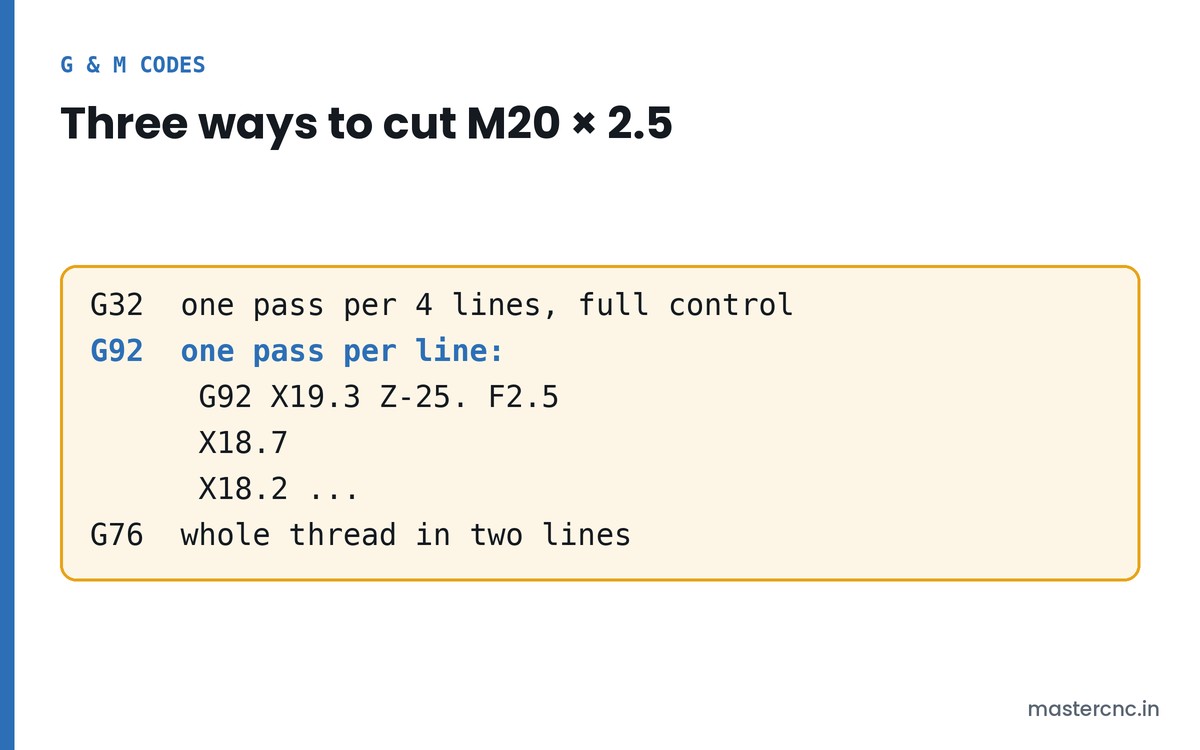
G92 (on G code system A) does the four moves of one pass in one block. Each following line gives only the new X:
G97 S800 M03
G00 X24. Z8.
G92 X19.3 Z-25. F2.5
X18.7
X18.2
X17.8
X17.45
X17.15
X16.95
X16.933
G00 X100. Z100.
You choose the depth of each pass. Keep the passes smaller as the thread gets deeper, and finish with a light pass or a repeat at the final size.
G76: the multi-pass cycle
G76 works out all the passes from the total depth and the first-pass depth, with a flank infeed that cuts on one side of the insert. Two lines for the whole thread. See the Fanuc G76 post for the full M20 × 2.5 example.
Which to use
| Method | Use when |
|---|---|
| G76 | Most threads: short program, good chip control with flank infeed |
| G92 | You want exact control of each pass depth, or the control has no G76 |
| G32 | Special threads, varying lead, unusual paths |
Common mistakes
- G96 left active: the lead changes as the diameter changes.
- F written as the pitch on a two-start thread (it must be the lead).
- Start point too close to the part: the first threads are wrong.
- Last pass too deep: poor finish on the flanks.
Thread depth and minor diameter for common metric threads are in the cheat sheet on the blog; check the final size with a ring gauge (see thread gauges).
Calculators, process sheet to program, simulation, codes and lessons. Free to start, no sign-in, on phone and laptop.
Open the app