Master
Part size changing during a batch
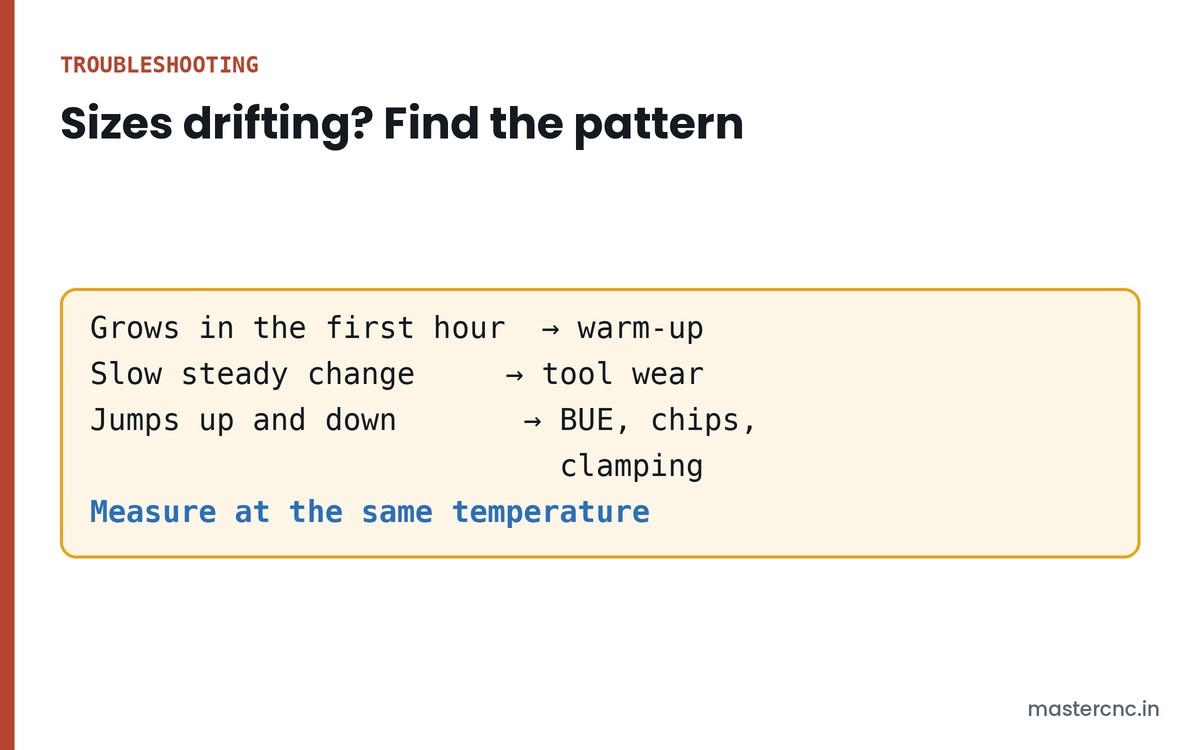
The first part is in size, the twentieth is 0.02 mm big, the fortieth is back in size. Size drift has a cause, and the pattern of the drift usually tells you which one. Write down the sizes and the time for a batch before you change anything.
Read the pattern
| Pattern | Likely cause |
|---|---|
| Changes in the first 30 – 90 minutes, then steady | Machine warming up (thermal growth) |
| Slow change in one direction all day | Tool wear |
| Random jumps | Built-up edge, chips in the jaws or collet, loose clamping |
| Different after a break or a stop | Machine cooling down |
| Different between morning and afternoon | Shop temperature, coolant temperature |
Warm-up and thermal growth
Spindles, ball screws and the machine frame grow as they warm up. The size settles once the machine reaches a steady temperature. Fix: run a warm-up program before the first part, and avoid long stops in the middle of tight work.
Tool wear
A turning insert wears and the diameter grows slowly (outside diameters) or shrinks (bores). Fix: correct with small wear offset steps at a fixed interval, or change the edge on a part count before it drifts too far. See wear offsets.
Part temperature
A steel part can grow by about 0.011 mm per metre per °C. A Ø50 part that is 20 °C warmer than the room measures about 0.011 mm big, and shrinks when it cools. Fix: measure parts at the same temperature every time, or let them cool before the final check. Watch out for hot parts in the afternoon.
Coolant
Coolant warms up during the day and with it the part and the machine. Low coolant level makes it worse. Keep the tank full and the concentration right.
Built-up edge, chips and clamping
Random jumps are rarely thermal. Look for built-up edge on the insert, chips in the chuck jaws or collet, a worn collet, or a part not seated against the stop.
How to keep sizes stable
- Warm the machine up before the first part.
- Measure at the same place, same temperature, same gauge.
- Correct in small steps, and write down every correction.
- Change edges on a schedule, not only when they break.
- Clean jaws and stops at every part change.
A simple size log (time, size, offset change) for one batch tells you more than any guess. Statistical tools like Cp and Cpk are covered later in this series.
Calculators, process sheet to program, simulation, codes and lessons. Free to start, no sign-in, on phone and laptop.
Open the app