Master
Why drills break: causes and fixes
A broken drill is often stuck in the part, which can turn a cheap tool into a scrapped part. Most breakages have one of a few causes, and most are easy to prevent.
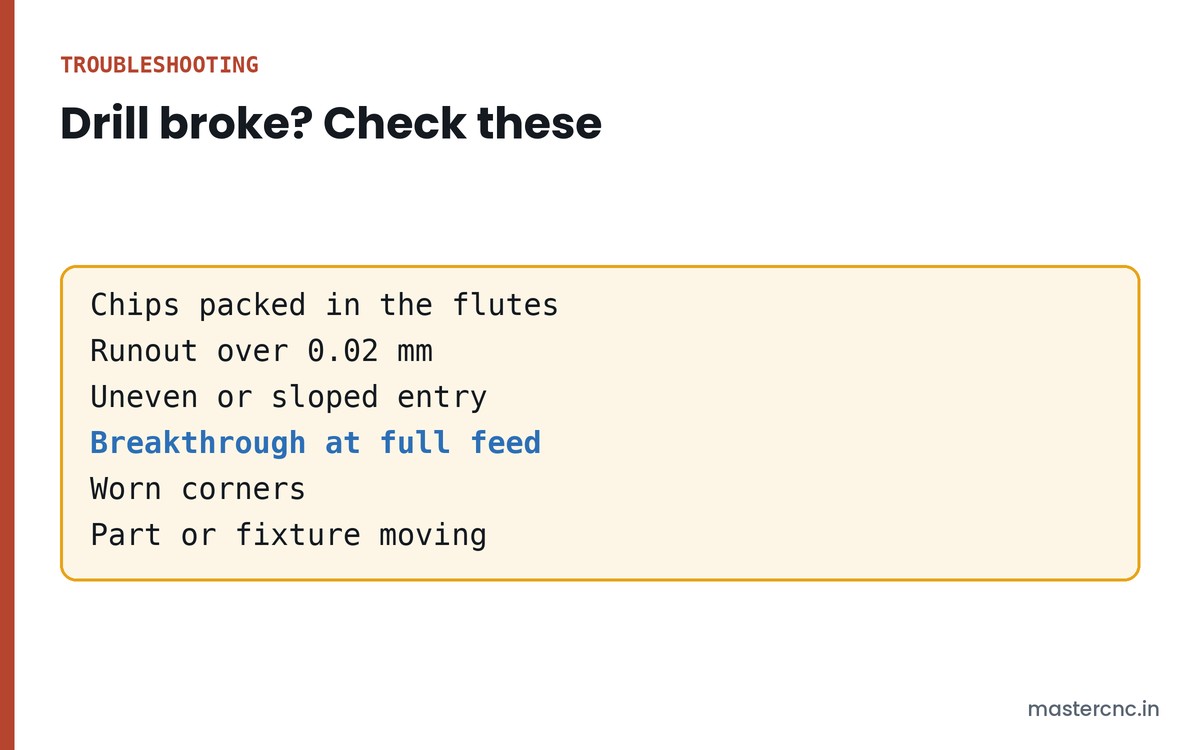
1. Chips pack in the flutes
In deep holes the chips cannot get out, they pack, the torque rises and the drill twists off. Fix: peck drilling (G83) for deep holes, through-coolant drills, or a drill with better chip flutes. See G83 vs G73.
2. Feed and speed
Too much feed overloads the drill; too little feed in stainless or hard steel rubs and work-hardens the bottom of the hole, and the next feed breaks the corners. Fix: start from the drill maker's data and stay in range. See starting cutting data.
3. Runout
A carbide drill running out more than about 0.02 mm cuts with one lip more than the other, makes oversize holes and breaks. Fix: clean holders, use hydraulic or shrink-fit holders for carbide drills, and check runout with an indicator.
4. Uneven entry
A drill entering a sloped, curved or rough surface bends sideways. Fix: spot or face the entry first, or use a drill made for uneven entry. Note that a 90° spot drill with a 140° drill point lets the drill start on its outer corners, which carbide drills do not like: use a spot angle equal to or larger than the drill point.
5. Breakthrough
As the drill exits, the last material breaks out and grabs the drill. Fix: reduce the feed for the last 1 – 2 mm, or drill to just below breakthrough and finish with a reduced feed.
6. Worn drills
Worn outer corners make the drill bind in the hole. Fix: change or regrind drills by hole count, and look at the corners regularly.
7. The part or fixture moves
Drilling thrust is high. A part that lifts or shifts takes the drill with it. Fix: support the part under the hole, clamp close to it.
8. Cross holes and interrupted cuts
Breaking into another hole makes the drill walk. Fix: reduce the feed through the intersection.
Common mistakes
- No coolant in a deep hole.
- Using a long drill when a short one would reach.
- Feed override turned down "to be careful" on a carbide drill: it rubs.
For tap breakage, see the separate post on why taps break in this series.
Calculators, process sheet to program, simulation, codes and lessons. Free to start, no sign-in, on phone and laptop.
Open the app