Master
Pocket milling: ramping, helical entry and trochoidal
Milling a closed pocket starts with a problem: the end mill has to get into the material from above. Then it has to clear the pocket without overloading in the corners. These are the usual ways to do both.
Getting in
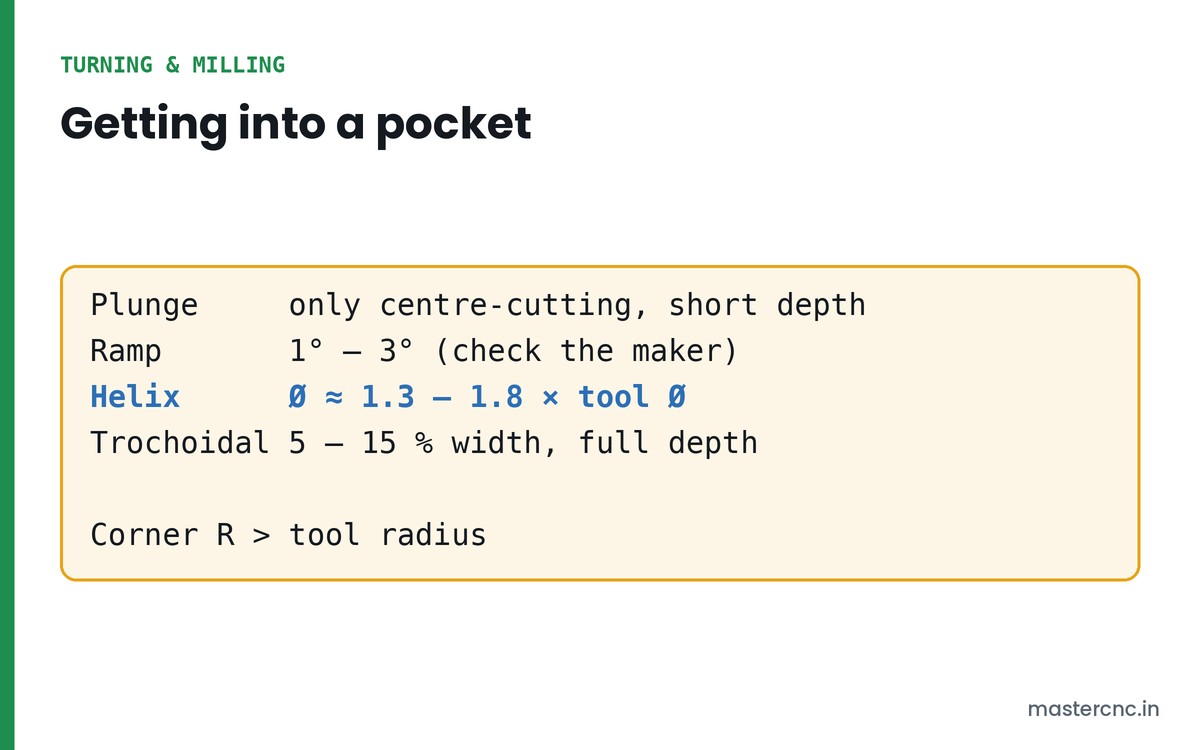
Plunging
Feeding straight down like a drill. Only possible with a centre-cutting end mill, at a low feed, and for small depths. Chips have nowhere to go. A pre-drilled start hole is safer.
Ramping
Feeding down at a shallow angle while moving sideways. Typical ramp angles are 1° – 3° for solid carbide end mills; the maker gives the limit for each tool. Steeper ramps overload the bottom edges.
Helical entry
The tool spirals down in a circle, which spreads the load and clears chips. Make the hole that the helix cuts about 1.3 – 1.8 times the tool diameter: big enough that the centre is cut and no core is left, small enough that the tool stays well supported. Example with a Ø10 end mill, a Ø16 hole (path radius 3), about 1 mm down per turn:
G00 X20. Y20.
G01 Z0.5 F500.
G01 X23.  (path radius 3)
G03 I-3. Z-1. F400.
G03 I-3. Z-2.
G03 I-3. Z-3.
G03 I-3.  (flat turn at the bottom)
A G03 with Z is a helical move. Check that your control has helical interpolation (most do).
Clearing the pocket
- Traditional: step-over 40 – 60 % of the diameter, small depth. Simple, but in the corners the tool is suddenly wrapped in material.
- Trochoidal / adaptive: small radial engagement (5 – 15 % of the diameter), full flute length depth, high feed. The tool load stays constant, heat goes into the chips, and tool life is much better. Needs CAM to program.
Corners
When an end mill goes into a corner with a radius equal to its own, it suddenly cuts with half its circumference. Make the pocket corner radius bigger than the tool radius, for example R6 with a Ø10 tool, or use a smaller tool for the corners only.
Chips
Recutting chips in a pocket breaks tools. Use air blast or through-tool coolant to clear them, especially in deep pockets.
Common mistakes
- Plunging with a non-centre-cutting end mill.
- Ramping at 10° "to save time".
- Helix diameter smaller than the tool: a solid core is left in the middle.
- Full slotting depth with traditional step-overs in the corners.
The end mill basics post explains which tools can plunge and ramp.
Calculators, process sheet to program, simulation, codes and lessons. Free to start, no sign-in, on phone and laptop.
Open the app