Master
Grooving and parting off without breaking inserts
Parting off is the cut that breaks the most inserts. The tool is thin, it goes deep, and at the centre the cutting speed drops to zero. A few simple rules make it routine.
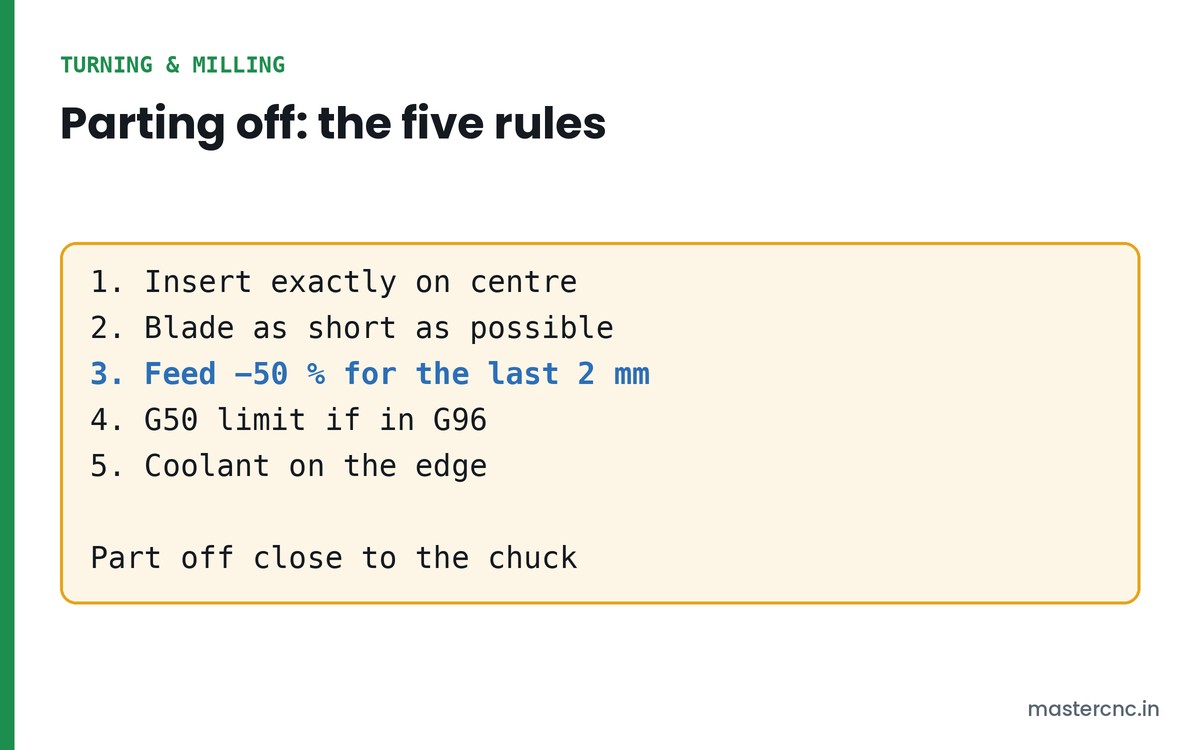
1. Centre height
The edge must be on the spindle centre line, within about ±0.1 mm. Too high and the insert rubs and breaks near the centre; too low and it leaves a pip and can be dragged under. Check it every time you change the blade.
2. Short blade overhang
Set the blade out only as far as the largest diameter needs plus a few millimetres. A long blade bends and chatters. Use the widest insert the part allows: wider is stronger.
3. Speed and feed near the centre
In G96 the spindle speeds up as the diameter shrinks, so set a G50 limit (see G96 and G50), or part off in G97 at a fixed RPM. Near the centre the cutting speed falls towards zero whatever you do, and the part starts to bend away: reduce the feed by about half for the last 2 mm.
G50 S2000
G96 S100 M03
G00 X42. Z-45. M08
G01 X4. F0.08
X-1. F0.04
G00 X45.
4. Chips
A parting insert makes a chip as wide as the groove. If it does not curl and narrow, it jams and breaks the insert. Use an insert with a chip-forming geometry for your material, a feed in its range, and coolant aimed at the edge. In stringy materials, a peck cycle such as G75 breaks the chip.
5. The pip and the burr
- A neutral insert cuts straight but leaves a small pip on the part.
- An insert with a lead angle (left or right hand) cuts the pip off the part, but bends more and can make a concave face. Use small angles, and only when the pip must go.
- Program a chamfer on the next part before parting, so the burr is not on a sharp edge.
Catch the part
Use a parts catcher or a sub-spindle where you can. A part dropping into the chips gets damaged, and a long part can whip and break the insert just before it drops.
Common mistakes
- Parting far from the chuck: the part vibrates.
- Blade not square to the axis: the insert rubs on one side.
- Full feed all the way to X0.
- No G50 limit in G96.
Grooving inserts follow the same rules for centre height, overhang and chip control. Start with the insert maker's feed range for the width you use.
Calculators, process sheet to program, simulation, codes and lessons. Free to start, no sign-in, on phone and laptop.
Open the app