Master
End mill basics: flutes, helix, coating, corner radius
Two end mills of the same diameter can behave completely differently. Flutes, helix, coating, corner shape and length decide where a cutter works well. Here is what each one does.
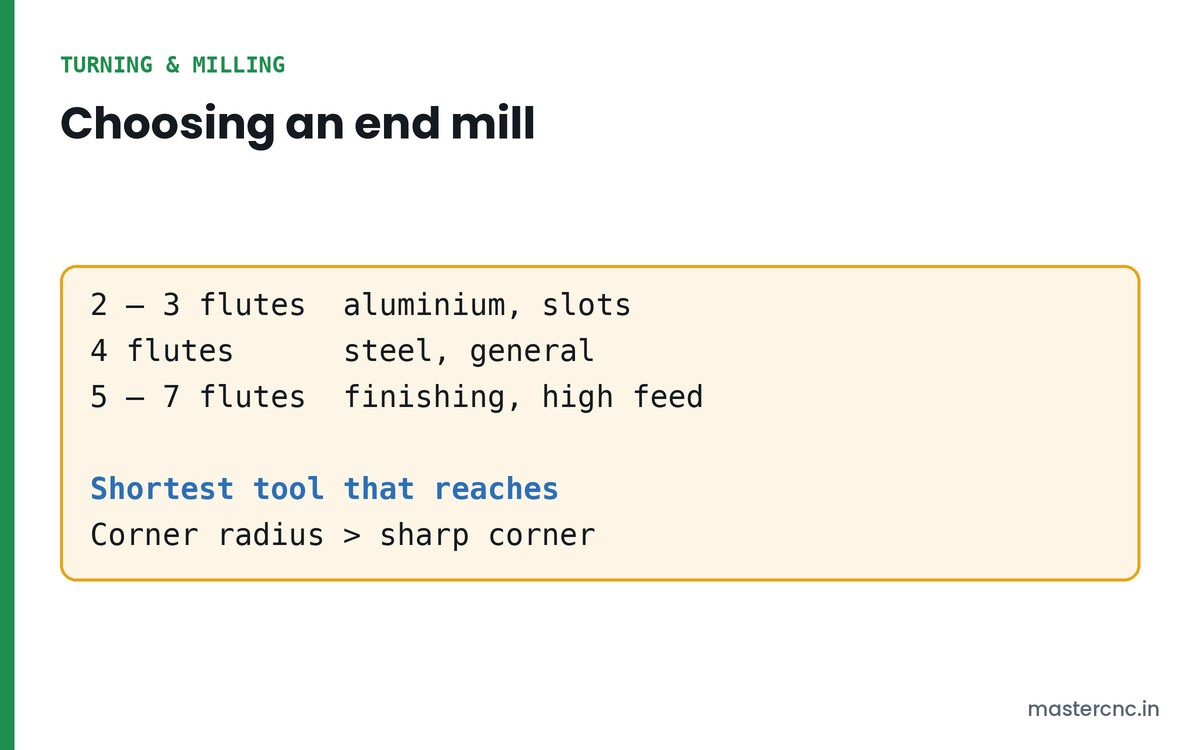
Number of flutes
| Flutes | Good for | Why |
|---|---|---|
| 2 | Aluminium, slotting, plunging | Big chip space |
| 3 | Aluminium, general use | Chip space with more strength |
| 4 | Steel, stainless, general | Stiffer core, more edges |
| 5 – 7 | Finishing, high-feed side milling in steel | More edges per turn, less chip space |
More flutes allow more feed at the same feed per tooth, but leave less room for chips. In deep slots and soft materials, chip space wins.
Helix angle
- About 30°: general purpose.
- 35 – 45°: smoother cutting and better finish, and it lifts chips well: common for aluminium and finishing.
- Variable helix or pitch: the flutes are not evenly spaced, which breaks up vibration. Good against chatter.
Coating
- Steel, stainless, cast iron: heat-resistant coatings based on TiAlN or AlTiN.
- Aluminium: uncoated polished, or low-friction coatings such as DLC or ZrN. Avoid aluminium-containing coatings: aluminium chips stick to them.
Corner shape
- Sharp corner: square shoulders, but the weakest point of the tool.
- Corner radius (for example R0.5): much stronger and lasts longer. Use it unless the drawing needs a sharp inside corner.
- Ball nose: 3D surfaces.
Length
A cutter's stiffness falls very quickly with stick-out. Use the shortest end mill and holder that reach the depth. For deep walls, a necked tool (short flutes, thinner neck) is stiffer than a long-flute tool.
Centre cutting
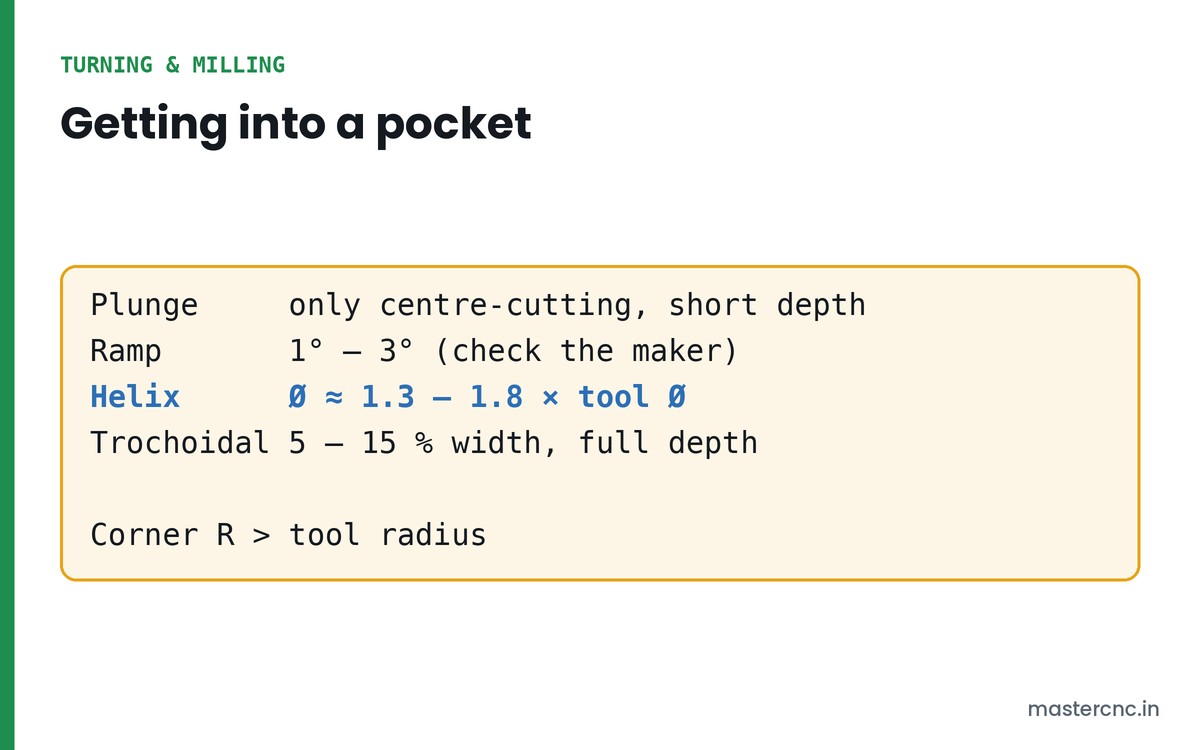
Only end mills with cutting edges to the centre can plunge or ramp. Check before plunging; otherwise, drill a start hole (see pocket milling).
Common mistakes
- A 4-flute steel end mill in aluminium: chips pack and weld.
- A long-flute tool where a short one would reach.
- Full-width slotting with a 6-flute finishing cutter.
- Running at the same feed per tooth on a 6-flute as a 3-flute and wondering why F is so high: check chip space instead.
Cutting data comes from the end mill maker for your exact tool; see starting cutting data for typical ranges.
Calculators, process sheet to program, simulation, codes and lessons. Free to start, no sign-in, on phone and laptop.
Open the app