Master
Boring bars: overhang ratio and avoiding chatter
A boring bar is a cantilever: the further it sticks out, the more it bends and vibrates. Choosing the right bar for the depth is the single biggest step towards a good bore.
The overhang ratio
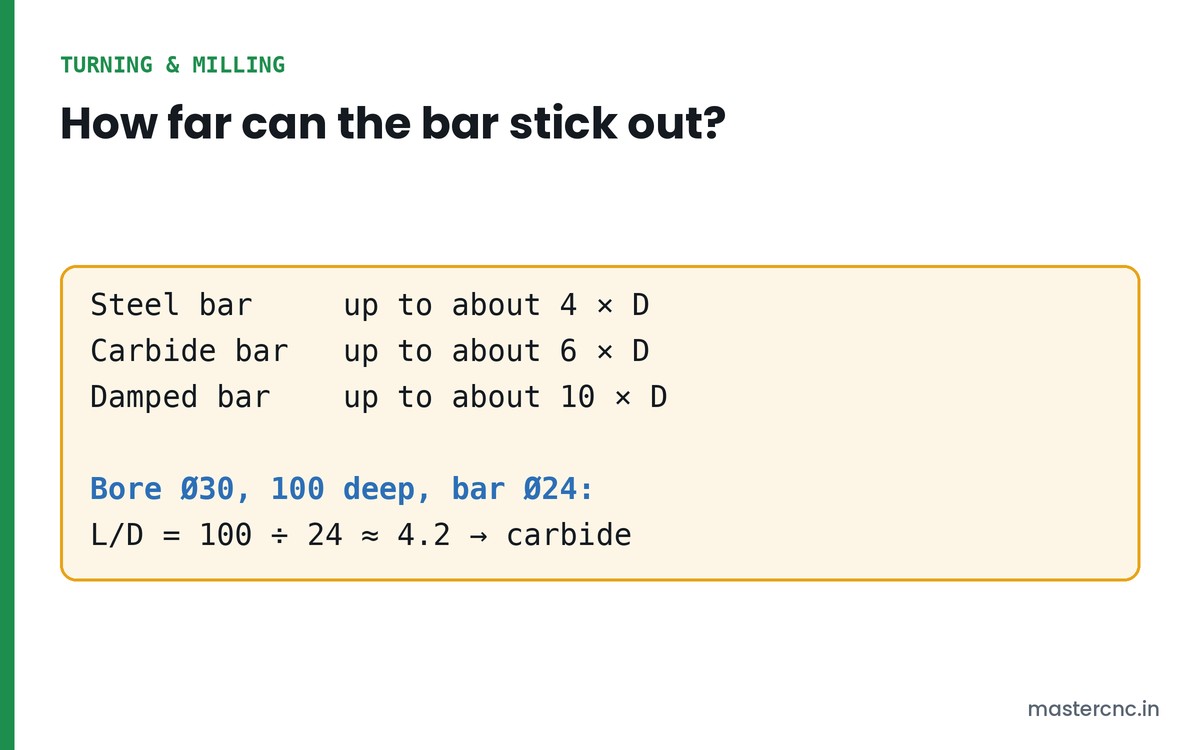
Overhang (L) is measured from the clamp face to the cutting edge. Divide it by the bar diameter (D):
| Bar material | Typical maximum L/D |
|---|---|
| Steel | about 3 – 4 × D |
| Solid carbide | about 5 – 6 × D |
| Damped (anti-vibration) steel | about 7 – 10 × D, longer for special bars |
These are general guides; each maker gives limits for its own bars.
Example
A Ø30 bore, 100 mm deep. The biggest bar that fits with room for chips is about Ø24 (roughly 75 – 80 % of the bore). L/D = 100 ÷ 24 ≈ 4.2: too long for a steel bar, fine for carbide.
Pick the biggest bar that fits
Stiffness grows very fast with diameter: a bar 25 % thicker is more than twice as stiff. Use the largest bar that still leaves space for chips and clears the bore when you retract.
Clamp it properly
- Use a split sleeve or a holder that grips the whole shank length, not a set screw on one spot.
- Keep the overhang as short as the bore needs, plus a few millimetres. Do not leave it long "for another job".
- Set the edge on centre height. Below centre, the bar rubs on small bores.
Insert and cutting choices
- Lead angle close to 90° (95° holder): cutting force goes along the bar, not sideways.
- Small nose radius (R0.2 – 0.4) and a sharp positive insert (CCMT, DCMT) for low forces.
- Feed: do not go too light; a firm cut is more stable than rubbing.
- Through-coolant clears chips out of deep bores.
- If it still chatters, change RPM by 10 – 20 % (see chatter in turning).
Common mistakes
- A thin bar in a big bore, "because it was in the turret".
- A negative insert with a big nose radius on a long bar.
- Measuring the bore and correcting the offset while the bar is still deflecting: take a spring pass first and check if the size changes.
Check the maker's overhang limits for your exact bar. A spring pass (a second pass at the same size) shows how much the bar is bending.
Calculators, process sheet to program, simulation, codes and lessons. Free to start, no sign-in, on phone and laptop.
Open the app