Master
Starting cutting data: steel, stainless and aluminium
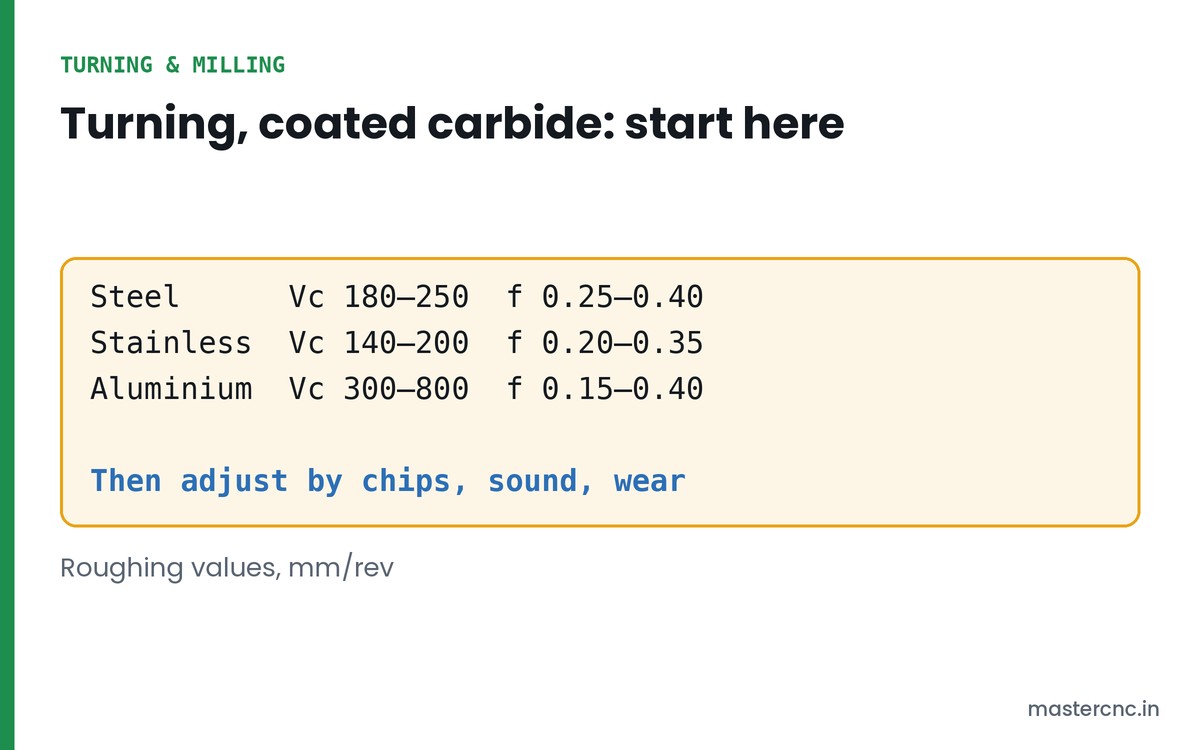
The best cutting data comes from the tool maker's catalogue for your exact insert, grade and material. When you do not have it to hand, these starting values for carbide tools get you cutting safely. Then adjust using the chips, the sound and the wear.
Turning (coated carbide inserts)
| Material | Cut | Vc (m/min) | f (mm/rev) | ap (mm) |
|---|---|---|---|---|
| Steel | Rough | 180 – 250 | 0.25 – 0.40 | 2 – 4 |
| Steel | Finish | 220 – 300 | 0.08 – 0.20 | 0.3 – 1 |
| Stainless | Rough | 140 – 200 | 0.20 – 0.35 | 1.5 – 3 |
| Stainless | Finish | 160 – 220 | 0.08 – 0.15 | 0.3 – 1 |
| Aluminium | Rough | 300 – 800 | 0.15 – 0.40 | 2 – 5 |
| Aluminium | Finish | 400 – 1000 | 0.08 – 0.15 | 0.3 – 1 |
Milling (solid carbide end mills, side milling)
| Material | Vc (m/min) | fz for Ø10 – 12 (mm/tooth) |
|---|---|---|
| Steel | 120 – 200 | 0.03 – 0.08 |
| Stainless | 80 – 140 | 0.02 – 0.06 |
| Aluminium | 300 – 600 | 0.04 – 0.12 |
Feed per tooth grows with cutter diameter and drops for full-width slots. Turn it into F with F = fz × z × n (see feed rate).
Drilling (solid carbide drills, Ø8 – 12)
| Material | Vc (m/min) | f (mm/rev) |
|---|---|---|
| Steel | 80 – 120 | 0.15 – 0.25 |
| Stainless | 50 – 80 | 0.10 – 0.18 |
| Aluminium | 150 – 250 | 0.15 – 0.30 |
HSS drills run much slower, about 20 – 30 m/min in steel.
Turning these into a program
Steel Ø50, rough:
n = 1000 × 200 ÷ (π × 50)
  = 1273 RPM

G50 S2500
G96 S200 M03
G71 U2.5 R0.5
G71 P10 Q20 U0.4 W0.1 F0.3
How to adjust
- Edge wears fast, chips are blue: lower Vc by 10 – 20 %.
- Built-up edge, torn surface: raise Vc (see built-up edge).
- Long chips: raise feed or depth (see chipbreakers).
- Edge chips or breaks: lower feed, or use a tougher grade.
- Chatter: see chatter in turning.
Common mistakes
- Using aluminium speeds on a steel part after a job change.
- Running stainless too slowly with a light feed: it work-hardens.
- Ignoring machine power on big roughing cuts. Check the spindle load meter.
These are general starting values for stable setups and coated carbide. Your tool maker's data, your machine's power and your setup's rigidity come first.
Try it in Master CNC
Calculators, process sheet to program, simulation, codes and lessons. Free to start, no sign-in, on phone and laptop.
Open the app