Master
Insert grades: ISO P, M, K, N, S, H material groups
An insert with the right shape but the wrong grade wears out in minutes or breaks on the first cut. Every tool maker sorts its grades by the same ISO material groups (ISO 513), with the same letters and colours. Learn the six groups and you can read any catalogue.
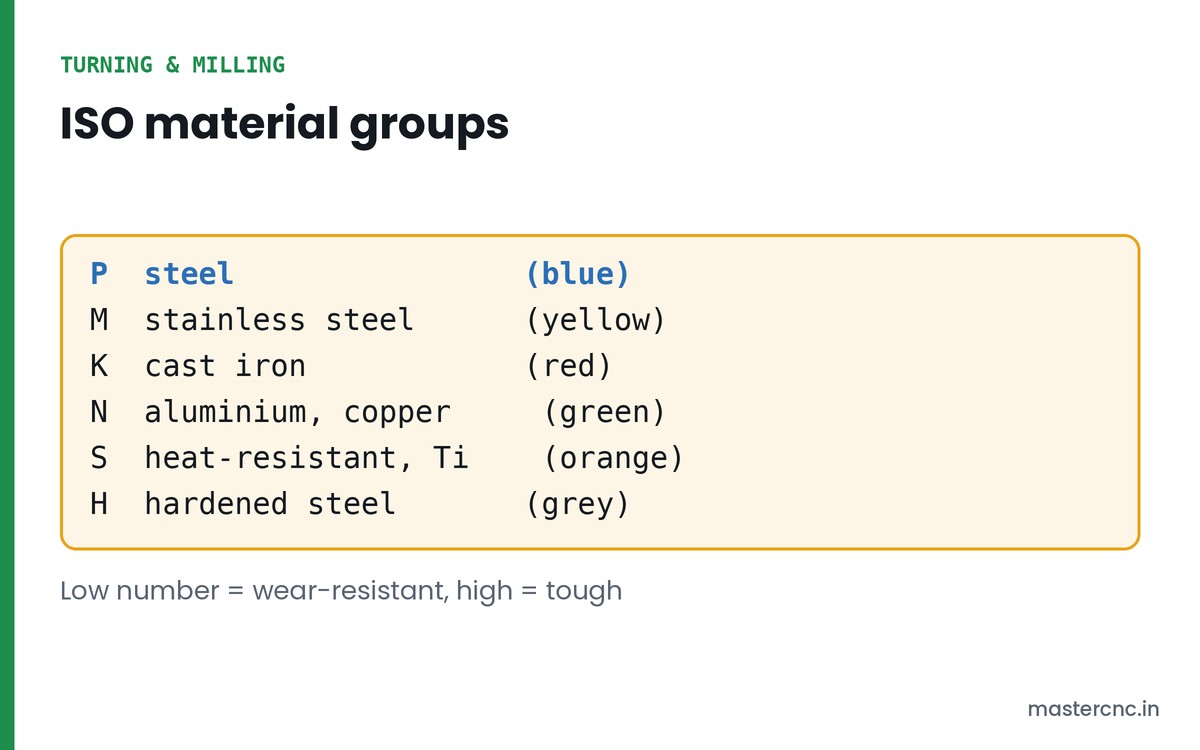
The six groups
| Group | Colour | Materials | What makes it hard |
|---|---|---|---|
| P | Blue | Steel, cast steel | Long chips, heat |
| M | Yellow | Stainless steel | Work hardening, sticky, built-up edge |
| K | Red | Cast iron | Abrasive, short chips |
| N | Green | Aluminium, copper, brass, plastics | Built-up edge, needs a sharp edge |
| S | Orange | Heat-resistant alloys, titanium | Heat, notch wear, low speeds |
| H | Grey | Hardened steel (about 45 – 65 HRC) | Very high cutting forces and heat |
What the number means
Catalogues place each grade on a scale, for example P10, P25, P40:
- Low number (01 – 15): hard and wear-resistant. Higher speeds, finishing, steady cuts.
- Middle (20 – 30): general purpose, the first choice for most jobs.
- High number (35 – 50): tough. Interrupted cuts, scale, unstable setups, lower speeds.
If an insert wears too fast, move to a lower number. If it chips or breaks, move to a higher number.
CVD or PVD coating?
- CVD coatings are thicker and resist heat and wear. They are the usual choice for turning steel and cast iron.
- PVD coatings are thinner, so the edge can be sharper. Common for stainless, heat-resistant alloys, milling and small, sharp inserts.
- Uncoated or polished grades with sharp edges are used for aluminium, where coatings can make chips stick.
Grade and chipbreaker work together
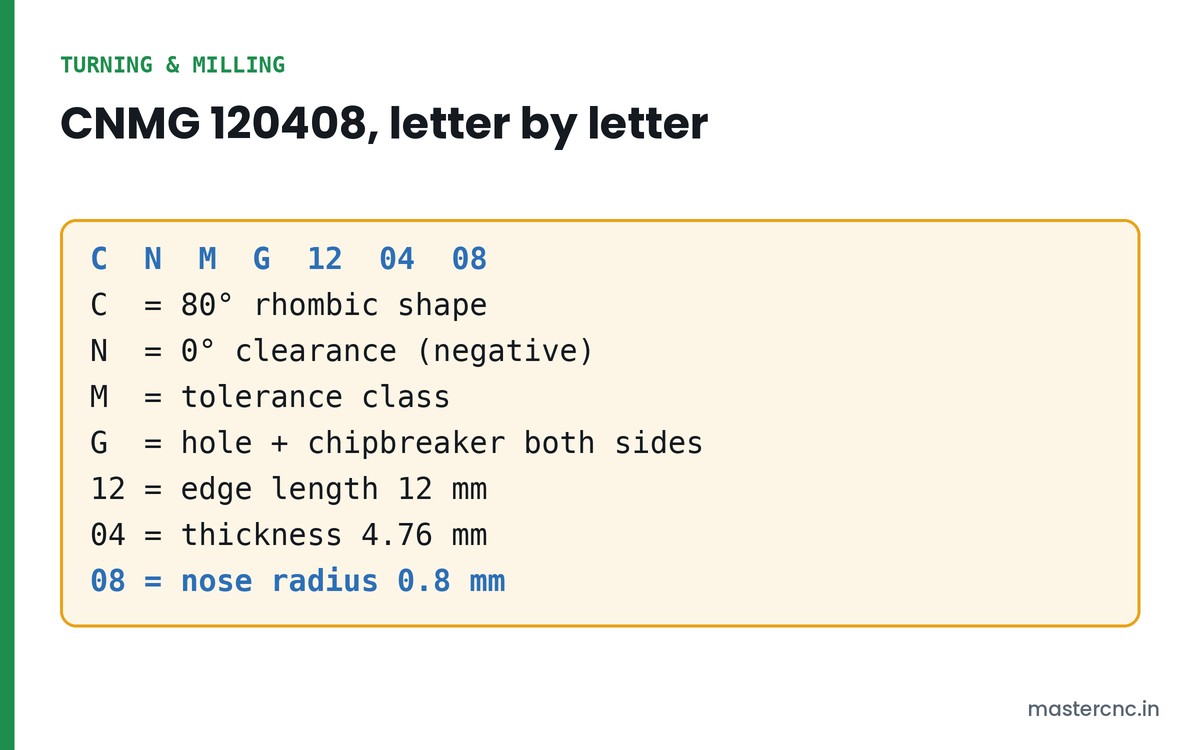
The full code on the box is something like CNMG 120408-MM 2025: shape and size (see insert codes), the chipbreaker after the dash and the grade at the end. Pick the grade for the material and the cut, then the breaker for the depth and feed.
Common mistakes
- Using a steel (P) grade on stainless all day: it works, but wears and builds up much faster than an M grade.
- A hard finishing grade on a forged skin or interrupted cut: the edge chips.
- Running a tough grade at finishing speeds and wondering why it wears.
- Comparing grades by name between brands. Compare by ISO group and number.
Grade names and the exact speed ranges come from each tool maker's catalogue. Use their recommended starting data, then adjust.
Calculators, process sheet to program, simulation, codes and lessons. Free to start, no sign-in, on phone and laptop.
Open the app