Master
Boring soft jaws step by step
Soft jaws are only as accurate as the way they are bored. Bored well, a part runs true to within one or two hundredths. Bored carelessly, they hold no better than hard jaws. The key is to bore them in exactly the state they will be in when they clamp the part.
1. Fit the jaws
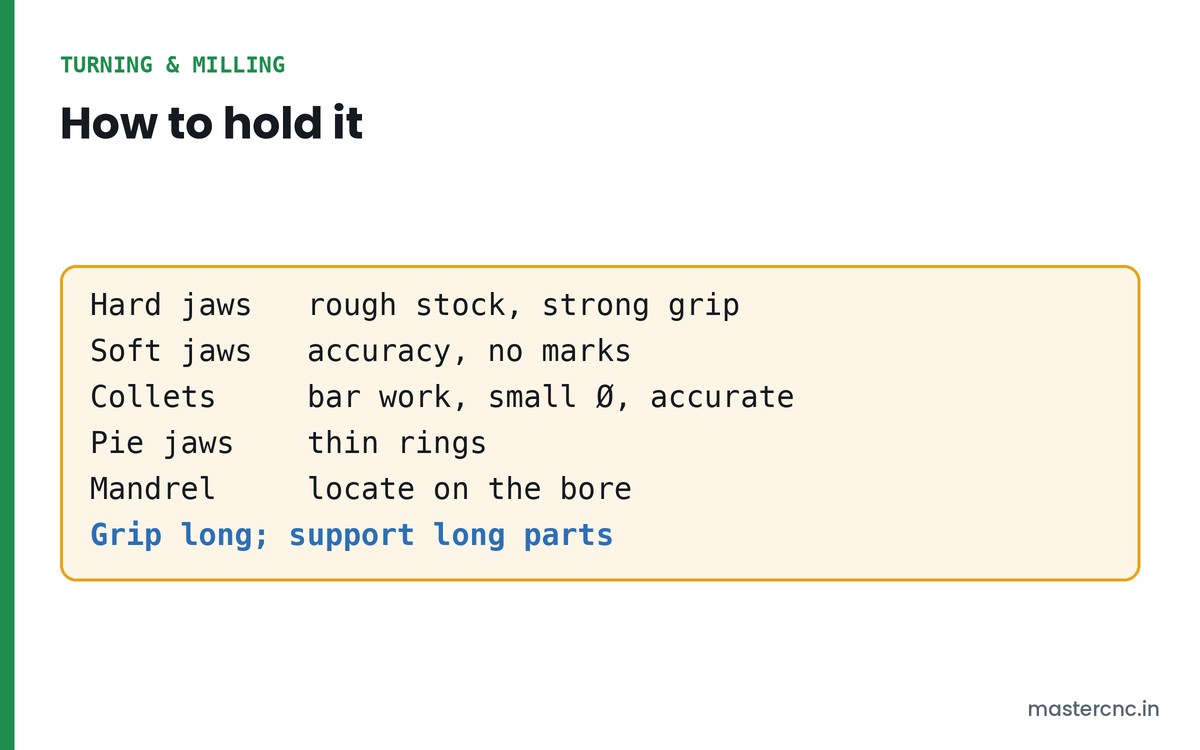
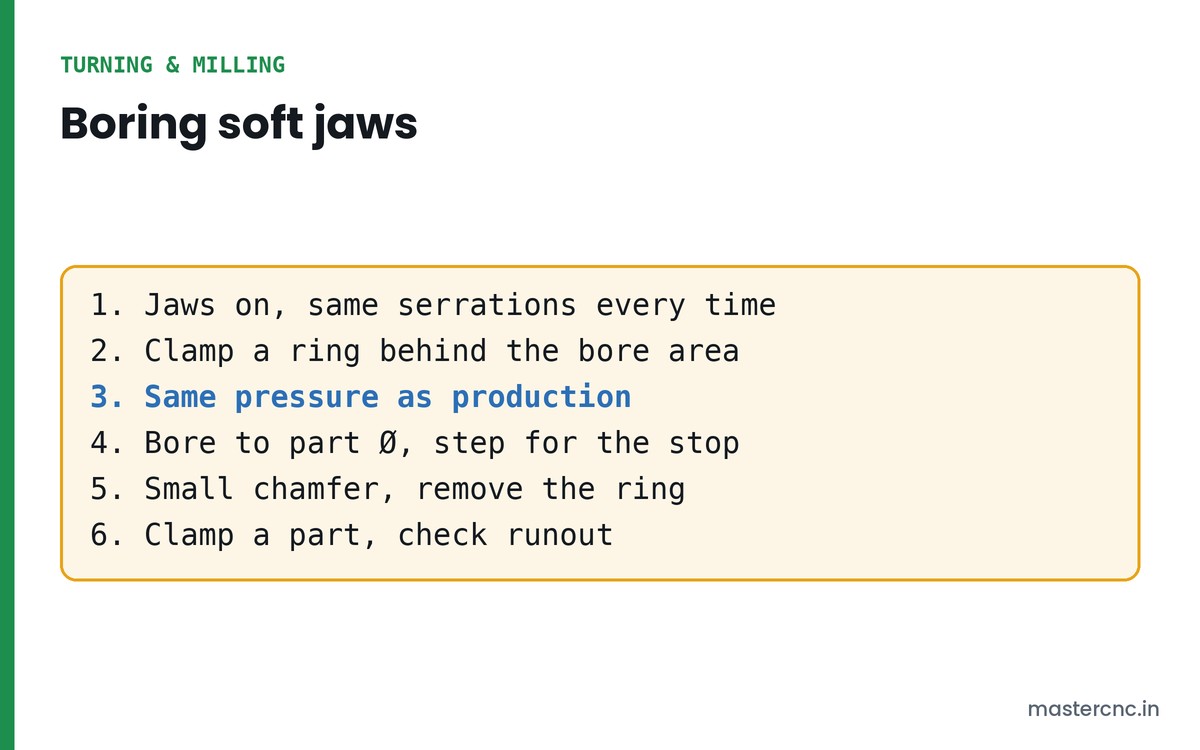
Mount the jaws on the chuck in the same serrations every time and number them (1, 2, 3 to match the chuck slots). Tighten the screws evenly.
2. Load the jaws with a ring
The jaws must be closed on something while you bore them, so they sit as they will on the part. Clamp a boring ring or a plug (a disc or a set of pins) towards the back or front of the jaws, outside the area you will bore. Choose its size so that, when clamping the real part, the jaws are near the middle of their stroke.
3. Use production pressure
Set the chuck pressure to the value you will use for the part. Jaws deflect under pressure; if you bore them at a different pressure, they will clamp at a different shape.
4. Bore the clamping diameter
- Bore to the part's clamping diameter; many setters bore a few hundredths smaller so the jaws close fully on the face of the bore.
- Bore deep enough to grip a good length of the part.
- Add a face step for the part to sit against, so it cannot move back.
- Take a light finishing pass with a sharp tool for a clean, round surface.
(example: part Ø50, grip 15 mm, step at Z-15)
G00 X44. Z2.
G01 Z-15. F0.15
X49.98  (step face)
Z2.  (out along the bore)
G00 X44.
(repeat to final Ø49.98, light last pass)
5. Finish
Put a small chamfer on the bore entry so parts slide in, deburr, remove the ring, and clean out the chips.
6. Check
Clamp a part, check runout with a dial indicator on a finished diameter. If it runs out more than expected, check the jaw numbering, the ring position and the pressure.
Gripping on the inside
For jaws that expand into a bore, do the same but load the jaws outward with a ring around them, and turn the outside diameter instead.
Common mistakes
- Boring the jaws open, with nothing clamped.
- Different pressure for boring and production.
- Jaws moved to other serrations after boring.
- Jaws at the end of their stroke: no clamping force left.
Check the chuck's speed limit with your soft jaws: tall jaws lower it. See lathe workholding.
Calculators, process sheet to program, simulation, codes and lessons. Free to start, no sign-in, on phone and laptop.
Open the app