Master
Lathe workholding: hard jaws, soft jaws, collets
Most turning problems that look like tool problems are really holding problems: parts that move, run out, chatter or distort. Choosing the right workholding is half the job.
Hard jaws
Serrated, hardened jaws. Strong grip on rough bar, castings and forgings. They mark the part, and repeat to only a few hundredths of a millimetre. Good for first operations on rough stock.
Soft jaws
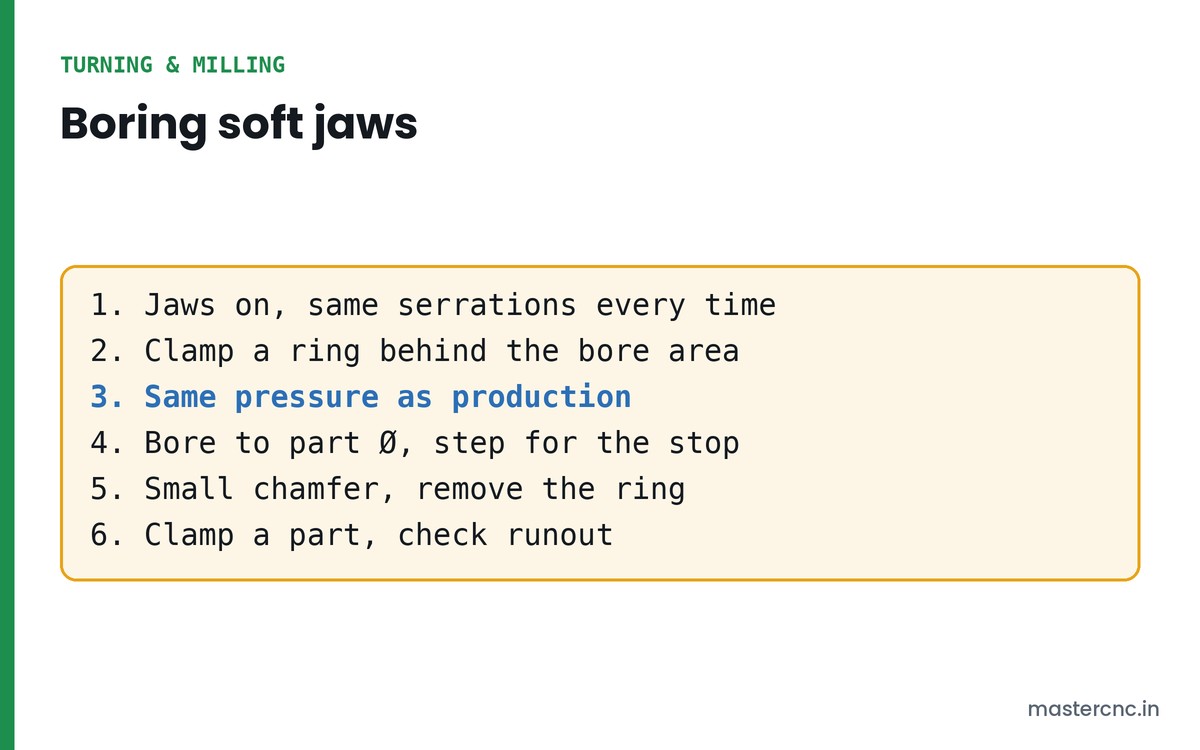
Unhardened jaws bored to the part's diameter on the machine. Full contact, accurate (often 0.01 – 0.02 mm runout), no marks. The standard for second operations and finished diameters. See boring soft jaws.
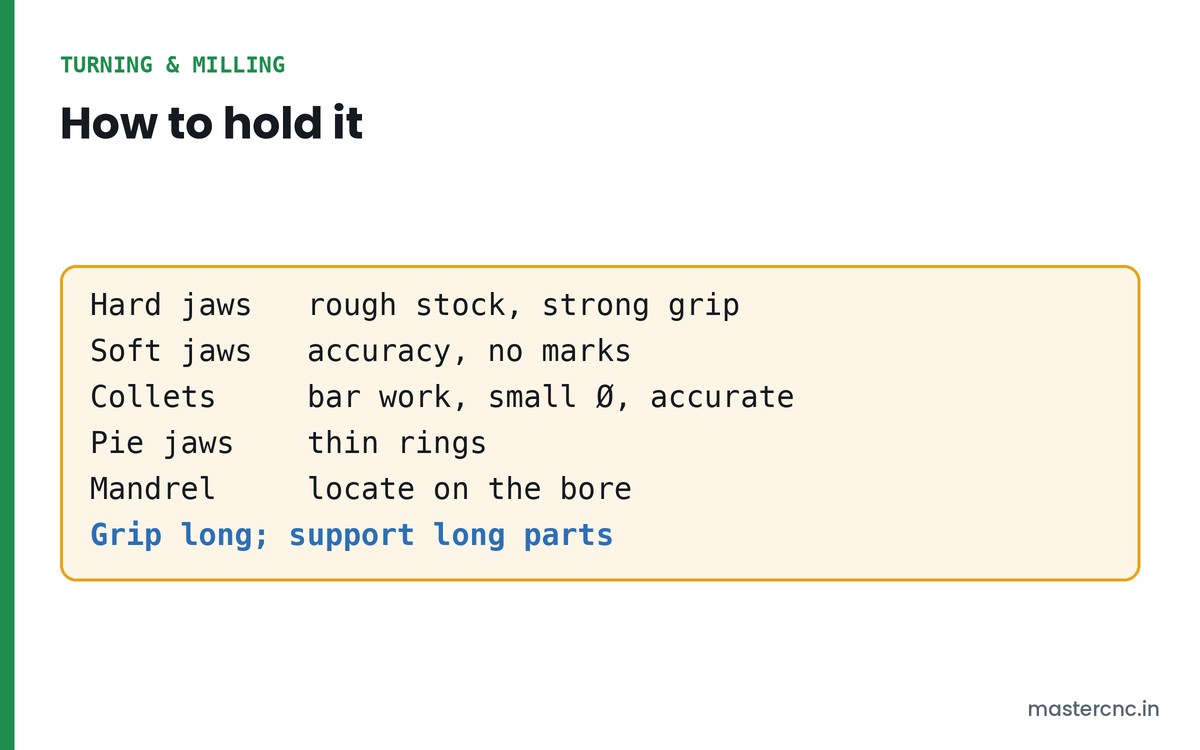
Collets
Grip all round on bar stock, usually up to about Ø65 depending on the system. Fast, accurate and gentle. Each collet suits a narrow size range.
Pie jaws and six-jaw chucks
Jaws that wrap around most of the part, or more jaws, spread the clamping force. Used for thin rings that a three-jaw chuck would squeeze out of round (see out-of-round bores).
Mandrels and expanding arbors
Grip inside a finished bore, so the outside runs true to it.
Centres and face drivers
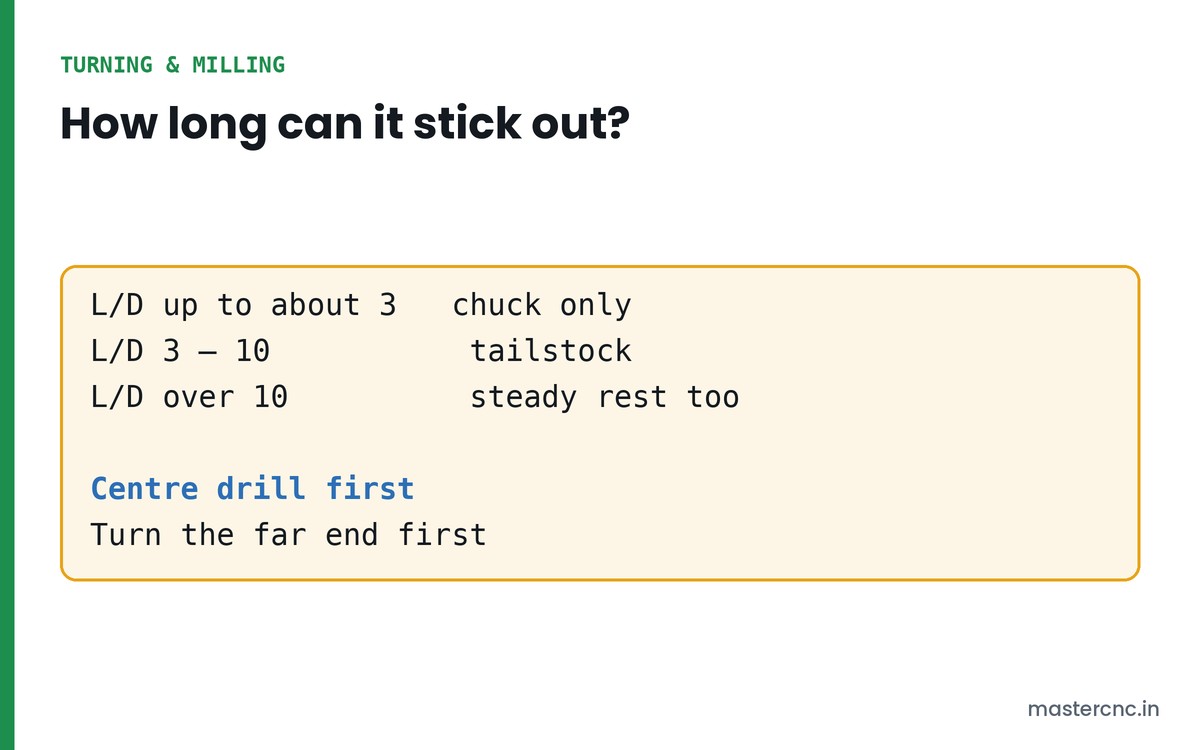
Long shafts between centres, with a face driver or a dog to turn them. Every diameter then runs true to the centres, and the whole length can be turned in one setup.
How much to grip
- Grip as long as the jaws allow, on a round, clean diameter.
- Parts sticking out more than about 3 × their diameter need tailstock or steady rest support.
- Seat the part against a stop or the jaw step so it cannot move back.
Speed limits
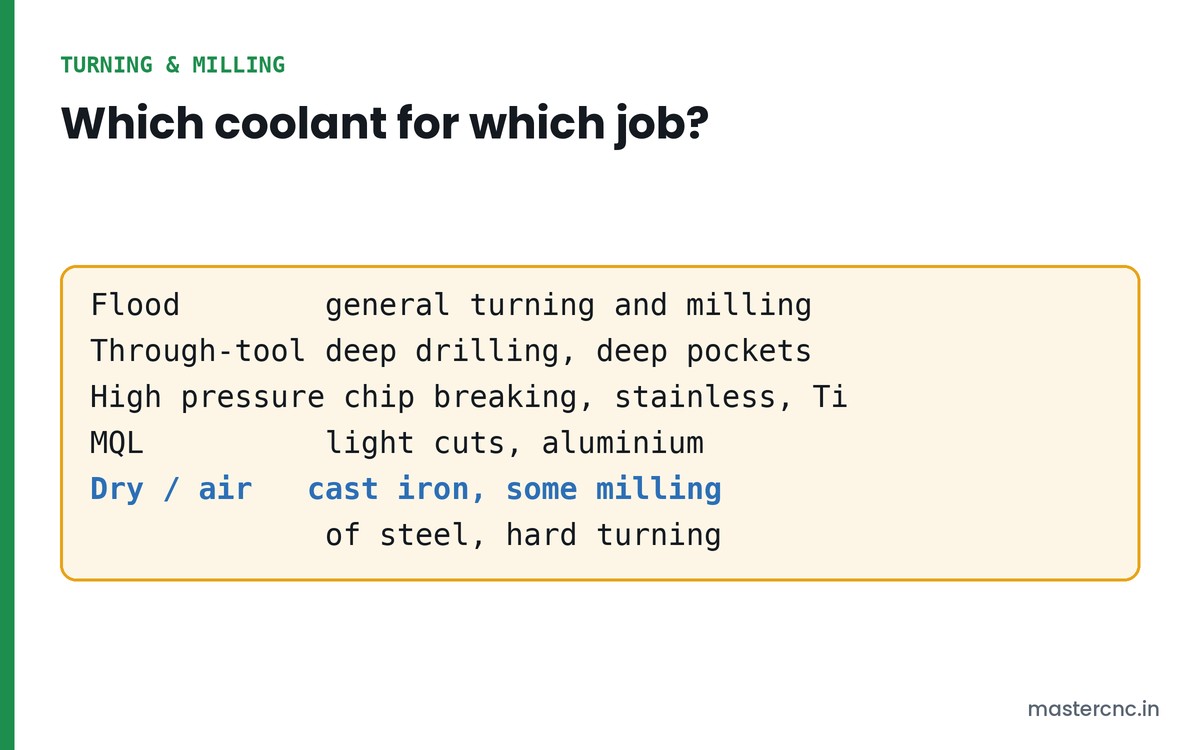
At high RPM the jaws are pulled outward and lose grip. Every chuck has a maximum speed, lower with heavy or tall soft jaws. Set the G50 limit below it (see G96 and G50).
Common mistakes
- Gripping a finished diameter with hard jaws.
- Thin part clamped at full pressure for the finish pass.
- Tall soft jaws run at the hard-jaw speed limit.
- Chips between part and jaws.
Chuck pressure and speed limits come from the chuck maker and machine builder. Check them for every jaw setup.
Calculators, process sheet to program, simulation, codes and lessons. Free to start, no sign-in, on phone and laptop.
Open the app