Master
Coolant: flood, through-spindle or MQL
Coolant does three jobs: it cools, it lubricates, and it carries chips away. Which job matters most depends on the operation, and that decides how to deliver it.
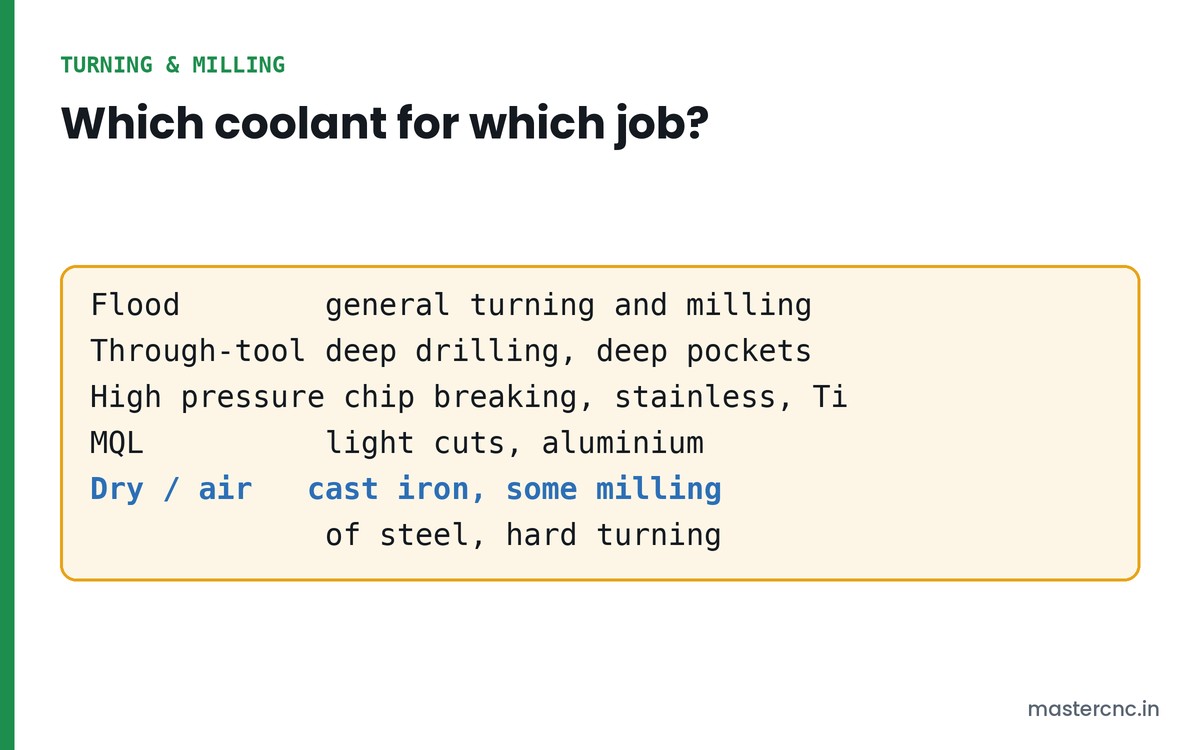
Flood coolant
Water-soluble coolant poured over the cut from nozzles. The standard for most turning and milling. Aim the nozzles at the cutting edge, not the part or the tool body, and keep the concentration right (see the coolant concentration post in this series).
Through-tool and through-spindle coolant
Coolant fed through the spindle and the tool to the cutting edge, often at 20 – 70 bar.
- Deep holes: chips are flushed out, so carbide drills can go deep without pecking.
- Deep pockets and slots: chips are blown out instead of re-cut.
- Turning with high-pressure jets: breaks chips in stainless, titanium and heat-resistant alloys.
MQL (minimum quantity lubrication)
A tiny amount of oil in compressed air, sprayed or fed through the tool. Lubricates, cools little. Clean parts and chips, less fluid to manage. Good for light cuts, aluminium and some drilling; needs a machine and tools set up for it.
Dry and air blast
- Cast iron: often cut dry or with air: chips are short and coolant makes a sludge.
- Milling steel with carbide: some tool makers prefer dry or air, because coolant hitting a hot edge on and off causes thermal cracks. Either flood it steadily or run dry, as the tool maker advises.
- Hard turning: often dry.
By material
| Material | Usual choice |
|---|---|
| Steel | Flood; through-tool for deep holes |
| Stainless | Flood or high pressure, good concentration |
| Cast iron | Dry or air, or flood with good filtration |
| Aluminium | Flood or MQL; lubrication stops built-up edge |
| Titanium, heat-resistant alloys | High-pressure flood |
Common mistakes
- Nozzles aimed at the part instead of the edge.
- Coolant on and off during an interrupted milling cut.
- Low concentration: rust, built-up edge, short tool life.
- Through-coolant drill used without coolant pressure.
Follow the tool maker's advice for coolant on each tool, and the safety data sheet for handling coolant.
Calculators, process sheet to program, simulation, codes and lessons. Free to start, no sign-in, on phone and laptop.
Open the app