Master
Chipbreakers: why chips wrap and how to fix it
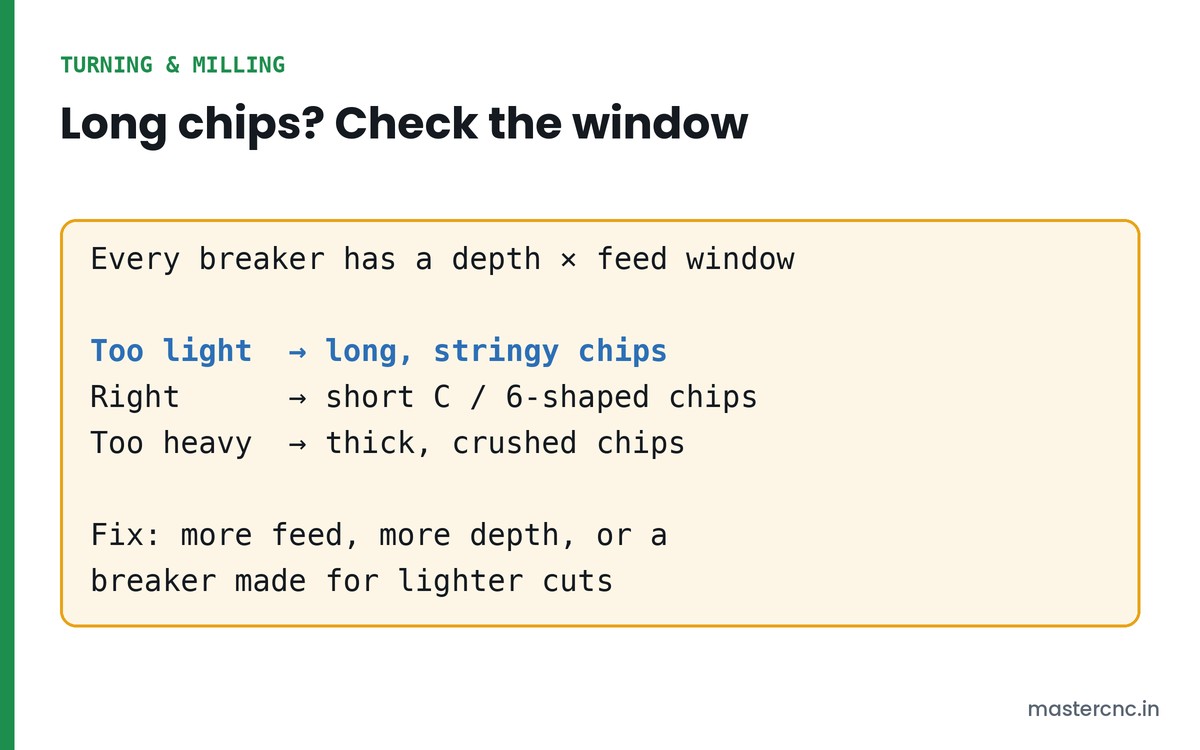
Long chips wrap around the part and the tool, scratch the finished surface, block the coolant and can pull the operator's hand in. The chipbreaker on the insert is there to curl and break the chip. It only works inside a certain range of depth and feed.
What good chips look like
- Good: short "C" or "6" and "9" shaped pieces, or short tight spirals. They fall away from the part.
- Too light: long ribbons or tangled "birds' nests". The breaker is not being used.
- Too heavy: very short, thick, crushed or powdery chips, often blue. The edge is overloaded and may break.
How a chipbreaker works
The breaker is the shaped groove and bumps behind the cutting edge. It bends the chip upwards so it hits the workpiece or the tool and snaps. For that, the chip must be thick and stiff enough. That is why feed matters most: feed sets the chip thickness. Depth of cut sets the chip width and how much of the breaker is used.
The breaker window
Every catalogue shows a small chart for each breaker: depth of cut on one axis, feed on the other, and a shaded area where it breaks chips. Typical windows for steel turning look like this:
| Breaker type | Depth (mm) | Feed (mm/rev) |
|---|---|---|
| Finishing | 0.2 – 1.5 | 0.05 – 0.20 |
| Medium | 1 – 5 | 0.15 – 0.40 |
| Roughing | 3 – 8 | 0.30 – 0.70 |
These are general ranges only: use the chart for your exact insert.
What to change when chips are too long
- Increase the feed a little. This is the strongest effect.
- Increase the depth of cut, so the chip reaches the breaker.
- Use a breaker made for lighter cuts (a finishing breaker for a finishing pass).
- Smaller nose radius: at small depths a big radius makes a thin, wide chip that does not break.
- Coolant aimed at the cutting zone, or high-pressure coolant if the machine has it.
Difficult materials
Soft low-carbon steel, stainless steel and aluminium make tough, stringy chips. Use breakers made for that material group, and accept a slightly higher feed in finishing if the surface allows it (see surface roughness from feed).
Common mistakes
- Reducing feed to "be gentle": the chips get longer.
- A roughing breaker for a 0.3 mm finish pass.
- Pulling chips off by hand with the spindle running. Stop the machine and use a hook.
Look at the chips on the first part, not just the dimensions. Chip shape tells you if the cut is in the right window.
Calculators, process sheet to program, simulation, codes and lessons. Free to start, no sign-in, on phone and laptop.
Open the app