Master
Insert codes explained: what CNMG 120408 means
Every turning insert has a code like CNMG 120408 printed on the box. It is not a part number: it is a short description of the insert, and it follows the same ISO system (ISO 1832) at every tool maker. Once you can read it, you can order the right insert, compare brands and set the nose radius on the offset page without guessing.
The code, position by position
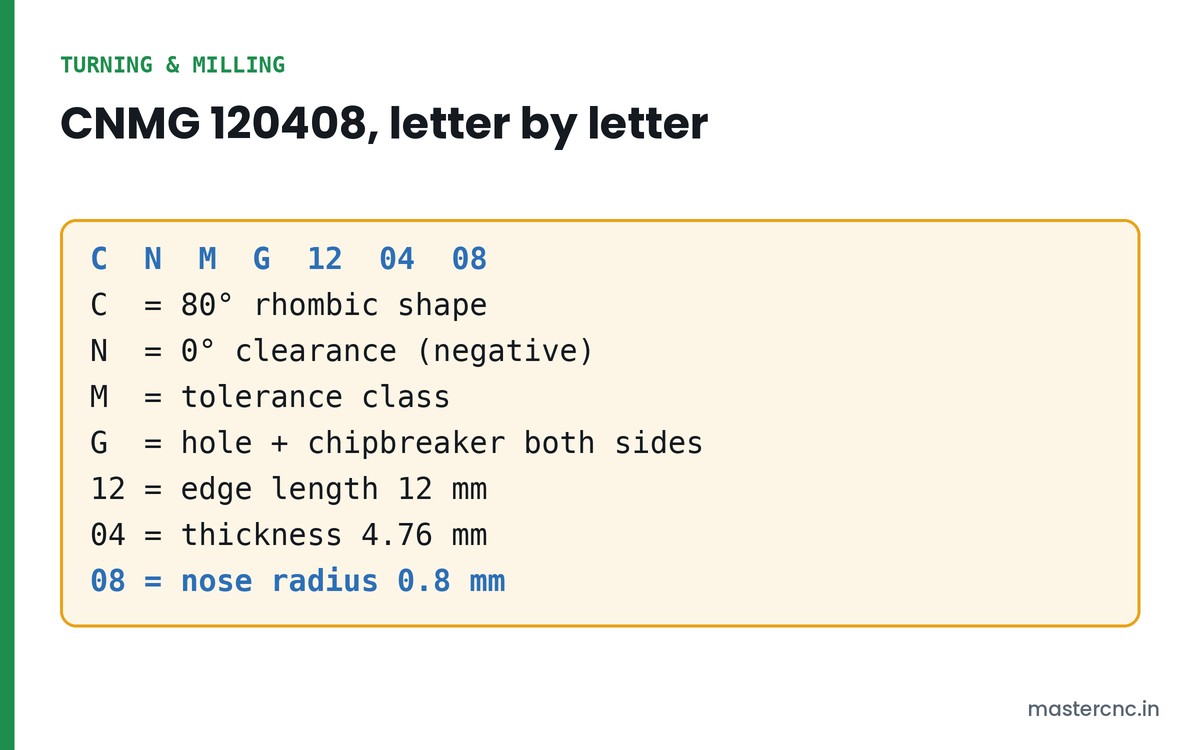
Take CNMG 120408. The first four letters describe the shape and type, the six digits describe the size.
| Position | In CNMG 120408 | Meaning |
|---|---|---|
| 1. Shape | C | Rhombic, 80° corner |
| 2. Clearance angle | N | 0° (a negative insert) |
| 3. Tolerance | M | Medium tolerance (pressed, not ground on the periphery) |
| 4. Type | G | Centre hole, chipbreaker on both sides |
| 5. Size | 12 | Cutting edge length about 12 mm |
| 6. Thickness | 04 | 4.76 mm |
| 7. Nose radius | 08 | 0.8 mm |
After these, makers add their own letters for the chipbreaker and the grade, for example CNMG 120408-PM 4325. Those parts are not ISO: check the maker's catalogue for what they mean.
1. Shape
The first letter is the corner angle. A bigger angle is stronger; a smaller angle reaches into tighter profiles.
| Letter | Shape | Typical use |
|---|---|---|
| S | Square, 90° | Heavy roughing, chamfering |
| C | Rhombic 80° | General turning and facing, the most common |
| W | Trigon 80° | Turning and facing, 6 edges on a negative insert |
| T | Triangle 60° | General turning, threading-style profiles |
| D | Rhombic 55° | Copy turning, profiles |
| V | Rhombic 35° | Fine profiling, deep undercuts |
| R | Round | Strong edge, radii and heavy cuts |
2. Clearance angle
The angle under the cutting edge. N = 0° means a negative insert: the holder tilts it to get clearance, and both sides can be used, so you get more edges. Positive inserts have the clearance ground in: B = 5°, C = 7°, P = 11°. They cut with less force, which helps on small boring bars and thin parts, but they have one usable side.
3. Tolerance
How accurately the insert is made. M is the usual class for pressed inserts. G is a ground insert with tighter size control, used for finishing and when you index without re-touching the tool. If you change brand or class, check the size after indexing.
4. Type: hole and chipbreaker
| Letter | Hole | Chipbreaker |
|---|---|---|
| N | None | None |
| A | Cylindrical | None |
| M | Cylindrical | One side |
| G | Cylindrical | Both sides |
| T | Countersunk (screw), one side | One side |
| W | Countersunk (screw), one side | None |
CNMG and WNMG are clamped with a lever or top clamp through the hole. CCMT and VBMT are held with a screw through the countersunk hole.
5, 6, 7. Size, thickness and nose radius
The size number is the cutting edge length in mm, rounded. The same insert can have a different number for each shape, because the size follows the edge length, not the inscribed circle:
- CNMG 12: edge 12.9 mm, inscribed circle 12.7 mm
- DNMG 15: edge 15.5 mm, inscribed circle 12.7 mm
- WNMG 08: edge 8.7 mm, inscribed circle 12.7 mm
- TNMG 16: edge 16.5 mm, inscribed circle 9.525 mm
Thickness: 04 = 4.76 mm, 06 = 6.35 mm, 02 = 2.38 mm. Nose radius: 04 = 0.4 mm, 08 = 0.8 mm, 12 = 1.2 mm, 16 = 1.6 mm.
Four codes you will see every week
CNMG 120408: 80° negative, chipbreaker both sides, R0.8. Roughing and general turning.DNMG 150608: 55° negative, 6.35 mm thick, R0.8. Profiling.VBMT 160404: 35° positive (5°), screw clamp, R0.4. Fine profiles and finishing.WNMG 080408: 80° trigon, negative, R0.8. Turning and facing.
Why the nose radius matters on the machine
The last two digits go straight into the offset page. With nose radius compensation (G41/G42) the control needs R = 0.8 for an ...08 insert, or chamfers and tapers come out wrong. The nose radius also sets the surface finish: a bigger radius allows more feed for the same Ra. See nose radius compensation and surface roughness from feed.
Common mistakes
- Changing from an ...08 to an ...04 insert and leaving R = 0.8 in the offset page.
- Putting a positive insert (CCMT) in a holder made for negative inserts (CNMG). The seat angle is different.
- Assuming the chipbreaker letters after the dash mean the same at every maker. They do not.
- Using a finishing breaker for roughing: the edge chips and chips do not break.
Check the holder code too: it tells you which insert shape and size fits. Values here follow ISO 1832; the maker's catalogue is the final word for grades, breakers and cutting data.
Calculators, process sheet to program, simulation, codes and lessons. Free to start, no sign-in, on phone and laptop.
Open the app