Master
Drilling: carbide vs HSS, point angle and coolant
A drill is the most used tool in most shops. Choosing between HSS, solid carbide and indexable drills is mostly about speed, rigidity and hole quality. Point angle and coolant are the other two decisions.
HSS drills
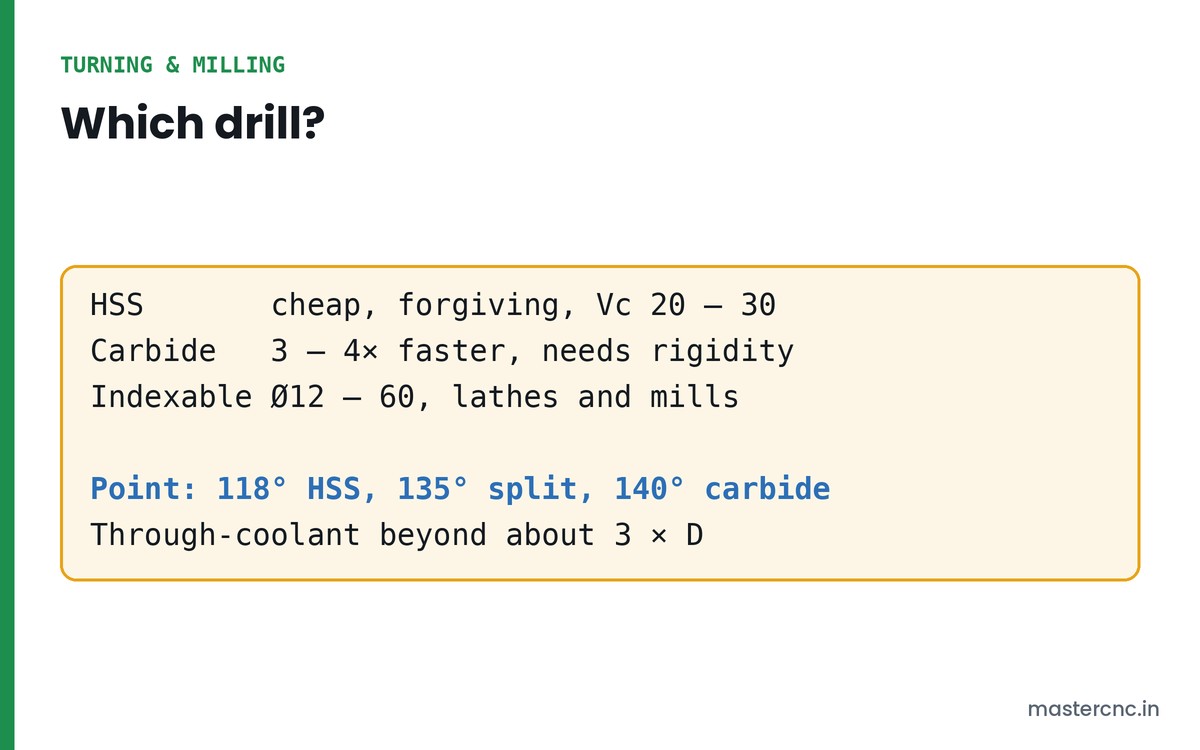
- Cheap, tough, forgiving of runout and less rigid setups.
- Slow: about 20 – 30 m/min in steel.
- Good for small batches, manual machines, odd sizes and weak setups.
Solid carbide drills
- About three to four times the cutting speed of HSS, longer tool life, better hole size and finish.
- Need a rigid machine, a good holder (hydraulic or shrink-fit) and runout under about 0.02 mm.
- Brittle: they do not like shocks, unstable parts or interrupted entry.
Indexable insert drills
- For larger holes, roughly Ø12 – 60 mm, usually 2 – 5 × D deep.
- Two inserts (centre and periphery). Cheap per hole: change the inserts, not the drill.
- Hole tolerance is wider than solid carbide. On a lathe you can shift X to make the hole slightly bigger or smaller.
- Need a lot of spindle power and good coolant.
Point angle
| Angle | Typical drill | Notes |
|---|---|---|
| 118° | General HSS | Classic; needs a centre drill or spot |
| 135° split point | HSS-Co, harder materials, stainless | Self-centring, less thrust |
| 140° | Solid carbide | Strong point, low thrust |
When spotting for a carbide drill, use a spot angle equal to or bigger than the drill point, so the drill centres on its point and not its corners. The peck drilling post shows the Z allowance for the point.
Coolant
- Up to about 3 × D, external coolant aimed at the drill is usually fine.
- Deeper holes need through-coolant, or peck drilling, to get chips out.
- Carbide drills with through-coolant often drill 5 – 8 × D in one go, without pecking.
What hole quality to expect
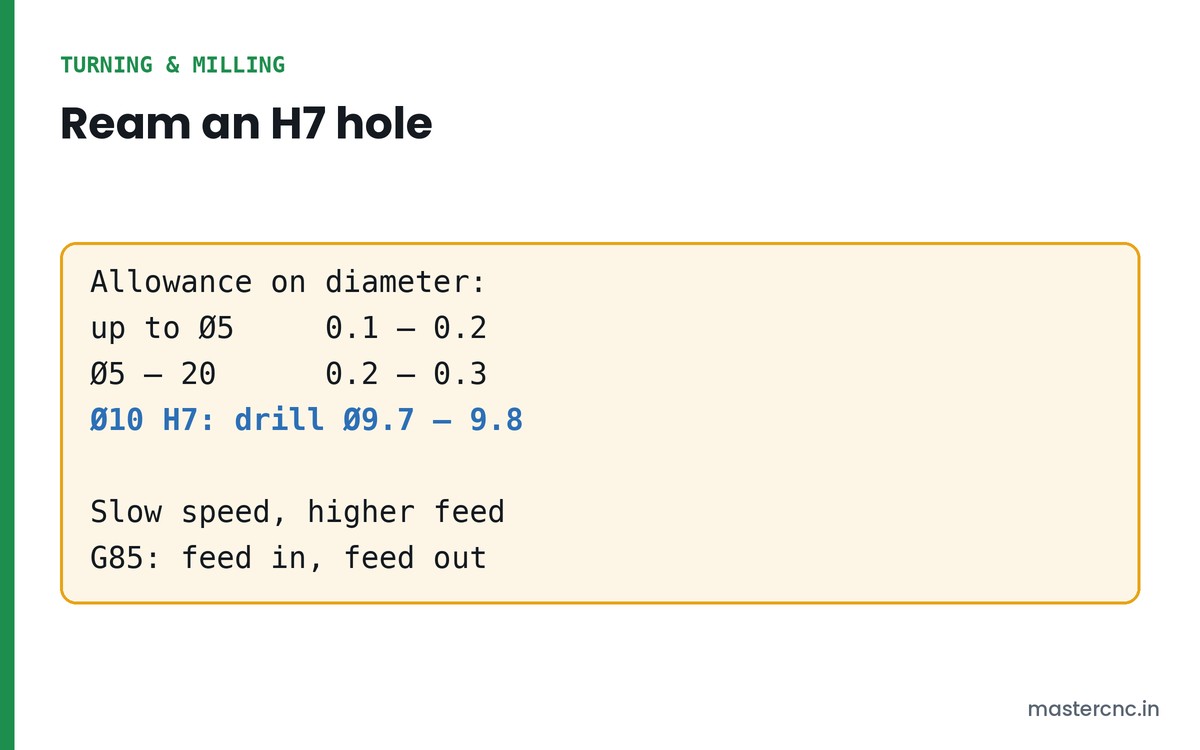
A good solid carbide drill typically holds about IT8 – IT9; HSS drills often cut slightly oversize. For H7 holes, drill undersize and ream (see reaming) or bore.
Common mistakes
- A carbide drill in a worn collet with runout.
- A 90° spot under a 140° carbide drill.
- HSS speeds on a carbide drill: it rubs and chips.
Cutting data comes from the drill maker; see starting cutting data for typical ranges and why drills break.
Calculators, process sheet to program, simulation, codes and lessons. Free to start, no sign-in, on phone and laptop.
Open the app