Master
Material removal rate and spindle power
A big roughing cut can stall the spindle or trip an overload alarm. Two short formulas tell you, before you cut, how much metal you are removing and how much power it needs.
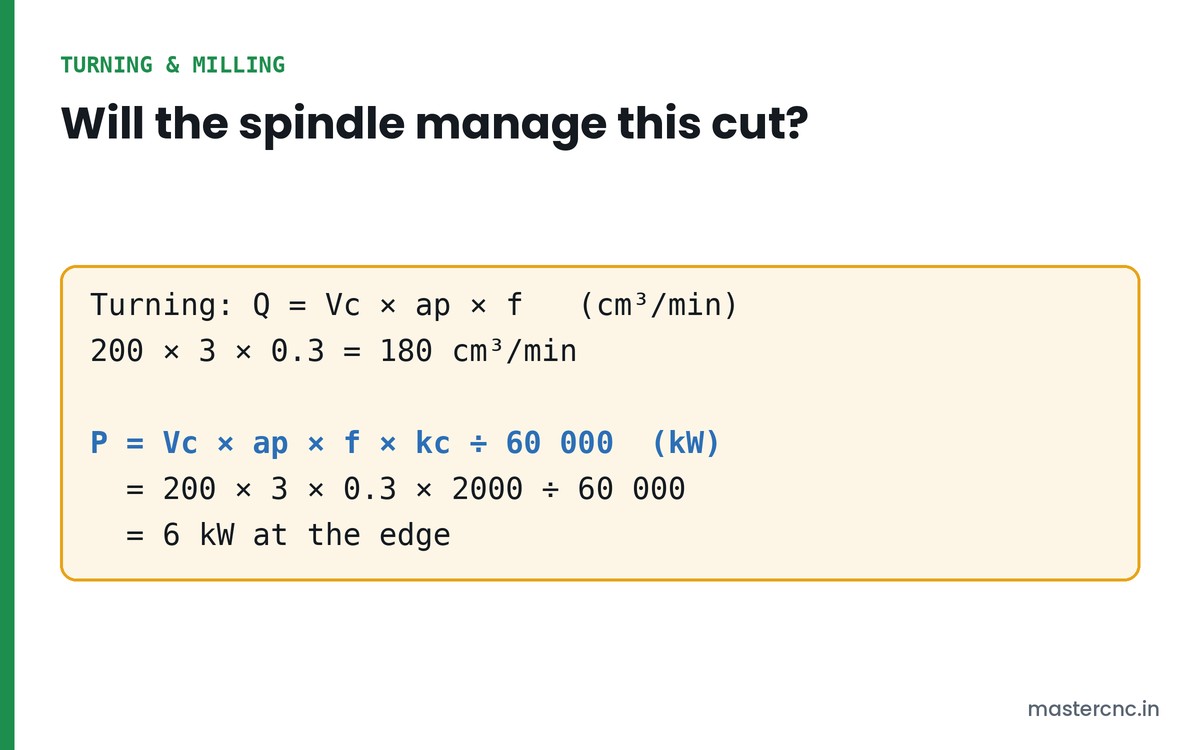
Turning
Q  = Vc × ap × f  (cm³/min)
Pc = Vc × ap × f × kc ÷ 60 000  (kW)

Vc = cutting speed, m/min
ap = depth of cut, mm
f  = feed, mm/rev
kc = specific cutting force, N/mm²
Example in steel: Vc 200, ap 3, f 0.3, kc 2000.
Q  = 200 × 3 × 0.3 = 180 cm³/min
Pc = 200 × 3 × 0.3 × 2000 ÷ 60 000 = 6 kW
Milling
Q  = ap × ae × vf ÷ 1000  (cm³/min)
Pc = ap × ae × vf × kc ÷ 60 000 000 (kW)

ap = axial depth, ae = radial width, mm
vf = table feed, mm/min
Example: ap 10, ae 5, vf 800 in steel (kc 2000): Q = 40 cm³/min, Pc ≈ 1.3 kW.
Typical kc values
| Material | kc (N/mm²), rough guide |
|---|---|
| Low-carbon steel | 1600 – 2000 |
| Alloy steel | 1900 – 2400 |
| Stainless steel | 2100 – 2600 |
| Cast iron | 1000 – 1400 |
| Aluminium | 600 – 900 |
kc rises as the chip gets thinner, so light feeds have higher kc. Tool catalogues give exact values with a chip-thickness correction.
Compare with the machine
- The spindle needs more than the cutting power: divide by an efficiency of about 0.8. 6 kW at the edge → about 7.5 kW at the motor.
- Check the power curve of your spindle. Many spindles only reach full power above a certain RPM; at low RPM (big diameters) the available power is lower.
- Watch the spindle load meter on the first part. Keep heavy roughing below about 80 % for long cuts.
Using it
- Too much power needed? Reduce depth or feed, or split the cut.
- Lots of power left? You can probably remove material faster.
- Higher feed with less depth often gives the same Q with less force on the tool.
The Master CNC app has cutting power calculators for turning and milling. Values here are approximate; your tool maker's data and machine manual are the reference.
Try it in Master CNC
Calculators, process sheet to program, simulation, codes and lessons. Free to start, no sign-in, on phone and laptop.
Open the app