Master
Thread milling vs tapping
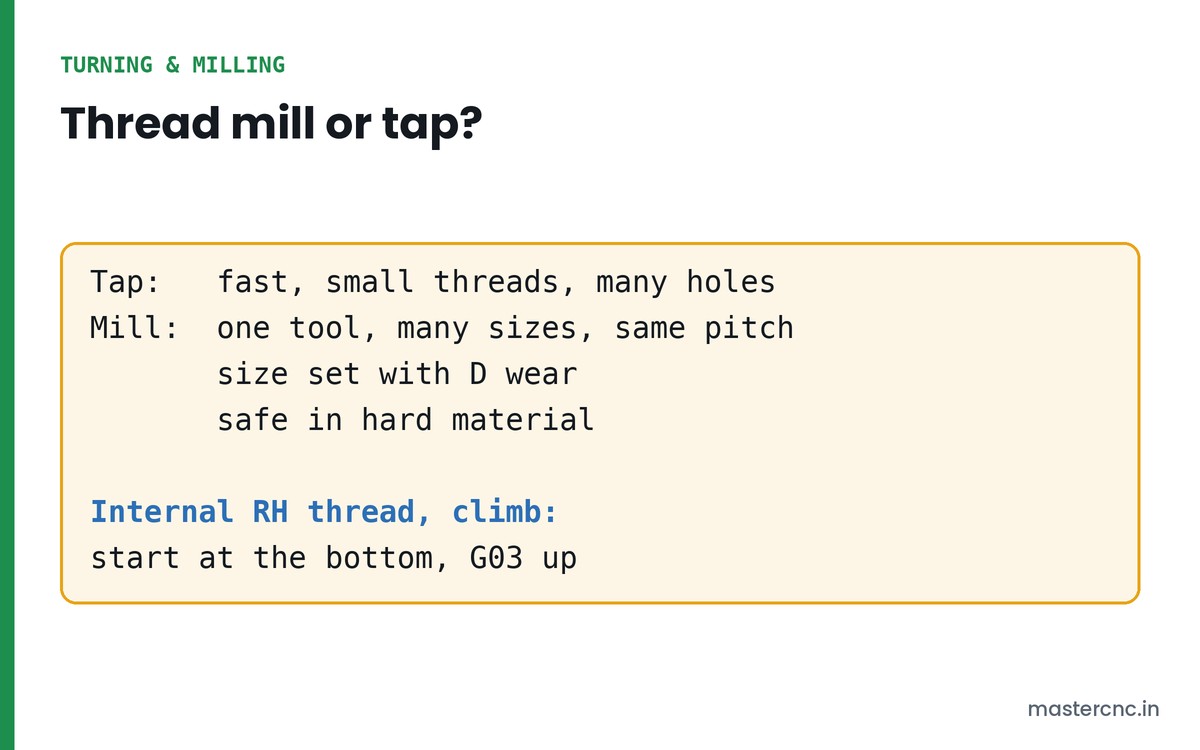
A tap cuts a thread in one in-and-out move. A thread mill is a small cutter with thread teeth that moves in a helix around the hole, one pitch up per turn. Each has its place.
When tapping is better
- Small threads (up to about M8) in normal materials.
- Many holes: tapping is usually faster per hole.
- Machines without helical interpolation or a CAM system.
When thread milling is better
- Large threads: a tap needs huge torque; a thread mill does not.
- Hard or difficult materials: a broken thread mill is easy to remove, a broken tap often scraps the part.
- Size control: adjust the thread size with the D wear offset.
- One tool, many sizes: the same 1.5 mm pitch mill cuts M10 × 1.5, M12 × 1.5, M20 × 1.5…
- Blind holes: full thread close to the bottom of the hole.
- Left- and right-hand threads with the same tool.
How the helix works
For an internal right-hand thread with climb milling (spindle M03): start at the bottom, move round counter-clockwise (G03) and up one pitch per turn. The direction of travel and the Z direction together decide right or left hand.
Example: M10 × 1.5, 12 mm deep, single-profile mill
A Ø6 thread mill (single tooth row), hole Ø8.5 drilled. Thread major Ø10, so the cutter centre runs on a radius of (10 − 6) ÷ 2 = 2 mm, with G41 compensation on the profile in practice. A simple version without compensation:
G90 G54 G00 X0 Y0
G43 H07 Z5.
G01 Z-12. F500.
G01 X1. F100.
G03 X2. Y0 R0.5  (arc in)
G03 I-2. Z-10.5 F120.  (1 turn up 1.5)
G03 I-2. Z-9.
... (repeat to the top)
G03 X1. Y0 R0.5  (arc out)
G00 X0 Y0
G00 Z50.
Real programs use cutter compensation so the size can be corrected with D wear, and CAM or a thread milling macro to calculate every move. Remember that the feed at the cutter centre is lower than at the cutting edge on internal threads: many CAM systems correct this.
Common mistakes
- G02 instead of G03, or going down instead of up: a left-hand thread or conventional milling.
- Thread mill too big for the hole: no room for the helix.
- Too long a thread with a long mill: it deflects and the thread tapers. Use several passes or a shorter mill.
Check the finished thread with a plug gauge (see thread gauges). For tapping, see G84 rigid tapping.
Calculators, process sheet to program, simulation, codes and lessons. Free to start, no sign-in, on phone and laptop.
Open the app