Master
Tool life and Taylor's equation
Every machinist knows that running faster wears tools faster. Taylor's equation puts a number on it, and the number is bigger than most people expect. It also explains why raising feed is usually a better way to cut cycle time than raising speed.
The equation
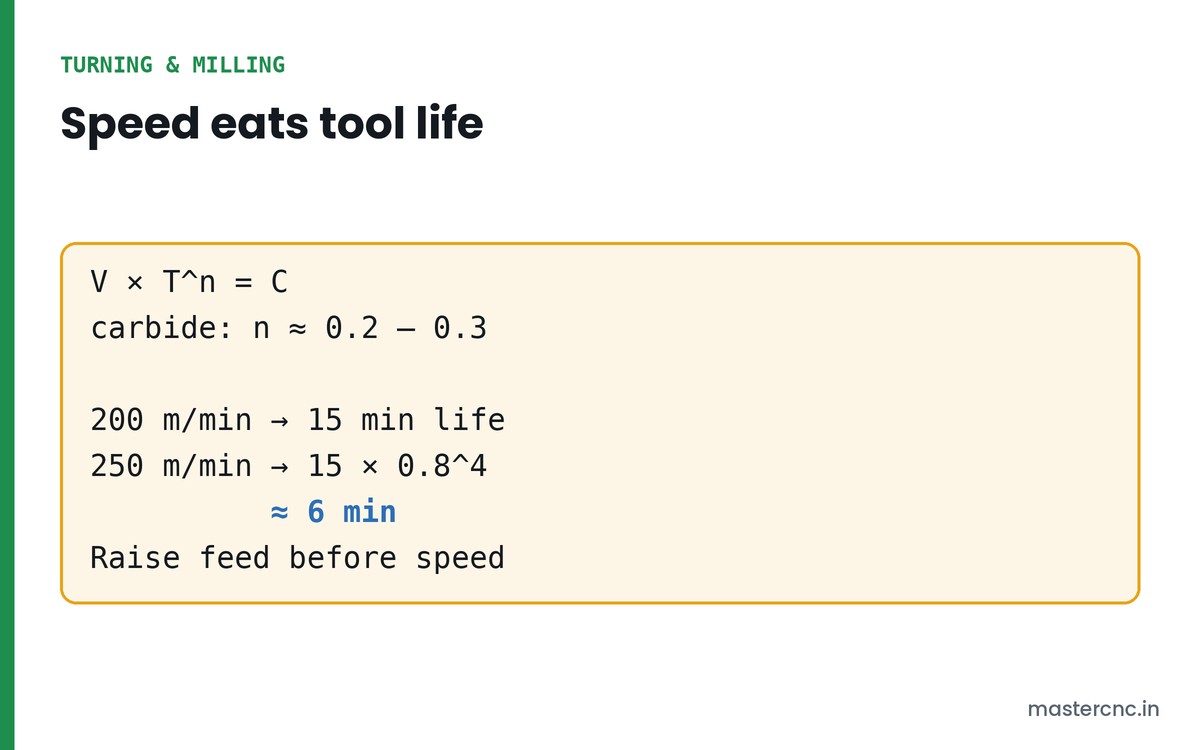
V × T^n = C

V = cutting speed (m/min)
T = tool life (min)
n = exponent for the tool material
C = constant for tool, material and conditions
| Tool material | Typical n |
|---|---|
| HSS | about 0.1 – 0.15 |
| Carbide | about 0.2 – 0.3 |
| Ceramic | about 0.4 – 0.6 |
Worked example
A carbide insert lasts 15 minutes at 200 m/min. With n = 0.25, what happens at 250 m/min?
T2 = T1 × (V1 ÷ V2)^(1/n)
   = 15 × (200 ÷ 250)^4
   = 15 × 0.41
   ≈ 6.1 min
A 25 % higher speed gives about 60 % less tool life. The parts per edge drop from 15 minutes' worth to 6 minutes' worth, while each part is only 20 % faster.
Feed is cheaper
Feed also affects tool life, but much less per unit of material removed. Raising feed by 25 % removes metal 25 % faster with a much smaller loss of tool life, as long as the insert, chipbreaker and surface finish allow it. So the usual order for more productivity is:
- Depth of cut as big as the machine and insert allow (fewer passes).
- Feed as high as the insert, finish and machine allow.
- Then speed, to the level that gives a sensible tool life.
Using it in the shop
- Measure real tool life at your current speed: parts per edge.
- Decide what tool life you want (for example one edge per shift, or per batch).
- Adjust speed in steps of 10 % and record the parts per edge.
The exponent and constant change with material, grade, coolant and feed, so treat the equation as a guide to the size of the effect, not an exact prediction.
For reading wear on the used edges, see tool wear types.
Calculators, process sheet to program, simulation, codes and lessons. Free to start, no sign-in, on phone and laptop.
Open the app