Master
Reducing burrs with better programming
Burrs cost time: someone has to remove them by hand, and a missed burr can stop an assembly. Most burrs can be made smaller, or removed in the machine, with a few changes to the program.
Where burrs come from
A burr forms where the tool pushes material over an edge instead of cutting it: at the exit of a cut, at a hole breakthrough and at the end of a turned diameter. Blunt tools and low feeds make bigger burrs, because the tool pushes more.
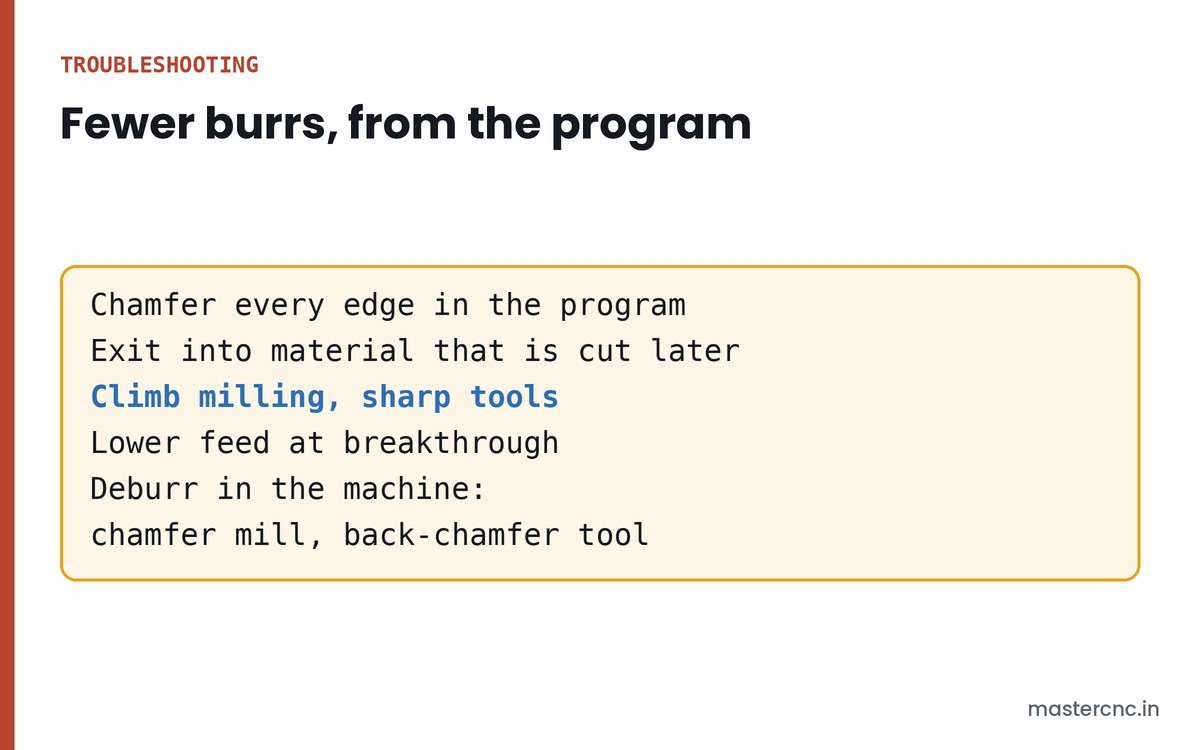
1. Program the chamfers
Put a small chamfer or radius on every edge the drawing allows: turned shoulders, hole entries, milled outlines. A chamfer pass after the main cut removes the burr the main cut made. On a lathe, a chamfer at the start of the next part's diameter before parting off saves a manual operation.
2. Exit into material
Plan the path so the tool leaves the cut into material that a later operation removes. For example, face mill across the part so the exit edge is the one that will be chamfered next, or mill an outline before drilling holes that break into it.
3. Cutting direction
Climb milling usually leaves a smaller burr on the finished edge than conventional milling (see climb vs conventional). On a lathe, face from the outside in on parts where the outer edge must be clean.
4. Sharp tools and the right feed
- Change worn edges before the burr gets big.
- Use positive, sharp inserts for finishing edges in soft materials.
- Do not feed too lightly: rubbing pushes a burr.
5. Breakthrough
Reduce the feed for the last 1 mm of a drill or an end mill breaking through. The exit burr is much smaller.
6. Deburr in the machine
- A chamfer mill run along the top edges after milling.
- Back-chamfer and back-spot-face tools for the underside of holes.
- Brush tools on machining centres for edges of milled parts.
- Cross-hole deburring tools for intersecting holes.
Common mistakes
- Leaving all deburring to manual work "because it always was".
- Deburring before the last finishing cut, which makes a new burr.
- Chamfers bigger than the drawing allows.
Check the drawing's edge note (for example "break all sharp edges 0.2 – 0.5") before programming chamfers.
Calculators, process sheet to program, simulation, codes and lessons. Free to start, no sign-in, on phone and laptop.
Open the app