Master
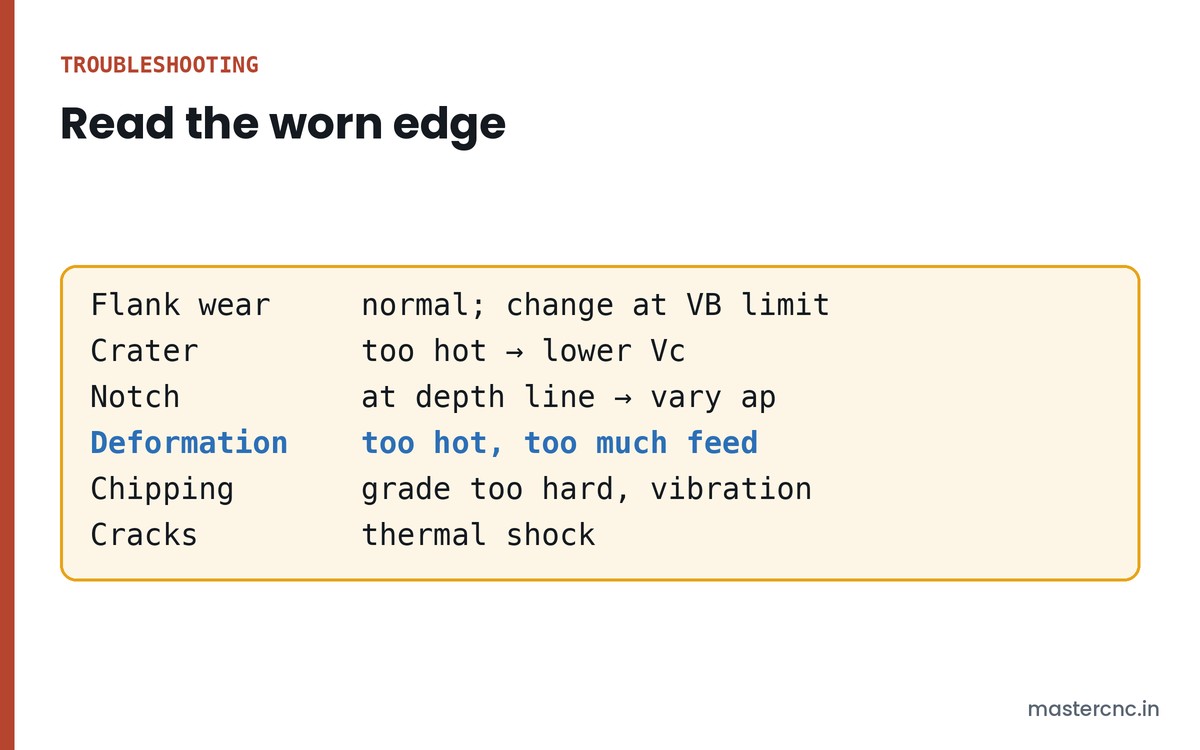
Tool wear types: flank, crater and notch
A worn insert is a report on your cutting data. Each type of wear has its own cause and its own fix. Look at every edge you change for a week and you will understand your process better than any catalogue.
Flank wear
An even worn land on the clearance face below the edge. This is normal wear and the one you want. Change the edge before the wear land gets too wide: as a rough guide about 0.2 – 0.3 mm for finishing and 0.4 – 0.6 mm for roughing.
Too fast? Lower the cutting speed or use a more wear-resistant grade.
Crater wear
A hollow on the rake face behind the edge, from heat and chemical wear, typical in steel at high speed. A deep crater weakens the edge until it breaks. Fix: lower Vc, a grade with a thicker or alumina-rich coating, better coolant.
Notch wear
A notch at the depth-of-cut line. Caused by a hard skin, work-hardened surfaces (stainless, heat-resistant alloys) or scale. Fix: vary the depth of cut between passes so the notch is not in the same place, use a round insert or a smaller lead angle, a tougher grade.
Plastic deformation
The edge sags or bulges because it got too hot and soft. It changes sizes and leads to breakage. Fix: lower Vc and feed, a harder grade.
Chipping
Small pieces broken out of the edge. Fix: a tougher grade, a stronger edge (honed or chamfered), less vibration, gentler entry into the cut. See why inserts break.
Thermal cracks
Small cracks across the edge, from heating and cooling in interrupted cuts or uneven coolant. Fix: steady flood coolant, or cut dry if the tool maker recommends it for the operation; a tougher grade.
Built-up edge
Material welded on the edge, not wear as such, but it tears the edge when it breaks off. See built-up edge.
Summary
| Wear | Main cause | First fix |
|---|---|---|
| Flank (fast) | Speed too high | Lower Vc |
| Crater | Heat, high speed in steel | Lower Vc, coated grade |
| Notch | Skin, work hardening | Vary depth, lead angle |
| Plastic deformation | Too hot | Lower Vc and feed |
| Chipping | Grade too hard, shocks | Tougher grade |
| Thermal cracks | Temperature changes | Steady coolant or none |
A magnifier or a cheap USB microscope near the machine makes wear easy to see. Keep a few worn edges with notes for training.
Calculators, process sheet to program, simulation, codes and lessons. Free to start, no sign-in, on phone and laptop.
Open the app