Master
Cutting time for turning and drilling
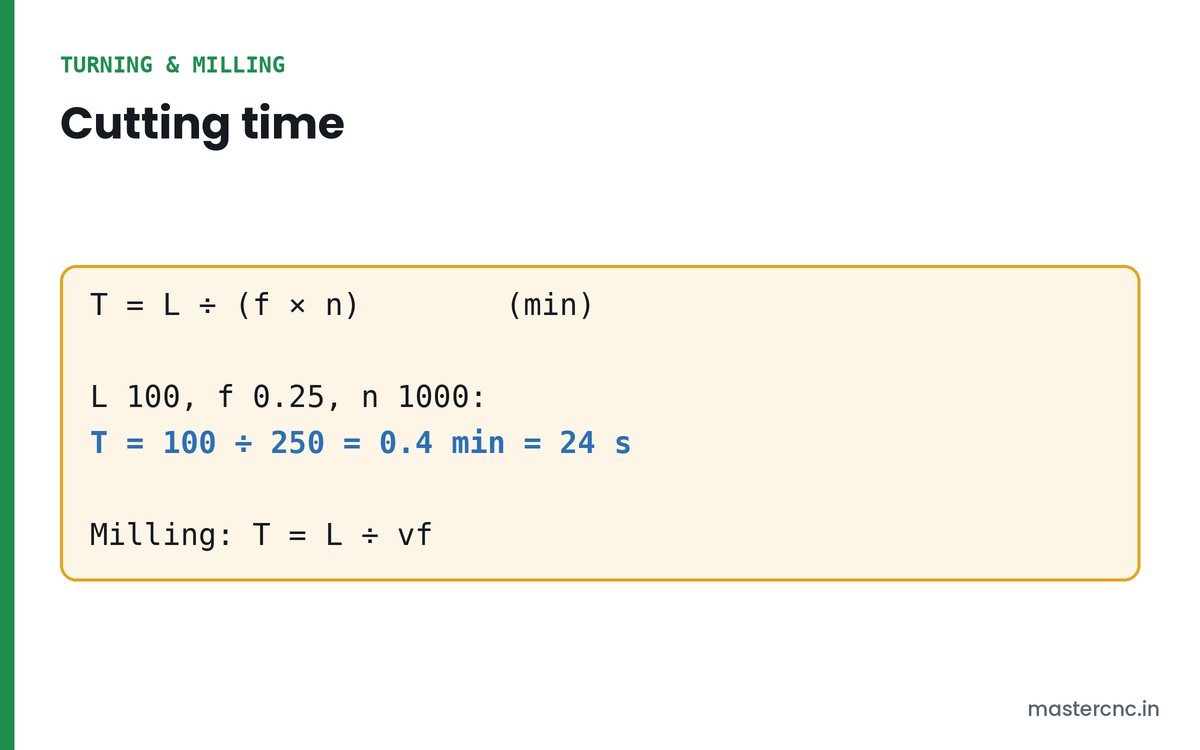
Cutting time is length divided by speed of travel. With it you can quote a job, compare two methods, or see whether a higher feed is worth it. Add rapid, tool change and loading time for the full cycle time.
Turning and drilling
T = L ÷ (f × n)  (minutes)

L = length of cut, mm (include approach)
f = feed, mm/rev
n = spindle speed, RPM
Example: turn 100 mm at f 0.25, n 1000: T = 100 ÷ 250 = 0.4 min = 24 s.
Turning in G96
In G96 the RPM changes with the diameter. For turning along a diameter, use the RPM at that diameter (see RPM formula). For facing from D to the centre, a good estimate uses the average diameter, as long as the spindle stays below its G50 limit; near the centre, where the speed is capped, the cut is slower.
Facing Ø80 → Ø0 at Vc 180, f 0.2:
average Ø40 → n ≈ 1432 RPM
L = 40 mm (radius)
T ≈ 40 ÷ (0.2 × 1432) ≈ 0.14 min ≈ 8 s
Drilling
L = hole depth + drill point (0.3 × D) + approach (2 mm)

Ø10 drill, 30 deep, f 0.2, n 1900:
L = 30 + 3 + 2 = 35
T = 35 ÷ (0.2 × 1900) = 0.092 min ≈ 5.5 s
Peck drilling adds the retract time; through-coolant drills without pecking are often much faster overall.
Milling
T = L ÷ vf  (vf in mm/min)

Contour 400 mm at F800: T = 0.5 min = 30 s
Cycle time
Cutting time is only part of it. Add:
- Rapid moves (short, but many).
- Tool changes: a few seconds each on a machining centre, an index on a lathe.
- Spindle start and stop, dwells.
- Loading, unloading and measuring.
On small parts the non-cutting time is often bigger than the cutting time. That is where to look first when you need a faster cycle.
The Master CNC app has cutting time calculators for turning, milling and drilling.
Calculators, process sheet to program, simulation, codes and lessons. Free to start, no sign-in, on phone and laptop.
Open the app