Master
Built-up edge: what it is and how to stop it
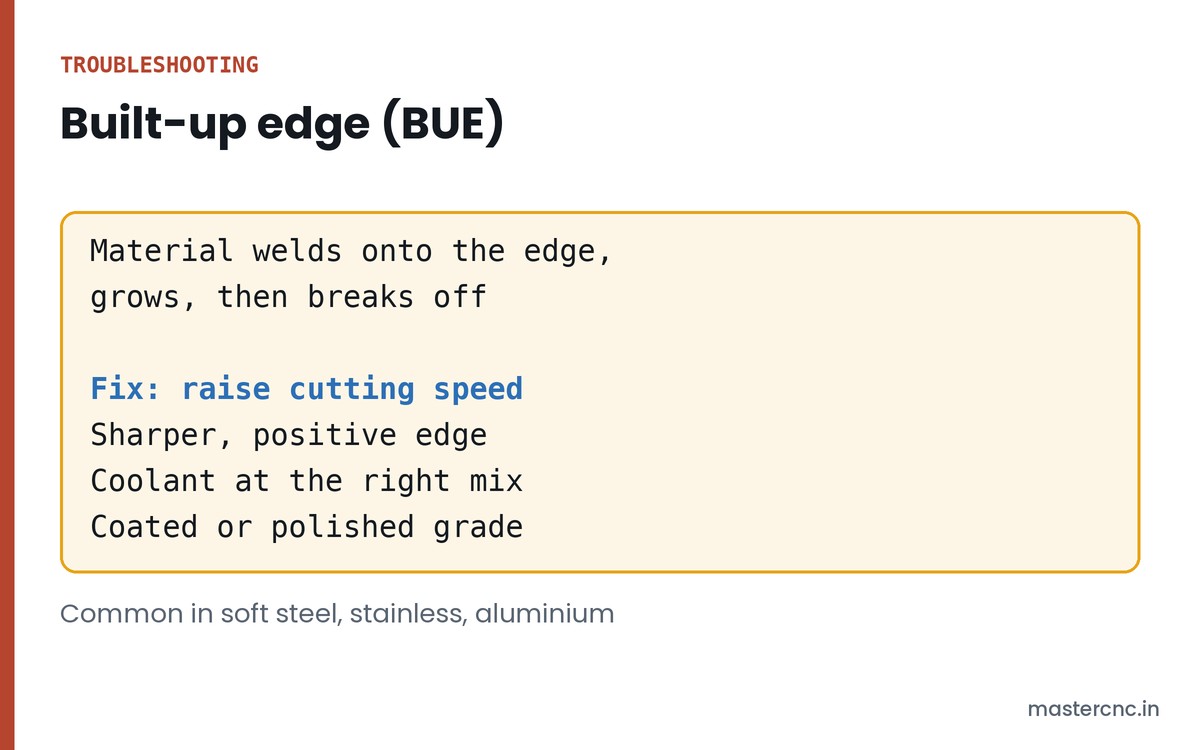
Built-up edge is workpiece material that welds onto the cutting edge. It grows, changes the shape of the edge, then breaks off and takes a piece of coating or carbide with it. The result is a torn surface, sizes that wander and short tool life.
How to spot it
- On the insert: a shiny lump of material stuck on the edge or the rake face. It does not wipe off.
- On the part: a dull, torn or smeared surface, sometimes with small bright flakes pressed in.
- Sizes: diameters change by a few hundredths as the BUE grows and breaks.
Why it happens
At low cutting temperatures, soft and sticky materials press-weld onto the edge. The risk is highest when:
- the cutting speed is too low (the most common cause);
- the material is soft low-carbon steel, stainless steel, aluminium or copper;
- the edge is blunt or negative, so it pushes and rubs;
- there is no coolant, or the coolant mix is too weak.
On a lathe in G97, small diameters run at a very low cutting speed. That is one more reason to use G96 for turning and facing.
How to stop it
- Raise the cutting speed into the catalogue range. Check your real Vc with the RPM formula.
- Use a sharper, positive insert made for the material (an M grade for stainless, a polished N grade for aluminium).
- Use coolant, aimed at the cut, with the right concentration.
- Coated grades with a smooth surface stick less. For aluminium, uncoated polished or special low-friction coatings.
- Feed: a slightly higher feed can help; very light feeds rub.
Common mistakes
- Slowing down "to save the tool": BUE gets worse.
- Picking the BUE off with a hard tool, which chips the edge.
- Using a general steel insert on aluminium.
If the surface is still rough after BUE is gone, go through the other causes in poor surface finish: 10 causes.
Try it in Master CNC
Calculators, process sheet to program, simulation, codes and lessons. Free to start, no sign-in, on phone and laptop.
Open the app