Master
Machining cast iron
Cast iron is one of the easiest materials to machine in one way and tricky in others. It makes short chips and cuts freely, but it is abrasive, its skin is hard, its edges break out, and its dust gets everywhere.
Grey and ductile iron
- Grey iron (flake graphite, for example EN-GJL-250): short, broken chips, low cutting forces, abrasive. Brittle edges.
- Ductile iron (nodular graphite, for example EN-GJS-500-7): stronger, longer chips, more like steel to cut, and harder on tools.
Tools and data
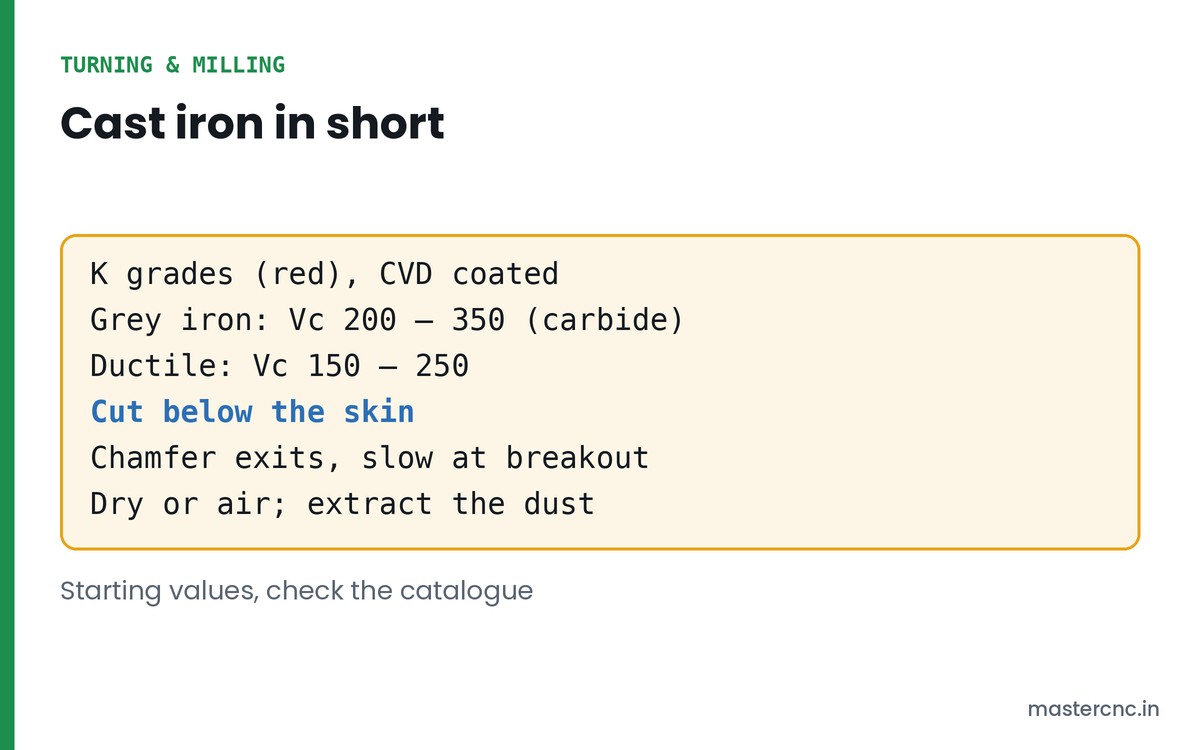
- Use K grades (ISO red group) with thick, wear-resistant CVD coatings (see insert grades).
- Typical starting speeds for coated carbide: grey iron about 200 – 350 m/min, ductile about 150 – 250 m/min. Ceramic and CBN tools run much faster on grey iron in suitable setups.
- Negative inserts with strong edges; chipbreakers matter less in grey iron because the chips break by themselves.
The skin
The outside of a casting can hold sand and hard spots. Take the first cut deep enough to get under the skin in one pass, rather than skimming along it, which wears the edge quickly. A tougher grade helps on the first pass.
Edge breakout
Grey iron is brittle: when the tool leaves the cut, the edge of the part can crumble. Fixes: program a chamfer on the exit edge before the main cut, reduce the feed at the exit, and plan the tool path to exit into material that is removed later (see reducing burrs).
Dry or wet
- Grey iron is often cut dry or with air blast. Coolant mixed with graphite dust makes a black sludge.
- Ductile iron is often cut with coolant, like steel.
- If you use coolant, keep it clean and well filtered.
Dust and health
Cast iron dust is fine and abrasive. It wears way covers and wipers, gets into electrics, and is not good to breathe. Use extraction or a closed machine, clean the machine often, and follow your shop's safety rules for dust.
Common mistakes
- Skimming the casting skin with a light finishing cut.
- Steel (P) grades on grey iron: they wear quickly.
- Sharp exit edges without a chamfer.
- Blowing dust off with compressed air into the machine's ways.
Cutting data varies a lot with the cast iron grade and hardness. Start from the tool maker's catalogue values for your exact material.
Calculators, process sheet to program, simulation, codes and lessons. Free to start, no sign-in, on phone and laptop.
Open the app