Master
Depth of cut and feed: roughing vs finishing
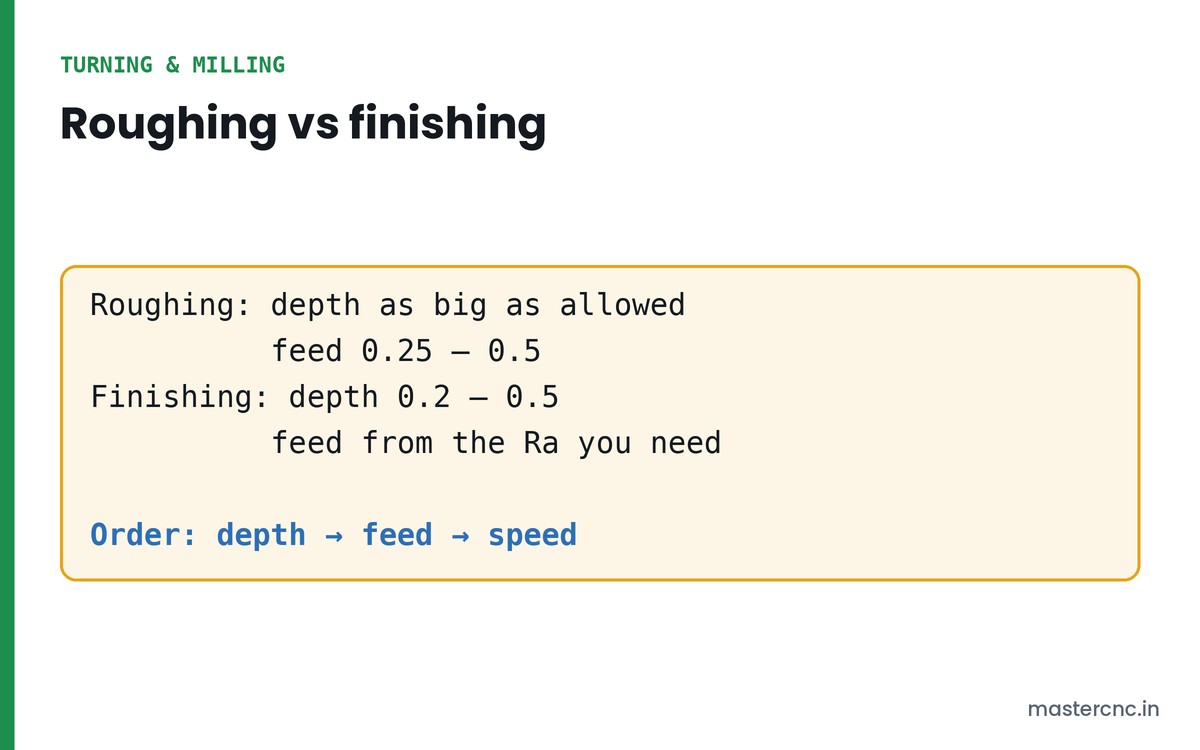
Roughing and finishing have different goals. Roughing removes metal as fast as the machine and tool allow. Finishing makes the size and surface. Each has its own rules for depth and feed.
Roughing
- Depth first: take as much depth as the insert, the machine power and the part allow. Fewer, deeper passes are faster and wear the tool less per unit of metal than many shallow ones.
- Then feed: use the highest feed the insert's chipbreaker and nose radius allow, typically 0.25 – 0.5 mm/rev in steel with a roughing insert.
- Then speed: set Vc for a sensible tool life (see tool life).
- Check the power needed (see spindle power).
Leave an even finishing allowance
Leave the same stock everywhere for the finish pass, for example 0.4 mm on diameter and 0.1 mm on faces with G71 (U0.4 W0.1). An even allowance gives an even finishing cut, and that gives consistent size and finish.
Finishing
- Depth: typically 0.2 – 0.5 mm. Not too light: the depth should be at least about the nose radius, or more than the edge rounding, so the insert cuts instead of rubbing and the chipbreaker works.
- Feed: set by the surface finish you need (see feed for Ra).
- Speed: often a little higher than roughing, with G96 on a lathe.
- Use a finishing insert and chipbreaker made for light cuts.
Semi-finishing
For tight tolerances on long or thin parts, add a semi-finish pass so the final pass removes a small, even amount. The deflection is then the same on every part, and the size repeats.
Typical starting values in steel (lathe)
| Pass | Depth (mm) | Feed (mm/rev) |
|---|---|---|
| Roughing | 2 – 5 | 0.25 – 0.50 |
| Semi-finishing | 0.5 – 1.5 | 0.15 – 0.25 |
| Finishing | 0.2 – 0.5 | 0.08 – 0.20 |
Common mistakes
- Many shallow roughing passes "to be safe".
- Finishing allowance of 0.05 mm: the insert rubs.
- Uneven stock left by roughing, so the finish pass changes depth along the part.
Values are general starting points; your insert's catalogue range and your machine's power and rigidity decide.
Calculators, process sheet to program, simulation, codes and lessons. Free to start, no sign-in, on phone and laptop.
Open the app